
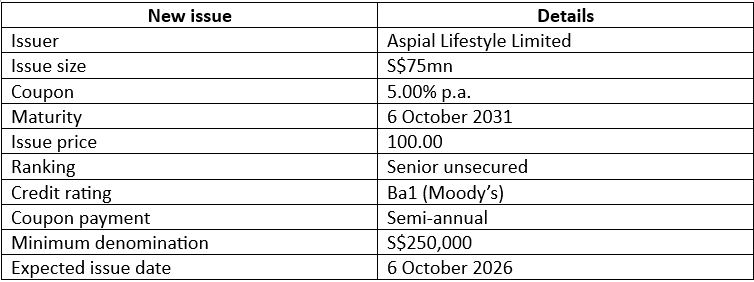
Aspial Lifestyle priced S$75mn of 5.00% senior unsecured notes due 6 October 2031 on 24 September 2026. The Series 006 notes were priced at par, with interest payable semi-annually, and Moody’s have been assigned a Ba1 rating. The notes are expected to be issued on 6 October 2026 in minimum denominations of S$250,000.
 Source: Aspial Lifestyle, Bloomberg
The net proceeds will mainly be used to refinance outstanding notes under Aspial’s MTN programme, with the remainder available for general corporate purposes including investments, acquisitions, expansion, working capital and capital expenditure.
1H26 Credit Performance Highlights
Stronger earnings provide better debt-servicing capacity
Aspial enters the new issuance with stronger operating performance. Revenue increased 26% YoY to S$464.2mn in 1H26, while EBITDA rose 45% to S$106.4mn. EBITDA/finance cost coverage consequently improved to 6.5x from 4.3x, providing greater headroom to service interest obligations.
The jewellery and luxury retail segment led the improvement, with margins widening to 12.5% from 7.0%. Management indicated that the embedded cost of existing retail gold inventory was around 30–40% below prevailing gold prices, supporting profitability during the period.
Pawnbroking also continued to provide recurring, collateral-backed earnings. Pawnbroking PBT increased 31% YoY to S$29.0mn, supported by higher interest income from a growing pledge book. Loans are secured primarily against gold and jewellery, while unredeemed items can be monetised through Aspial’s retail network.
Larger equity buffer, although debt remains elevated
Aspial completed an S$84.8mn equity raising in June 2026, improving debt/tangible equity to 2.2x from 3.1x a year earlier. Together with stronger earnings, this provides creditors with a larger loss-absorption buffer.
However, this should not be interpreted as outright deleveraging. Total borrowings remained elevated, while around S$67.5mn of the equity proceeds was redeployed into the secured-lending business. The leverage improvement therefore came largely from a stronger equity base rather than a reduction in absolute debt.
Refinancing remains the key credit constraint
Aspial had S$82.6mn of cash at 1H26, of which management indicated around S$52.6mn was unrestricted, compared with S$567.1mn of current interest-bearing borrowings. The group also had around S$100mn of undrawn facilities, while management expects most short-term borrowings to be rolled over. This makes continued access to bank and capital-market funding important. The new 2031 issue helps extend the maturity of the debt being refinanced, but it does not remove Aspial’s broader refinancing dependence.
Gold prices remain an earnings sensitivity
Gold prices have supported of Aspial’s recent earnings, particularly in its jewellery retail business. Management indicated that the embedded cost of existing retail gold inventory was around 30–40% below prevailing gold prices, helping retail margins widen to 12.5% in 1H26 from 7.0% a year earlier. This provides some near-term earnings support, although the margin benefit should gradually moderate as inventory is replenished at higher gold prices. A material correction in gold prices could also narrow retail margins.
Relative Value
 Source: Bloomberg
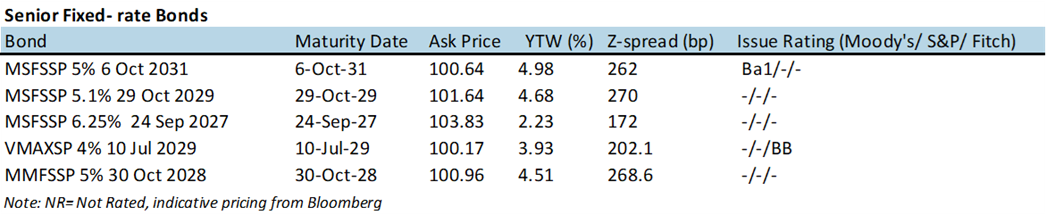
The new Aspial 5.00% 2031 offers 4.98% YTW and 262bps Z-spread. Versus Aspial 2029, investors get 24bps more yield for around two extra years, but the spread is 12bps tighter.
Compared with MoneyMax 2028, Aspial 2031 offers around 47bps more yield, although its Z-spread is around 7bps tighter, at 262bps versus 269bps. Aspial’s credit metrics compare favourably, with debt/tangible equity of 2.2x versus 2.8x and EBITDA/finance-cost coverage of 6.5x versus 4.8x, although investors are taking close to three additional years of tenor.
ValueMax 2029 remains the stronger credit and trades materially tighter at a 202bp Z-spread. The new Aspial 2031 therefore offers around 60bps of additional credit spread, consistent with Aspial’s higher leverage, weaker interest coverage and longer maturity.
Our Credit View
We are positive on Aspial Lifestyle’s credit profile following the improvements in earnings, interest coverage and its equity buffer. Retail profitability and continued pawn-book growth lifted EBITDA/finance-cost coverage to 6.5x, while the June equity raising helped reduce debt/tangible equity to 2.2x. The key watchpoint remains liquidity. Current interest-bearing borrowings remain high relative to unrestricted cash, leaving Aspial dependent on continued refinancing. Gold prices are another earnings watchpoint, particularly for the retail segment, as part of the recent margin expansion was supported by the gap between prevailing gold prices and the lower embedded cost of existing inventory.
Company Overview:
Aspial Lifestyle operates across three businesses: (i) jewellery and luxury retail, (ii) pawnbroking, and (iii) secured lending. Retail comprises Lee Hwa, Goldheart, Maxi-Cash Retail, Dr Emas and Niessing, covering new and pre-owned jewellery, gold and luxury goods. The model is partly integrated with pawnbroking, as unredeemed pledged items can be monetised through the group’s pre-owned retail channel.
Pawnbroking is conducted mainly through Maxi-Cash in Singapore and Dr Pajak in Malaysia, offering short-tenor loans backed by gold, jewellery and luxury goods. The secured lending business focuses on Australian property-backed loans. BigFundr is the group’s MAS-licensed digital platform, connecting third-party investors with these lending opportunities and earning platform-related fees. Aspial does not guarantee the performance of investments funded through BigFundr, with investment losses borne by investors. The group operated 118 physical stores as at 1H26, comprising 78 in Singapore, 24 in Malaysia and 16 international stores under Niessing.