
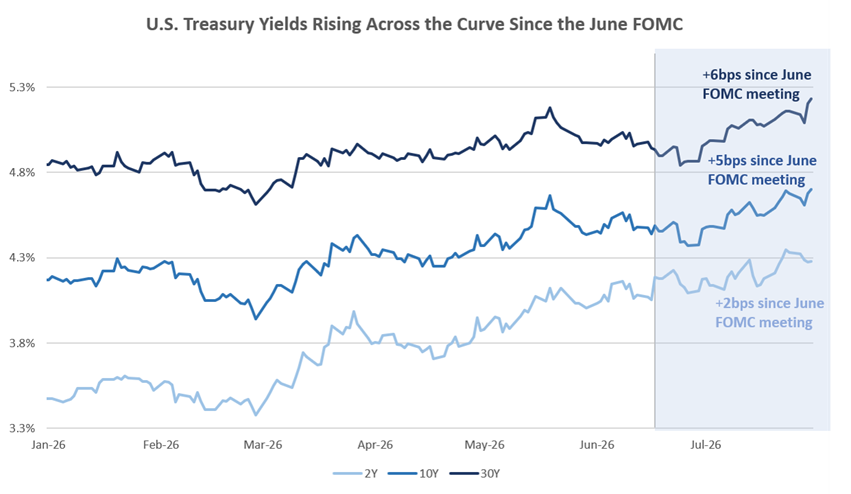
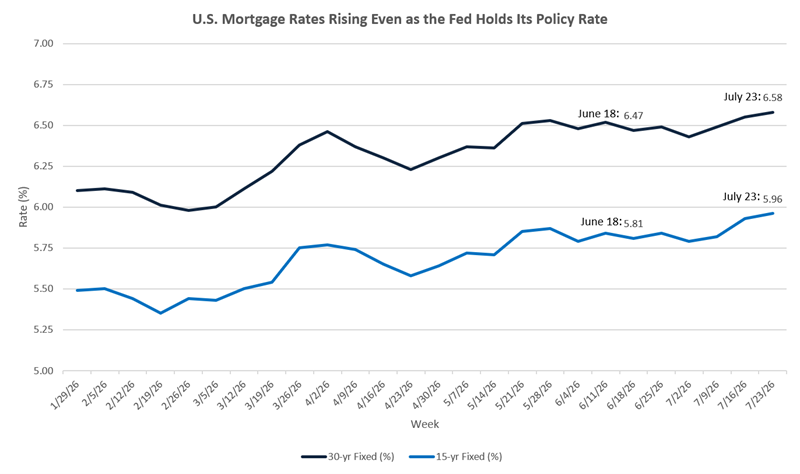
When the Federal Reserve left interest rates unchanged at 3.50%–3.75% at its July meeting, the decision came as little surprise. Markets had largely expected the Committees to remain on hold. Over the six weeks since the previous FOMC meeting, Treasury yields have risen across the curve. The two-year Treasury yield has increased by around 2bp, while the 10-year and 30-year yields have climbed by roughly 5bp and 6bp, respectively. Those moves have pushed borrowing costs higher for households and businesses, tightening financial conditions even though the Fed has not changed its policy rate. From the Committee’s perspective, higher Treasury yields have already tightened financial conditions by raising borrowing costs, reducing the need for the Fed to raise rates immediately.
 Source: Bloomberg, Phillip Bond Desk
 Source: Freddie Mac, Phillip Bond Desk
Chairman Kevin Warsh reinforced that patience should not be mistaken for a softer stance on inflation. Throughout the press conference, he repeatedly stressed that the Fed’s 2% inflation target remains unchanged and rejected the idea that a few encouraging inflation reports are enough to declare victory. After more than five years of above-target inflation, the Committees want convincing evidence that underlying price pressures are easing on a sustained basis before considering the job complete.
That approach also marks a subtle change in how the Fed is assessing the economy. Rather than reacting mechanically to each CPI or PCE release, the Committee is placing greater emphasis on broader inflation dynamics, financial conditions and structural developments affecting the economy.
Artificial intelligence was also discussed during the meeting. The Fed acknowledged that rapid investment in AI infrastructure is supporting manufacturing activity and could eventually lift productivity and expand the economy’s productive capacity. However, the Committees believe it is still too early to determine when these supply-side benefits will materialise or whether they will be sufficient to offset stronger demand. Until clearer evidence emerges, AI remains an important source of uncertainty rather than a reason to assume inflation will moderate.
Taken together, the July meeting offers an early glimpse of how monetary policy may evolve under Warsh. The Fed is relying less on forward guidance and allowing financial markets to play a larger role in transmitting policy. Instead of signalling every move in advance, the Fed appear more willing to observe how Treasury yields and broader financial conditions respond to incoming economic data before deciding whether additional tightening is necessary.
Our View
Our base case remains that the Fed will leave rates unchanged through year-end. The recent rise in Treasury yields has already tightened financial conditions, while inflation has shown signs of gradual moderation, giving the Committees more time to assess whether price pressures are returning sustainably to the 2% target. That said, the window to remain on hold is unlikely to stay open indefinitely. Renewed tensions in the Middle East have pushed Brent crude back above US$90 per barrel, while tariff-related costs are expected to feed gradually into consumer prices. If these pressures begin to lift underlying inflation more broadly, higher Treasury yields alone may no longer provide sufficient restraint, strengthening the case for another rate hike. Markets are currently pricing around a 66% probability of a 25bp increase at the September meeting.
For credit markets, the Fed’s greater reliance on financial conditions suggests that Treasury yields could remain elevated in the near term. Inflation uncertainty, resilient economic activity and reduced forward guidance are likely to keep rate volatility high, particularly at the longer end of the curve. Even if the Fed leaves its policy rate unchanged, elevated Treasury yields will continue to raise the all-in funding cost for corporate issuers.