
Clifford Capital
Clifford Capital is an infrastructure credit platform specialising in global infrastructure debt origination, distribution and investment, founded in 2012 and headquartered in Singapore. Certain Clifford Capital entities benefit from Government of Singapore guarantees under a policy mandate to support companies and projects with a Singapore nexus. These guarantees do not extend to the Bayfront issuing SPVs or the notes issued under the platform, which remain limited-recourse obligations supported by their respective collateral portfolios. The group has recorded more than US$14.9bn of cumulative financing commitments across the energy and utilities, natural resources, industrial and transportation, and social and digital infrastructure sectors.
Clifford Capital operates through four principal group entities, covering corporate lending, infrastructure loan distribution, centralised group services and third-party asset management.
 Source: Clifford Capital
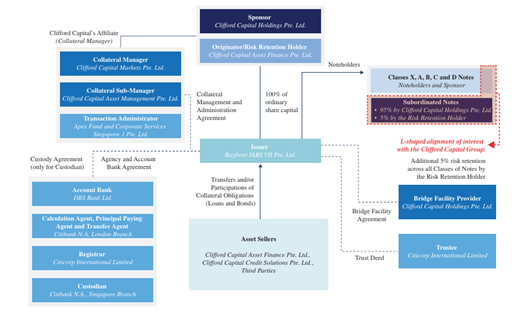
The Bayfront IABS platform is Clifford Capital’s infrastructure securitisation platform, established to mobilise institutional capital into infrastructure financing. Through the platform, selected project finance and infrastructure-related loans are transferred into separately incorporated special-purpose vehicles (SPVs), which issue rated notes to institutional investors. This enables Clifford Capital to broaden investor access to infrastructure debt while recycling capital for future lending.
 Source: Clifford Capital
Understanding Infrastructure ABS
What are IABS?
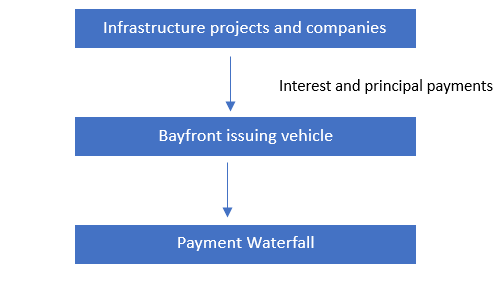
Infrastructure asset-backed securities (IABS) enable investors to gain exposure to diversified portfolios of infrastructure loans through rated debt securities. Rather than investing directly in individual infrastructure loans, investors purchase notes issued by an SPV that holds a portfolio of project finance and corporate infrastructure assets. Interest and principal collected from the underlying borrowers are distributed to investors according to a predefined payment waterfall.
Structure of Infrastructure ABS
Evolution of the Bayfront Platform
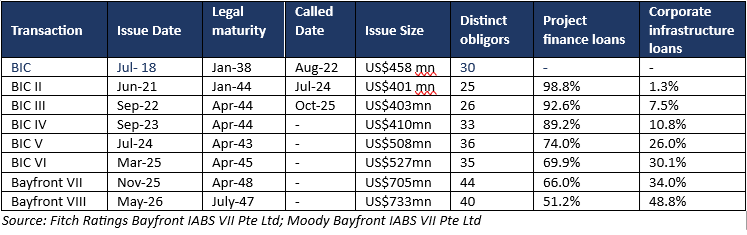
Platform scale has increased
The Bayfront platform has expanded materially across recent vintages, with initial portfolio size increasing from US$458mn for BIC III to US$733mn for Bayfront VIII. The number of distinct obligors also increased from 26 to 40, although Bayfront VIII is slightly less granular than Bayfront VII (which contained 44 obligors). The larger portfolio demonstrates Clifford Capital’s growing capacity to source and securitise infrastructure debt through repeat issuance.
The collateral risk profile has broadened
As the platform expanded, the share of project finance assets declined from 92.6% in BIC III to 51.2% in Bayfront VIII, while corporate infrastructure exposure increased from 7.4% to 48.8%. According to Moody, Bayfront VIII also introduced 14.1% construction-stage assets, reflecting a broader investment universe than earlier vintages. While this supports larger and more diversified issuance, it also places greater emphasis on transaction structure and credit enhancement to maintain the same level of protection for senior noteholders.
Platform Track Record
Call history
| Transaction | Priced | Called | Approximate time to call |
| BIC | July 2018 | August 2022 | 4.1 years |
| BIC II | June 2021 | July 2024 | 3.1 years |
| BIC III | September 2022 | October 2025 | 3.1 years |
The first three platform transactions were called after three to four years. This provides evidence that the platform has previously executed optional redemptions and returned investor principal well ahead of legal maturity. However, calls remain dependent on economics, available financing and the transaction conditions, so historical calls should not be treated as contractual repayment dates.
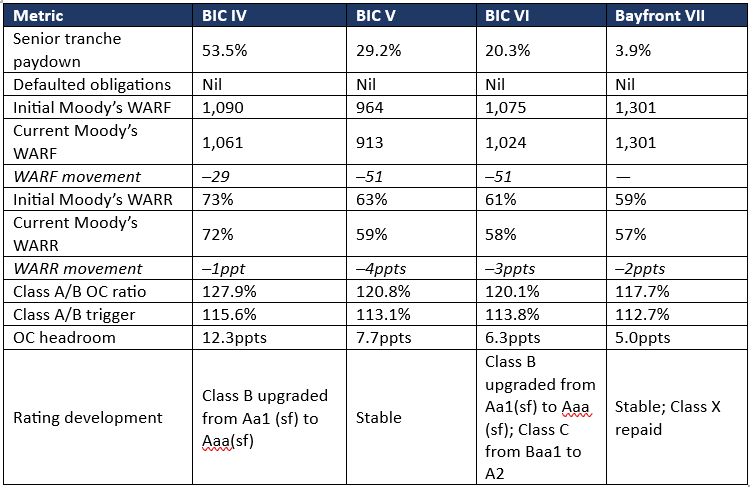
Performance of BIC IV, BIC V, BIC VI, Bayfront VII as of 31 March
 Source: Moody’s Bayfront Infrastructure Capital IV, V, VI and VII
Note (a): OC means overcollateralisation. OC ratio = adjusted collateral principal/ outstanding balance of the relevant notes.
Note: Senior tranche paydown measures the reduction in the most senior tranche or tranches from their original balances. A lower WARF indicates stronger average credit quality, while a higher WARR indicates stronger expected recovery.
Credit performance has remained stable
Performance across the active Bayfront transactions has remained satisfactory, with no outstanding defaulted obligations as of 31 March 2026. Senior-note repayment ranged from 3.9% for Bayfront VII to 53.5% for BIC IV, reflecting progressive deleveraging as the transactions seasoned.
Collateral quality has broadly held up
Moody’s WARF was stable or improved across all four transactions, indicating that average portfolio credit quality has broadly held up. BIC IV, BIC V and BIC VI recorded WARF improvements of 29–51 points, while Bayfront VII’s WARF remained unchanged. Rating actions were also stable to positive, with upgrades to rated junior tranches in BIC IV and BIC VI.
Recovery assumptions have softened
Moody’s WARR declined by 1–4ppts, indicating weaker expected recoveries if an underlying exposure defaults. Nevertheless, all four transactions remained above their Class A/B OC triggers, with headroom ranging from 5.0ppts to 12.3ppts. Recovery assumptions remain an important monitoring point, particularly as corporate infrastructure exposure forms a larger share of recent portfolios.
Credit View: Overall, the platform has demonstrated successful calls, progressive senior deleveraging, nil outstanding defaulted obligations across the active vintages and stable-to-positive rating performance. The principal area to monitor is the decline in recovery assumptions, particularly as corporate infrastructure exposure forms a larger share of recent portfolios.
Bayfront IABS VIII – Case study
Bayfront IABS VIII is the 8th public infrastructure ABS issuance sponsored by Clifford Capital and closed on 6 May 2026. It is backed by a US$733.3mn portfolio of project finance and corporate infrastructure loans and bonds across Asia-Pacific, Europe and the Americas.
Key Transaction characteristics
| Transaction characteristic | Bayfront IABS VIII |
| Initial portfolio size | US$733.3mn |
| Portfolio diversification | 44 loans and bonds across 40 projects and 16 countries of risk |
| Portfolio mix (Moody) | 63.9% project finance; 36.1% corporate infrastructure |
| Average collateral quality (Fitch) | BB to BB− |
| Moody’s expected recovery rate | 52% |
| Top five projects | 23.1% of portfolio |
| Initial weighted-average life | 4.7 years |
| Class A terms | Aaa/AAA; 32% subordination; SOFR +138bps |
| Replenishment and non-call period | Until July 2029 |
| Legal final maturity | July 2047 |
Portfolio Profile
Bayfront VIII is the platform’s largest transaction to date. While the portfolio spans 40 underlying obligors/projects and 16 countries of risk, the largest exposures continue to drive a significant portion of portfolio risk. The top five obligors represent 23.1% of the pool, while the three largest sectors and countries account for 42.6% and 49.0%, respectively.
The collateral profile is modestly weaker than Bayfront VII. Fitch assessed average credit quality at BB to BB−, compared with BB+ to BB for Bayfront VII, while Moody’s expected recovery rate declined to 52% from 59%. Bayfront VIII also carries a higher corporate infrastructure allocation and 14.1% construction-stage exposure, resulting in greater reliance on corporate performance and project execution.
Capital Structure and Loss protection
| Class | Initial amount | Share | Moody’s rating | Effective subordination | Coupon |
| Class A | US$498.7mn | 68.0% | Aaa (sf) | 32.0% | SOFR + 138bps |
| Class B | US$124.7mn | 17.0% | Aa2 (sf) | 15.0% | SOFR + 180bps |
| Class C | US$44.0mn | 6.0% | Baa3 (sf) | 9.0% | SOFR + 340bps |
| Class D | US$29.3mn | 4.0% | Unrated | 5.0% | SOFR + 540bps |
| Sub Notes | US$36.6mn | 5.0% | Unrated | First-loss | N.A |
Class A benefits from US$234.6mn, or 32%, of junior capital beneath it. Portfolio losses are absorbed first by the subordinated notes, followed by Classes D, C and B, before affecting Class A principal. This subordination, together with senior payment priority and transaction-level safeguards, supports the Aaa/AAA rating despite the underlying portfolio’s BB to BB− average credit quality.
During the reinvestment period, eligible principal proceeds may be used to acquire replacement assets. Principal that is not reinvested and principal received after the reinvestment period, is applied sequentially to the notes, allowing senior classes to amortise ahead of junior principal.
Overcollateralisation (OC) Tests
| Coverage test | Initial ratio | Trigger | Initial headroom |
| Class A/B OC | 117.6% | 112.6% | 5.0ppts |
| Class C OC | 109.9% | 105.9% | 4.0ppts |
| Class D OC | 105.3% | 103.8% | 1.5ppts |
All OC ratios were above their respective triggers at issuance. If a test is breached, available cash is redirected to repay the senior-most outstanding notes until the relevant test is restored. The narrower headroom for the junior classes reflects their lower position in the capital structure.
Credit View: Bayfront VIII provides strong structural protection for Class A through 32% subordination, senior payment priority and positive OC-test headroom. These strengths are balanced against a modestly weaker collateral profile than Bayfront VII, including lower expected recoveries, a larger corporate infrastructure allocation and construction-stage exposure. With no post-issuance performance history, the main monitoring points are credit migration, performance of the largest obligors, construction execution and the pace of senior deleveraging.