

Brief Overview
Singapore banking shows encouraging momentum with interest rates rising for the fourth consecutive month and loan growth reaching 10% year-on-year for the first time since COVID. Phillip Securities Research maintains an ACCUMULATE recommendation on the sector, highlighting that volume growth is now compensating for what interest margins cannot deliver. The firm has raised target prices for DBS to S$85.00 and OCBC to S$33.20.
Investment Positives
The strongest positive driver is Singapore loan growth reaching 10% year-on-year for the first time since COVID, with July 2026 showing 9.96% year-on-year growth. This volume expansion is becoming the key growth engine for banks, effectively replacing the contribution that interest margins previously provided.
OCBC is demonstrating confidence in this trend by raising its loan growth guidance, signalling management’s optimism about sustained lending momentum. The current account savings account (CASA) segment shows robust growth at 12% year-on-year, providing banks with a stable funding base.
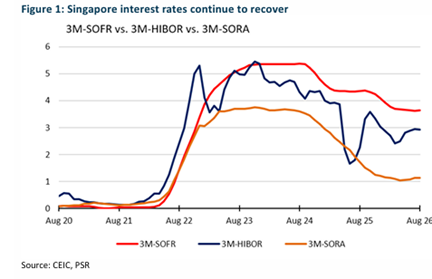
Interest rate trends are stabilising favourably, with 3-month SORA rising for four consecutive months to 1.14% in August. Whilst this represents only a 1 basis point month-on-month increase, it marks the smallest year-on-year decline in 21 months at 58 basis points below the previous year’s level.
The analyst has raised profit after tax and minority interest estimates by 1% and increased return on equity projections by 0.7%, reflecting improved operational performance expectations. Banks’ financial year 2026 estimated dividend yields remain attractive at 3.9%, with buybacks and capital return dividends supporting return on equity.
Challenges
The key limitation is that net interest margins are stabilising rather than recovering meaningfully. Whilst SORA has risen for four consecutive months, it remains 58 basis points below year-ago levels, constraining margin expansion potential.
The CASA ratio has eased to 20.4% of deposits despite absolute growth, indicating some pressure on the funding mix. Additionally, deposit pricing pressures persist, evidenced by UOB raising its 12-month promotional rate by 10 basis points to 1.40% in August, suggesting that deposit pricing has stopped falling and competitive dynamics remain challenging.
Outlook
The analyst expects 3-month SORA to hold around current levels through the second half of 2026 estimated, providing stability for planning purposes. The sector outlook centres on volume-driven growth compensating for margin constraints, with banks positioned to benefit from sustained loan demand whilst managing funding costs.
Recommendation & Target Price
Phillip Securities Research maintains an ACCUMULATE recommendation on Singapore banks. The firm has raised target prices, setting DBS at S$85.00 (previously S$79.00) and OCBC at S$33.20 (previously S$31.70), based on higher loan growth expectations and improved profit estimates. The analyst prefers DBS for its fixed dividend per share policy and raised financial year 2026 estimated guidance, and OCBC for its wealth momentum and remaining capital return potential.
Frequently Asked Questions
Q: What is driving the positive outlook for Singapore banks?
A: Loan growth has reached 10% year-on-year for the first time since COVID, with volume now compensating for what interest margins cannot deliver.
Q: How are interest rates affecting bank margins?
A: 3-month SORA has risen for four consecutive months to 1.14% but remains 58 basis points below year-ago levels, causing net interest margins to stabilise rather than recover meaningfully.
Q: What changes have been made to bank valuations?
A: Target prices have been raised for DBS to S$85.00 from S$79.00 and OCBC to S$33.20 from S$31.70, based on higher loan growth and 1% increased profit estimates.
Q: How attractive are bank dividends currently?
A: Banks' financial year 2026 estimated dividend yields remain attractive at 3.9%, supported by buybacks and capital return dividends that enhance return on equity.
Q: What is happening with bank deposit trends?
A: CASA grew 12% year-on-year, though the CASA ratio eased to 20.4% of deposits, and deposit pricing has stopped falling with competitive pressures evident.
Q: Which banks does the analyst prefer and why?*
A: The analyst prefers DBS for its fixed dividend per share policy and raised financial year 2026 estimated guidance, and OCBC for its wealth momentum and remaining capital return potential.
Q: What is the interest rate outlook?
A: 3-month SORA is expected to hold around current levels through the second half of 2026 estimated, providing rate stability for the banking sector.
This article has been auto-generated using PhillipGPT. It is based on a report by a Phillip Securities Research analyst.
Disclaimer
These commentaries are intended for general circulation and do not have regard to the specific investment objectives, financial situation and particular needs of any person. Accordingly, no warranty whatsoever is given and no liability whatsoever is accepted for any loss arising whether directly or indirectly as a result of any person acting based on this information. You should seek advice from a financial adviser regarding the suitability of any investment product(s) mentioned herein, taking into account your specific investment objectives, financial situation or particular needs, before making a commitment to invest in such products.
Opinions expressed in these commentaries are subject to change without notice. Investments are subject to investment risks including the possible loss of the principal amount invested. The value of units in any fund and the income from them may fall as well as rise. Past performance figures as well as any projection or forecast used in these commentaries are not necessarily indicative of future or likely performance.
Phillip Securities Pte Ltd (PSPL), its directors, connected persons or employees may from time to time have an interest in the financial instruments mentioned in these commentaries.
The information contained in these commentaries has been obtained from public sources which PSPL has no reason to believe are unreliable and any analysis, forecasts, projections, expectations and opinions (collectively the “Research”) contained in these commentaries are based on such information and are expressions of belief only. PSPL has not verified this information and no representation or warranty, express or implied, is made that such information or Research is accurate, complete or verified or should be relied upon as such. Any such information or Research contained in these commentaries are subject to change, and PSPL shall not have any responsibility to maintain the information or Research made available or to supply any corrections, updates or releases in connection therewith. In no event will PSPL be liable for any special, indirect, incidental or consequential damages which may be incurred from the use of the information or Research made available, even if it has been advised of the possibility of such damages. The companies and their employees mentioned in these commentaries cannot be held liable for any errors, inaccuracies and/or omissions howsoever caused. Any opinion or advice herein is made on a general basis and is subject to change without notice. The information provided in these commentaries may contain optimistic statements regarding future events or future financial performance of countries, markets or companies. You must make your own financial assessment of the relevance, accuracy and adequacy of the information provided in these commentaries.
Views and any strategies described in these commentaries may not be suitable for all investors. Opinions expressed herein may differ from the opinions expressed by other units of PSPL or its connected persons and associates. Any reference to or discussion of investment products or commodities in these commentaries is purely for illustrative purposes only and must not be construed as a recommendation, an offer or solicitation for the subscription, purchase or sale of the investment products or commodities mentioned.
This advertisement has not been reviewed by the Monetary Authority of Singapore.