Baiduri Bank priced S$280mn of 2.95% senior unsecured notes due 26 October 2029 at par. The 3-year notes carry a semi-annual coupon and a minimum denomination of S$250,000. S&P rates Baiduri Bank A- with a Stable outlook.
| New issue |
Details |
| Issuer |
Baiduri Bank Sendirian Berhad |
| Issue size |
S$280mn |
| Coupon |
2.95% p.a. |
| Maturity |
26 October 2029 |
| Issue price |
100.00 |
| Ranking |
Senior unsecured |
| Credit rating |
A- (S&P) |
| Coupon payment |
Semi-annual |
| Minimum denomination | S$250,000 |
Source: Bloomberg
Credit Performance Highlights
Weaker Interest Income and Higher Costs Weighed on Profitability
| Metric | FY2023 | FY2024 | FY2025 |
| Return on equity | 13.9% | 13.8% | 11.7% |
| Net interest margin | 3.83% | 3.73% | 3.45% |
| Cost-to-income ratio | 44.82% | 45.56% | 50.6% |
| Loan-to-deposit ratio | 61.17% | 62.26% | 73.66% |
| Net stable funding ratio | 191.56% | 176.68% | 141.83% |
Source: Offering Circular
Earnings remained predominantly interest-driven, with net interest income (NII) accounting for 84.1% of the Group’s operating income in FY2025, followed by net fee income (9.2%) and other operating income (6.7%). NII declined for the second consecutive year, falling 2.8% YoY to B$165.6mn in FY2025 from B$170.3mn in FY2024 and B$171.2mn in FY2023. The decline was mainly driven by lower interest income from bank placements and investment securities amid lower market interest rates, which outweighed higher lending income and savings on funding costs. Consequently, NIM narrowed to 3.45% from 3.73% in FY2024. Meanwhile, net fee income increased 6% YoY to B$18.1mn, while other operating income fell 40.8% to B$13.2mn, given lower foreign-exchange gains and other fees.
Profitability weakened further as operating expenses increased and credit costs rose. Operating expenses rose 4.3% YoY to B$99.6mn, lifting the cost-to-income ratio to 50.6% from 45.6% in FY2024. Meanwhile, higher loan impairment charges and lower recoveries of previously written-off loans further weighed on earnings. Together with weaker operating income, this drove a 21.5% decline in pre-tax profit to B$98.1mn. However, net profit fell by a smaller 7.7% to B$95.8mn, mainly due to lower tax expenses.
Asset quality remained stable but rising credit concentration
The Group’s NPL ratio held at 3% in FY2025 (FY2024: 2.99%).Sector performance was mixed.
NPLs in services and transportation increased 39.5% and 143.2%, respectively, while the construction and property sector’s NPL ratio improved to 4.4% from 5.3%. However, rapid loan growth has increased borrower concentration. Syndicated loans more than doubled to B$670.8mn, accounting for 22.6% of gross loans, while the top 10 borrowers’ share of gross loans rose to 19.8% from 15.7% in FY2024.
Strong Buffers Support Creditworthiness
Capitalisation remains strong, providing substantial loss-absorption capacity. The Group’s Tier 1 capital ratio stood at 23.0% in FY2025 (FY2024: 23.6%), while its total capital adequacy ratio was 23.4%, comfortably above the respective 6.5% and 11.5% regulatory minimums applicable to domestic systemically important banks (D-SIBs). This provides a sizeable capital buffer against potential credit losses, although continued loan growth could place pressure on capital ratios.
Liquidity remains robust, supported by a predominantly deposit-funded balance sheet. The Group’s liquidity coverage ratio (LCR) increased to 690.5% in FY2025 from 673.2% in FY2024, while the net stable funding ratio (NSFR) remained healthy at 141.8%, despite declining from 176.7%.
Capital buffers remain substantial under stressed conditions.
| (B$mn) | Base | Moderate | Severe | Very Severe |
| Starting Tier 1 capital |
816.86 |
816.86 |
816.86 |
816.86 |
| Retained earnings assumed |
+40.00 |
+35.00 |
0 |
0 |
| Incremental credit losses |
0 |
−27.02 |
−143.76 |
−228.56 |
| Remaining Tier 1 capital |
856.86 |
824.83 |
673.10 |
588.30 |
| RWA growth assumed | +5% | +10% | +15% | +20% |
| Stressed RWA | 3,728.95 | 3,906.52 | 4,084.09 | 4,261.65 |
| Stressed Tier 1 ratio | 22.98% | 21.11% | 16.48% | 13.80% |
| Stressed total capital ratio | 23.37% | 21.49% | 16.84% | 14.15% |
Source: Bond Desk Illustrative assumptions
Capital buffers remain resilient under stressed conditions. Based on FY2025 Group capital, Baiduri’s Tier 1 ratio stood at 23%. Under our illustrative very severe scenario, which assumes additional defaults of 15% and 10% among performing construction/property and transportation loans, respectively, alongside a full default by the largest borrower, incremental credit losses are estimated at B$228.6mn. Assuming a further 20% increase in RWA and no additional retained earnings, the Tier 1 and total capital ratios would decline to 13.8% and 14.2%, respectively. Both remain above regulatory minimums, although the total capital ratio would retain only 2.7 percentage points of headroom above the 11.5% requirement, suggesting that capital adequacy remains manageable even under significant credit stress.
Bond Analysis
Senior unsecured bondholders benefit from contractual protections, including a change-of-control put. The notes rank equally with other unsecured and unsubordinated obligations, subject to statutory priorities. Under the programme terms, bondholders may require redemption at 101% of principal if Baiduri Holdings’ ownership and control fall below 51%, subject to the final Pricing Supplement. The notes also benefit from a negative pledge and cross-default provisions. While Brunei has no statutory bank bail-in regime, the bonds remain unsecured and are not government-guaranteed. Overall, strong capital and liquidity buffers support repayment capacity, although recovery remains subject to the bank’s financial condition and applicable insolvency laws.
 Source: Bloomberg
Baiduri’s 2.95% October 2029 senior unsecured notes appear fairly valued at current levels. The notes trade at a Z-spread of 94.1bp and YTW of 2.89%, broadly in line with SHBVN’s October 2029 notes at 93.5bp and 2.89%, respectively. Despite their closely matched maturities, SHBVN benefits from an AA issue rating supported by CGIF’s guarantee, compared with Baiduri’s A- issuer rating and unguaranteed structure. The marginal 0.6bp spread premium offers limited compensation for the difference in credit protection. Baiduri also trades 10.4bp and 18.7bp wider than HDFC Bank’s November 2029 notes and Al Rajhi Bank’s January 2029 sukuk, respectively. However, differences in credit fundamentals and bond structures limit direct comparability. Overall, we view Baiduri’s valuation as fair, with limited relative-value upside at current spreads.
Our Credit View
We maintain a stable credit view on Baiduri Bank, supported by its strong capitalisation, robust liquidity and established domestic banking franchise. The Group’s FY2025 Tier 1 and total capital ratios of 23% and 23.4%, respectively, provide substantial headroom above regulatory requirements, while its LCR of 690.5% and predominantly deposit-funded balance sheet support liquidity resilience. Asset quality remained broadly stable, with an NPL ratio of 3.0%.
However, weakening profitability and rapid loan growth warrant monitoring. FY2025 net profit declined 7.7% YoY, while earnings pressure persisted into 7M26. Meanwhile, the increasing concentration of large corporate exposures raises the risk of sizeable credit losses. Nevertheless, we expect Baiduri’s substantial capital and liquidity buffers to support its debt-servicing capacity over the medium term.
Company Overview:
Group Structure
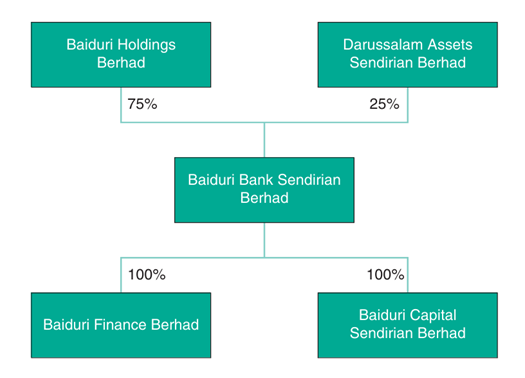
Baiduri Bank was established in 1994 and commenced retail banking operations in 1996. It is Brunei Darussalam’s second-largest bank and one of two domestic systemically important banks (D-SIBs) designated by the Brunei Darussalam Central Bank (BDCB). The Group operates across retail, corporate and institutional banking; wealth management; treasury and transaction banking; complemented by consumer financing through Baiduri Finance and investment services through Baiduri Capital.
The Group’s operations remain predominantly concentrated in Brunei Darussalam, where it maintains an established domestic banking franchise and the country’s second-largest branch network. Its activities also include international lending and treasury investments, while its Singapore representative office, established in May 2025, supports regional banking relationships. As at FY2025, the Group reported total assets of B$5.01bn, gross loans of B$2.96bn and customer deposits of B$3.97bn. Baiduri Bank is privately held, with Baiduri Holdings owning 75% and Darussalam Assets Sendirian Berhad, a government-linked investment company, owning 25%.