How CFDs Complement Your Trading and Investing Strategies April 2, 2026
How CFDs Complement Your Trading and Investing Strategies
In today’s fast-moving financial markets, investors and traders are constantly seeking ways to improve their strategies and capture to new opportunities. Contracts for Difference (CFDs) have become a popular tool because they offer flexibility, access to global markets, and the ability to trade both rising and falling prices. However, CFDs are complex, leveraged products that carry a higher level of risk and may not be suitable for all investors.
What Are CFDs?
A Contract for Difference (CFD) is a derivative product that allows you to participate in the price movement of an asset without owning the underlying assets.1 Instead of purchasing the asset, you initiate an agreement with a CFD broker to settle the difference between the opening and closing prices of your position. CFDs also allow you to trade a variety of asset classes within a single account, making them a flexible and versatile tool for enhancing both trading and investing strategies.
How CFDs Complement Trading Strategies?
For traders, CFDs provide opportunities that may not always be available in traditional markets. Their flexibility and fast execution make them well suited for short-term strategies such as day trading, swing trading, and scalping.
Leverage for Capital Efficiency
CFDs allow traders to improve their capital efficiency as they are traded on margin. This means traders can initiate positions with a smaller initial capital outlay. As a result, this increases accessibility to financial markets, especially for those with limited capital. However, leverage also amplifies losses, making proper risk management essential,2 which we will explore in more detail later.
Example:
If a trader wants to gain exposure to shares worth US$10,000, using 10:1 leverage they would only need to provide US$1,000 as margin. By applying proper risk management, such as limiting the trade to a small portion of total capital and using stop-loss orders, potential losses can be controlled while still benefiting from leverage.
Positioning for Rising or Falling Markets
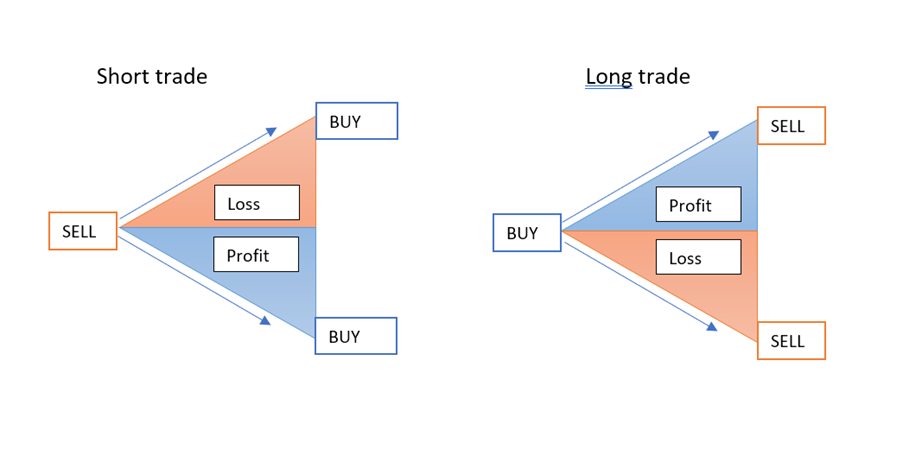
One notable advantage of CFDs is the ability to short sell. This enables traders to manage their positions and potentially generate profits or mitigate losses during periods of market decline. Downward movements can be especially pronounced during risk-off phases, and CFDs offer flexibility for traders to adopt either long or short positions. When market sentiment turns negative, sharp declines in price may occur, presenting opportunities for traders seeking to capitalize on strong, short-term momentum. With the ability to short sell through CFDs, traders can take advantage of these downward moves rather than missing potential opportunities when markets drop.3
Access to Multiple Global Market
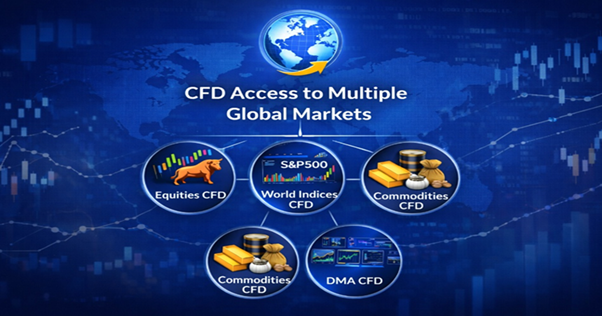
When trading CFDs, traders can access multiple global markets through a single trading account rather than opening separate accounts for each market4. As global markets operate across different time zones, this access allows traders to participate in markets at various times throughout the day. This creates a more continuous flow of opportunities, particularly during periods of heightened volatility.
How CFDs Complement Investing Strategies?
CFDs are often associated with short-term trading. However, when structured effectively, they can enhance long-term investing strategies. They are not meant to replace traditional investing, instead, they act as a strategic tool to improve flexibility, capital efficiency, and risk management.
1) Adding Tactical Opportunities to a Portfolio
Long-term investors build portfolios based on strategic asset allocation, selecting quality investments to hold for several years and benefit from sustained market growth. However, markets do not move in a straight line, and short-term volatility can arise from economic data releases, sector forward narrative, and global events. CFDs offer a way for investors to take advantage of these shorter-term market movements without altering their core long-term holdings.
2) Hedging Long-Term Positions
Hedging is a risk management strategy that involves taking positions designed to offset potential losses in an existing investment portfolio5. Market volatility is an unavoidable part of investing. Unexpected events such as economic uncertainty, geopolitical developments, and changes in interest rates may include a financial shock, triggering market corrections. These occurrences can disrupt market stability and lead to significant fluctuations in asset prices. Instead of selling long-term holdings during periods of uncertainty, investors can use CFDs to hedge their exposure.
For example, if an investor holds a portfolio of technology stocks and expects short-term market weakness, they may open a short CFD position on technology stock or index. If the market declines, the losses in the portfolio may be partially offset by gains from the CFD position. This allows investors to manage short-term downside risk while continuing to hold their long-term investments6.
3) Capital Efficiency and Diversification
Unlike traditional investing, CFDs require only margin rather than the full capital outlay of the underlying asset. This allows investors to gain market exposure while keeping more capital available for other opportunities.
In addition, CFDs provide new investment opportunities beyond traditional exchange-traded products such as foreign exchange (FX), global indices, and commodities. This allows long-term investors to broaden their exposure to different asset classes without trading directly in those markets7.
As financial markets move rapidly, opportunities may arise unexpectedly. If capital is fully committed to long-term positions, investors may miss these opportunities. By incorporating CFDs, investors can maintain greater flexibility while continuing to participate in the markets.
Key Considerations: Risks of Trading CFDs
CFDs are leveraged financial instruments and carry a higher level of risk compared to traditional investments. Even small price movements in the underlying asset can have a significant impact on a trader’s position. As a result, both gains and losses are magnified. Therefore, it is important for investors and traders to understand the potential risks and apply proper risk management when trading CFDs8.
- Leverage Risk – Leverage allows traders to control larger positions with less capital, but it can also amplify losses and the losses may exceed initial capital if the market moves against the trade.
- Market Volatility – Sudden market movements caused by economic news or geopolitical events can lead to rapid price changes and unexpected losses.
- Margin Call Risk – If account equity falls below the required margin level, traders may need to add funds or risk having positions forced closed.
- Overnight Financing Costs – Holding CFD positions overnight may incur financing charges, which can affect overall profitability.
Mitigating Risks and Best Practices
To manage these risks effectively, traders should adopt disciplined practices: traders should set stop-loss and take-profit levels to define clear exit points9 and conservative position sizes, diversify across various markets and asset classes, and monitor positions regularly. New traders are advised to start with smaller trades or demo accounts to gain experience, as well as periodically review and adjust strategies to respond to changing market conditions.
Conclusion
CFDs are versatile financial instruments that can add value to both trading and investing strategies. For traders, they offer provide ease of trade, leverage, and the ability to profit in rising or falling markets. For investors, CFDs can enhance portfolio flexibility, support hedging strategies, and flexibility in managing portfolios.
Whether you are seeking to capture short-term opportunities or manage long-term portfolio risks, CFDs can serve as a valuable tool within a broader financial strategy. When used responsibly, they can help bridge the gap between active trading and long-term wealth accumulation.
Promotion
Start your CFD journey with us and enjoy 0 commission on US equity CFDs for 30 days when you open a CFD account with us. In addition, receive S$50 cash credit when you fund and trade.

As long as you open a POEMS CFD Account during the promotion period of 10 March 2026 to 10 June 2026 (both dates inclusive) and do NOT have any existing POEMS CFD Account(s), your 0 commission on US Equity CFDs for 30 days will be active upon receiving an email notification to indicate promotion has been activated for the account. For more information, you can visit our CFD website or click here
References:
- Understanding contracts for difference. (n.d.).
https://www.moneysense.gov.sg/understanding-contracts-for-difference/ - MarketMates. (2024, August 13). Trading 101: Leverage and margin explained.
https://marketmates.com/learn/cfd-trading/trading-101-leverage-and-margin-explained/ - Phillip CFD. (2021a, March 16). What is Short-Selling? | CFD Trading Singapore | Phillip CFD.
https://www.phillipcfd.com/products/what-is-short-selling/ - What is CFD trading – a beginner’s guide. (2026, January 12). TradingView.
https://www.tradingview.com/news/forexlive:704a82432094b:0-what-is-cfd-trading-a-beginner-sguide/#:~:text=Types%20of%20CFD%20Markets,%2C%20and%20Ripple%20(XRP) - Popular hedging Strategies for traders in 2025 for FXOPEN:EURUSD by FXOpen. (2025, March 19). TradingView.
https://www.tradingview.com/chart/EURUSD/oeOYrKIr-Popular-Hedging-Strategies-for-Traders-in-2025/ - Hedging in Share Market | Types of Hedging Strategies in Trading. (n.d.).
https://www.truedata.in/blog/hedging-in-share-market? - Gratton, P. (2025, August 28). Understanding Contract for Differences (CFDs): Key insights and benefits. Investopedia.
https://www.investopedia.com/articles/stocks/09/trade-a-cfd.asp - What is CFD trading – a beginner’s guide. (2026b, January 12). TradingView.
https://www.tradingview.com/news/forexlive:704a82432094b:0-what-is-cfd-trading-a-beginner-s-guide/ - Gratton, P. (2025b, August 28). Understanding Contract for Differences (CFDs): Key insights and benefits. Investopedia
https://www.investopedia.com/articles/stocks/09/trade-a-cfd.asp
Disclaimer
These commentaries are intended for general circulation and do not have regard to the specific investment objectives, financial situation and particular needs of any person. Accordingly, no warranty whatsoever is given and no liability whatsoever is accepted for any loss arising whether directly or indirectly as a result of any person acting based on this information. You should seek advice from a financial adviser regarding the suitability of any investment product(s) mentioned herein, taking into account your specific investment objectives, financial situation or particular needs, before making a commitment to invest in such products.
Opinions expressed in these commentaries are subject to change without notice. Investments are subject to investment risks including the possible loss of the principal amount invested. The value of units in any fund and the income from them may fall as well as rise. Past performance figures as well as any projection or forecast used in these commentaries are not necessarily indicative of future or likely performance.
Phillip Securities Pte Ltd (PSPL), its directors, connected persons or employees may from time to time have an interest in the financial instruments mentioned in these commentaries.
The information contained in these commentaries has been obtained from public sources which PSPL has no reason to believe are unreliable and any analysis, forecasts, projections, expectations and opinions (collectively the “Research”) contained in these commentaries are based on such information and are expressions of belief only. PSPL has not verified this information and no representation or warranty, express or implied, is made that such information or Research is accurate, complete or verified or should be relied upon as such. Any such information or Research contained in these commentaries are subject to change, and PSPL shall not have any responsibility to maintain the information or Research made available or to supply any corrections, updates or releases in connection therewith. In no event will PSPL be liable for any special, indirect, incidental or consequential damages which may be incurred from the use of the information or Research made available, even if it has been advised of the possibility of such damages. The companies and their employees mentioned in these commentaries cannot be held liable for any errors, inaccuracies and/or omissions howsoever caused. Any opinion or advice herein is made on a general basis and is subject to change without notice. The information provided in these commentaries may contain optimistic statements regarding future events or future financial performance of countries, markets or companies. You must make your own financial assessment of the relevance, accuracy and adequacy of the information provided in these commentaries.
Views and any strategies described in these commentaries may not be suitable for all investors. Opinions expressed herein may differ from the opinions expressed by other units of PSPL or its connected persons and associates. Any reference to or discussion of investment products or commodities in these commentaries is purely for illustrative purposes only and must not be construed as a recommendation, an offer or solicitation for the subscription, purchase or sale of the investment products or commodities mentioned.
This advertisement has not been reviewed by the Monetary Authority of Singapore.
About the author
Brenice Siew Kai Xuan
Dealer
CFD Central Dealing Team
Brenice graduated from UCSI University with a Bachelor's Degree majoring in Finance and Investment. She believes investment is a continuous learning process, where understanding market behaviour and managing risks are essential to building sustainable returns. She enjoys learning to enhance her trading knowledge, technical analysis skills, and overall market understanding.
 Unveiling Opportunity: Exploring the Potential of European Equities
  Mastering Stop-Loss Placement: A Guide to Profitability in Forex Trading
  Crude Realities: Understanding oil prices and how to trade them
  Gold at All-Time Highs: What’s Fuelling the 2025 Rally?