JPMorgan Chase Delivers Solid Q4 Results Despite Investment Banking Headwinds January 29, 2026

Company Overview and Market Position
JPMorgan Chase operates as one of the largest diversified financial services institutions globally, with leading positions in Consumer & Community Banking and Corporate & Investment Banking. The bank’s diversified revenue streams and strong market presence enable consistent performance across various economic cycles.
Strong Fourth Quarter Performance
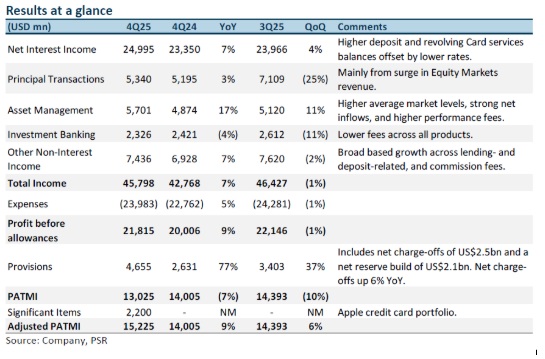
JPMorgan Chase & Co reported adjusted fourth quarter 2025 profit after tax and minority interests of US$15.2 billion, representing a 9% year-over-year increase that met analyst estimates. The bank’s full-year 2025 earnings reached 101% of forecasted levels, demonstrating consistent execution across its diversified business model. The company increased its dividend per share by 20% to US$1.50, while the dividend payout ratio rose to 32% from 26% in the previous year. Additionally, JPMorgan returned significant capital to shareholders through US$7.9 billion in net common stock repurchases during the quarter.
Revenue Growth Drivers and Segment Performance
Net interest income grew 7% year-over-year, supported by higher deposit balances and increased revolving balances in the Card Services division, despite a 7-basis point decline in net interest margin. The bank’s loan portfolio expanded 9% year-over-year, contributing to overall growth momentum. Non-interest income increased 7% year-over-year, serving as the primary growth driver with notable strength in principal transactions and asset management fees, which surged 17%. However, investment banking fees declined 4%, creating a headwind for overall performance.
Forward Guidance and Investment Outlook
JP Morgan’s management provided fiscal year 2026 guidance projecting net interest income of US$103 billion, representing 7% growth, while expenses are expected to reach US$105 billion, indicating 10% growth. Phillip Securities Research maintains a NEUTRAL recommendation with a raised target price of US$320, up from the previous US$305, based on fiscal year 2026 estimates. The research firm’s Gordon Growth Model valuation assumes 2.54 times price-to-book value and a 20.6% return on equity estimate.
Investment Merits and Risk Considerations
The bank’s ability to generate consistent revenue growth across all segments, particularly in Consumer & Community Banking and Corporate & Investment Banking, represents a key investment merit. However, analysts express caution regarding macro uncertainties including trade tensions and policy shifts that could increase provisions and non-performing loans. Additionally, higher expense growth trajectory may pressure earnings, while current valuations appear elevated with price-to-earnings ratio at 15 times versus the 10-year average of 11.6 times.
Frequently Asked Questions
Q: What was JPMorgan Chase’s fourth quarter 2025 profit performance?
A: JPMorgan Chase reported adjusted fourth quarter 2025 profit after tax and minority interests of US$15.2 billion, representing a 9% year-over-year increase that met analyst estimates.
Q: How did the bank’s net interest income perform despite margin pressure?
A: Net interest income grew 7% year-over-year from higher deposit balances and increased revolving balances in Card Services, even though the net interest margin declined by 7 basis points.
Q: Which business segments drove non-interest income growth?
A: Non-interest income increased 7% year-over-year, primarily driven by principal transactions and asset management fees, which grew 17%, while investment banking fees declined 4%.
Q: What is JPMorgan’s guidance for fiscal year 2026?
A: JPMorgan’s management provided guidance for fiscal year 2026 net interest income of US$103 billion, representing 7% growth, and expenses of US$105 billion, indicating 10% growth.
Q: What is Phillip Securities Research’s investment recommendation?
A: Phillip Securities Research maintains a NEUTRAL recommendation with a target price of US$320, raised from the previous US$305, based on fiscal year 2026 estimates.
Q: What are the key investment merits for JPMorgan Chase?
A: The bank’s ability to continue growing revenue across all segments, particularly in Consumer & Community Banking and Corporate & Investment Banking, represents the primary investment merit.
Q: What risks are analysts concerned about regarding JPMorgan’s outlook?
A: Analysts express caution due to macro uncertainties such as trade tensions and policy shifts that could increase provisions and non-performing loans, plus higher expense growth that may pressure earnings.
Q: How do current valuations compare to historical levels?
A: Current valuations appear elevated with the price-to-earnings ratio at 15 times versus the 10-year average of 11.6 times, and price-to-book ratio at 2.5 times versus the 10-year average of 1.5 times.
This article has been auto-generated using PhillipGPT. It is based on a report by a Phillip Securities Research analyst.
Disclaimer
These commentaries are intended for general circulation and do not have regard to the specific investment objectives, financial situation and particular needs of any person. Accordingly, no warranty whatsoever is given and no liability whatsoever is accepted for any loss arising whether directly or indirectly as a result of any person acting based on this information. You should seek advice from a financial adviser regarding the suitability of any investment product(s) mentioned herein, taking into account your specific investment objectives, financial situation or particular needs, before making a commitment to invest in such products.
Opinions expressed in these commentaries are subject to change without notice. Investments are subject to investment risks including the possible loss of the principal amount invested. The value of units in any fund and the income from them may fall as well as rise. Past performance figures as well as any projection or forecast used in these commentaries are not necessarily indicative of future or likely performance.
Phillip Securities Pte Ltd (PSPL), its directors, connected persons or employees may from time to time have an interest in the financial instruments mentioned in these commentaries.
The information contained in these commentaries has been obtained from public sources which PSPL has no reason to believe are unreliable and any analysis, forecasts, projections, expectations and opinions (collectively the “Research”) contained in these commentaries are based on such information and are expressions of belief only. PSPL has not verified this information and no representation or warranty, express or implied, is made that such information or Research is accurate, complete or verified or should be relied upon as such. Any such information or Research contained in these commentaries are subject to change, and PSPL shall not have any responsibility to maintain the information or Research made available or to supply any corrections, updates or releases in connection therewith. In no event will PSPL be liable for any special, indirect, incidental or consequential damages which may be incurred from the use of the information or Research made available, even if it has been advised of the possibility of such damages. The companies and their employees mentioned in these commentaries cannot be held liable for any errors, inaccuracies and/or omissions howsoever caused. Any opinion or advice herein is made on a general basis and is subject to change without notice. The information provided in these commentaries may contain optimistic statements regarding future events or future financial performance of countries, markets or companies. You must make your own financial assessment of the relevance, accuracy and adequacy of the information provided in these commentaries.
Views and any strategies described in these commentaries may not be suitable for all investors. Opinions expressed herein may differ from the opinions expressed by other units of PSPL or its connected persons and associates. Any reference to or discussion of investment products or commodities in these commentaries is purely for illustrative purposes only and must not be construed as a recommendation, an offer or solicitation for the subscription, purchase or sale of the investment products or commodities mentioned.
This advertisement has not been reviewed by the Monetary Authority of Singapore.
About the author

Glenn Thum
Glenn covers the Banking and Finance sector. He has had 3 years of experience as a Credit Analyst in a Bank, where he prepared credit proposals by conducting consistent critical analysis on the business, market, country and financial information. Glenn graduated with a Bachelor of Business Management from the University of Queensland with a double major in International Business and Human Resources.