Magnificent 7 Technology Stocks Face Sharp Pullback Amid AI Spending Concerns, Despite Strong Demand Fundamentals July 24, 2026
Market Performance and Key Concerns
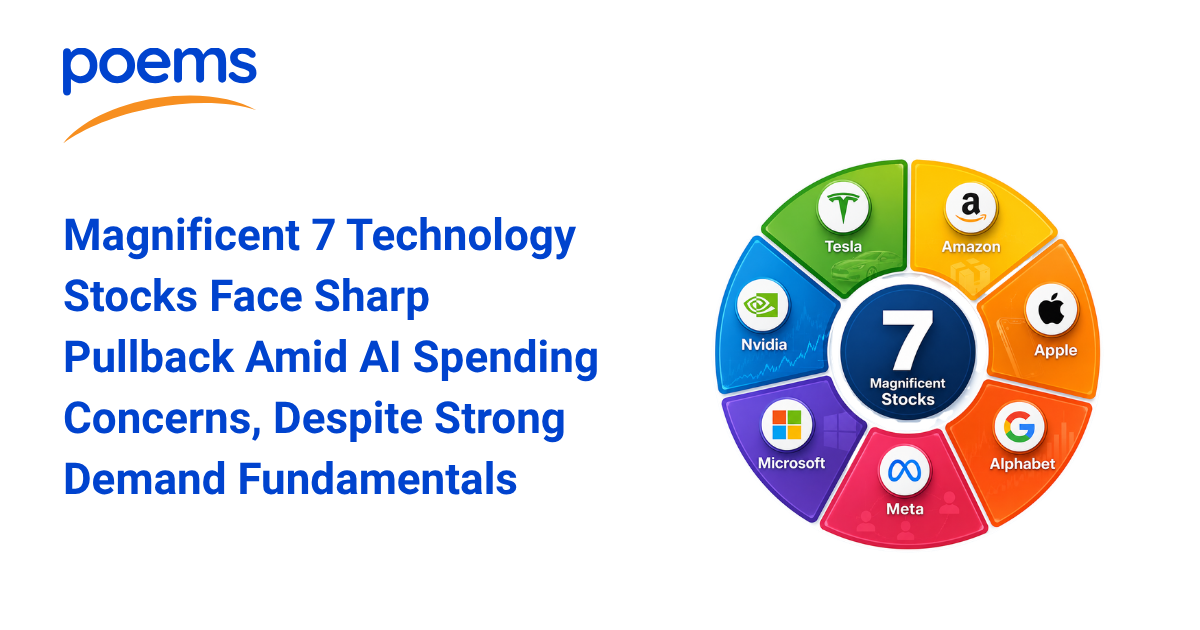
The Magnificent 7 technology stocks experienced a significant pullback in June 2026, declining 8.5% compared to May’s positive 5.4% performance. This sharp reversal saw the group substantially underperform both the S&P 500, which fell 1.1%, and the NASDAQ, which declined 2.8%. The decline was primarily driven by investor concerns over the substantial artificial intelligence spending commitments from major hyperscalers, including Microsoft (-17%), Meta (-11%), Amazon (-12%), and Google (-6%).
These concerns were amplified by the four hyperscalers raising approximately US$139 billion in bonds during the first half of 2026, representing a 35% increase from their total bond issuances in 2025. Additional uncertainty emerged following the appointment of new Federal Reserve Chair Kevin Warsh in May, raising speculation about potential interest rate increases that could elevate AI financing costs.
Individual Stock Performance
Microsoft emerged as the biggest laggard, falling 17% after providing aggressive capital expenditure guidance of US$190 billion for fiscal year 2026, which exceeded consensus estimates of US$155 billion by 23%. This increase was attributed to higher-than-expected component prices driven by surging memory costs. Meta declined 11% amid reports that the company was considering raising tens of billions in equity funding to support its capital expenditure plans.
Fundamental Demand Remains Strong
Despite market concerns, research indicates that hyperscaler capital expenditure decisions are fundamentally sound, driven by genuine organic demand rather than speculative supply planning. The combined first quarter 2026 backlog for Microsoft, Google, and Amazon increased 46% year-over-year to US$873 billion, excluding deals with Anthropic and OpenAI. These partnerships, estimated at US$580 billion, are excluded from organic growth calculations due to their long-term nature of more than five years and associated execution and funding risks.
The US$873 billion organic backlog serves as a reliable indicator of short-to-medium term AI demand from enterprises and sovereign nations, with the majority expected to be recognised within the next two years. Google noted that cloud revenue could have been higher if capacity constraints hadn’t limited its ability to meet enterprise demand, whilst Amazon’s Trainium chips are nearly fully subscribed and Microsoft anticipates capacity constraints continuing through 2026.
Investment Outlook
The research maintains an overweight recommendation on the Magnificent 7, noting that June’s pullback reduced forward price-to-earnings valuations to 38.4 times from May’s 39.7 times. The underperformance reflects broader investor rotation away from mega-cap technology stocks with high AI spending towards more attractively valued defensive sector names.
Frequently Asked Questions
Q: How did the Magnificent 7 perform in June 2026 compared to broader markets?
A: The Magnificent 7 declined 8.5% in June 2026, significantly underperforming the S&P 500, which fell -1.1% and NASDAQ, which declined -2.8%, marking a sharp reversal from May's positive 5.4% performance.
Q: What were the main concerns driving the sell-off?
A: Investors were primarily concerned about high AI spending by hyperscalers, with the four major companies raising US$139 billion in bonds in the first half of 2026, 35% higher than their total 2025 bond issuances. Additional uncertainty arose from potential Fed rate hikes under new Chair Kevin Warsh.
Q: Which stock was the worst performer and why?
A: Microsoft was the biggest laggard, falling 17% due to aggressive capex guidance of US$190 billion for FY2026, which was 23% higher than consensus estimates of US$155 billion, driven by surging memory costs.
Q: What evidence supports continued AI demand?
A: The combined 1Q26 backlog of Microsoft, Google, and Amazon increased 46% year-over-year to US$873 billion, excluding Anthropic/OpenAI deals, indicating strong organic demand from enterprises and sovereign nations.
Q: Why are Anthropic and OpenAI deals excluded from organic growth assumptions?
A: These deals, estimated at US$580 billion, are long-term commitments exceeding five years that carry significant execution and funding risks, with both companies currently unprofitable and relying on external capital rather than operating cash flow.
Q: What is the current investment recommendation for the Magnificent 7?
A: The research maintains an overweight recommendation, noting that June's pullback reduced forward P/E valuations to 38.4 times from May's 39.7 times, making the group more attractively valued.
Q: What capacity constraints are hyperscalers experiencing?
A: Google mentioned cloud revenue could have been higher if it had been able to meet enterprise demand, Amazon's Trainium chips are almost fully subscribed, and Microsoft expects to be capacity-constrained at least through 2026.
This article has been auto-generated using PhillipGPT. It is based on a report by a Phillip Securities Research analyst.
Disclaimer
These commentaries are intended for general circulation and do not have regard to the specific investment objectives, financial situation and particular needs of any person. Accordingly, no warranty whatsoever is given and no liability whatsoever is accepted for any loss arising whether directly or indirectly as a result of any person acting based on this information. You should seek advice from a financial adviser regarding the suitability of any investment product(s) mentioned herein, taking into account your specific investment objectives, financial situation or particular needs, before making a commitment to invest in such products.
Opinions expressed in these commentaries are subject to change without notice. Investments are subject to investment risks including the possible loss of the principal amount invested. The value of units in any fund and the income from them may fall as well as rise. Past performance figures as well as any projection or forecast used in these commentaries are not necessarily indicative of future or likely performance.
Phillip Securities Pte Ltd (PSPL), its directors, connected persons or employees may from time to time have an interest in the financial instruments mentioned in these commentaries.
The information contained in these commentaries has been obtained from public sources which PSPL has no reason to believe are unreliable and any analysis, forecasts, projections, expectations and opinions (collectively the “Research”) contained in these commentaries are based on such information and are expressions of belief only. PSPL has not verified this information and no representation or warranty, express or implied, is made that such information or Research is accurate, complete or verified or should be relied upon as such. Any such information or Research contained in these commentaries are subject to change, and PSPL shall not have any responsibility to maintain the information or Research made available or to supply any corrections, updates or releases in connection therewith. In no event will PSPL be liable for any special, indirect, incidental or consequential damages which may be incurred from the use of the information or Research made available, even if it has been advised of the possibility of such damages. The companies and their employees mentioned in these commentaries cannot be held liable for any errors, inaccuracies and/or omissions howsoever caused. Any opinion or advice herein is made on a general basis and is subject to change without notice. The information provided in these commentaries may contain optimistic statements regarding future events or future financial performance of countries, markets or companies. You must make your own financial assessment of the relevance, accuracy and adequacy of the information provided in these commentaries.
Views and any strategies described in these commentaries may not be suitable for all investors. Opinions expressed herein may differ from the opinions expressed by other units of PSPL or its connected persons and associates. Any reference to or discussion of investment products or commodities in these commentaries is purely for illustrative purposes only and must not be construed as a recommendation, an offer or solicitation for the subscription, purchase or sale of the investment products or commodities mentioned.
This advertisement has not been reviewed by the Monetary Authority of Singapore.
 Wells Fargo Maintains Growth Momentum Despite Rate Headwinds
  Raffles Education Set for Growth Pivot as Focus Shifts to ASEAN K-12 Expansion
  Nanofilm Technologies Targets Growth Through Commercialisation of Deep Tech Solutions
  JPMorgan Chase Maintains ACCUMULATE Rating Despite Lower Target Price