Magnificent 7 Monthly: Signs of AI Returns on Investment September 11, 2026
Brief Overview
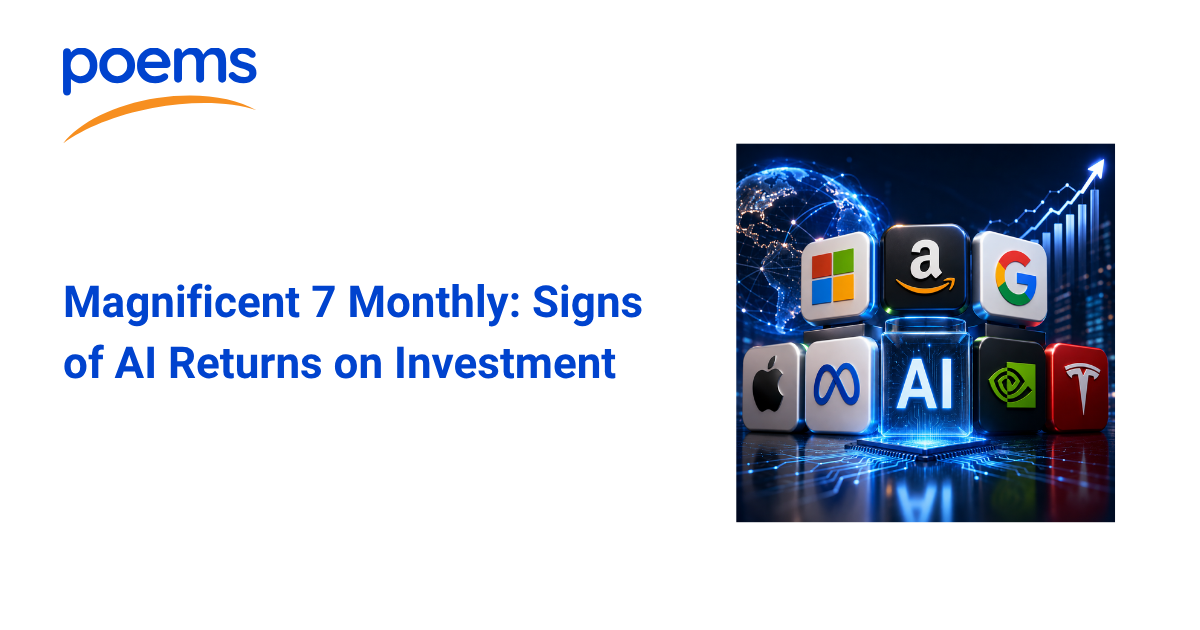
In July 2026, the Magnificent 7 (Mag-7) stocks rebounded 4.5 per cent from the previous month’s 8.5 per cent decline, outperforming both the S&P 500 (-0.1%) and NASDAQ (-6.6%). The rebound was driven by cloud service providers (CSPs) — Microsoft, Amazon and Alphabet — which posted a record combined 2Q26 cloud operating margin of 39 per cent and revenue acceleration of 43 per cent year-on-year to US$106 billion. All Mag-7 companies excluding NVIDIA beat revenue expectations, with combined revenue accelerating 21 per cent year-on-year to US$608.9 billion, the highest growth since 3Q21.
Investment Positives
Cloud revenue acceleration signals AI returns. The market rewarded CSPs showing early returns on elevated AI spending. GOOGL’s Cloud revenue surged 82 per cent year-on-year to US$24.8 billion, the fastest growth among the CSPs. AWS accelerated 37 per cent year-on-year to US$42 billion for a fifth consecutive quarter, while Microsoft Azure grew 43 per cent year-on-year. Combined cloud backlog accelerated 152 per cent year-on-year to US$1.7 trillion, reflecting strong enterprise and sovereign AI demand.
Alphabet offers the fastest cloud growth at a steep valuation discount. GOOGL trades at a 17x forward P/E, a 53 per cent discount to the Mag-7 average, while delivering the highest cloud growth rate among CSPs over the past five years. Its cloud backlog grew nearly 4x year-on-year to US$514 billion, providing strong revenue visibility.
Microsoft delivered strong results. Azure revenue reached an annual run-rate of US$100 billion, commercial remaining performance obligations stood at US$678 billion (26% enterprise growth year-on-year excluding OpenAI’s commitment), and the company notably refrained from raising capex guidance when peers did.
Amazon’s AWS positioning is increasingly differentiated. Bedrock’s model-agnostic platform reduces dependence on any single model provider, while custom silicon (Trainium and Graviton) reduces reliance on third-party GPUs, with multi-year commitments from Anthropic and OpenAI validating this strategy.
NVIDIA stands to benefit from hyperscaler capex surges. 2026 hyperscaler capex guidance increased 5 per cent to US$748 billion, representing a 97 per cent year-on-year increase. NVIDIA’s partnerships with Apollo, BlackRock, Blackstone, Brookfield, Goldman Sachs and KKR to deploy over US$500 billion of third-party capital turn AI compute infrastructure into an investable asset class.
Meta’s advertising revenue grew 27 per cent year-on-year, driven by strong user engagement, while the BlackRock joint venture for a 1GW Texas data centre campus offers a capital-efficient path to AI infrastructure.
Investment Negatives
Tesla’s profitability collapsed. Adjusted PATMI fell 17 per cent year-on-year despite record deliveries, as a 47 per cent year-on-year jump in operating expenses, lower regulatory credits and a US$240 million energy warranty charge weighed. Operating margin fell to 1.4 per cent, and free cash flow turned negative at US$1.1 billion. China demand fell 33 per cent year-on-year in July, with domestic market share declining to 5.2 per cent. Robotaxi geographic expansion continues without meaningful fleet scale, while NHTSA opened a suspension probe into 1.2 million vehicles. Valuations remain extremely stretched at approximately 310x P/E.
Meta’s free cash flow collapsed 91 per cent year-on-year to US$784 million as capex surged 88 per cent. Narrowed FY26 capex guidance of US$130–145 billion raised concerns, particularly as Meta lacks a cloud computing business to demonstrate returns on high AI spending.
Apple faces supply constraints limiting revenue capture, elevated memory costs pressuring margins, and regulatory delays for Apple Intelligence in Europe and China — markets collectively accounting for approximately 44 per cent of revenue.
Alphabet’s free cash flow turned negative for the first time since its IPO at negative US$5.9 billion, as capex doubled year-on-year.
Outlook
The market is increasingly differentiating between companies demonstrating clear paths to returns on AI spending and those where investment returns remain uncertain. CSPs with accelerating cloud revenue and growing backlogs are being rewarded, while companies with rising capex but unclear monetisation face selling pressure. Enterprise and sovereign AI demand remains robust, as evidenced by the combined US$1.7 trillion cloud backlog.
Recommendation & Target Price
Phillip Securities Research maintains an OVERWEIGHT recommendation on the Mag-7. Individual stock recommendations and target prices are as follows: Alphabet (BUY, TP US$425), Amazon (ACCUMULATE, TP US$320), Apple (REDUCE, TP US$290), Meta Platforms (BUY, TP US$750), Microsoft (ACCUMULATE, TP US$515), NVIDIA (BUY, TP US$285), and Tesla (SELL, TP US$220). The top Mag-7 pick is Alphabet.
Frequently Asked Questions
Q: Why does Phillip Securities Research maintain an OVERWEIGHT on the Mag-7?
A: The market is rewarding CSPs that show early returns on AI spending through cloud revenue acceleration. Combined cloud backlog accelerated 152 per cent year-on-year to US$1.7 trillion, signifying strong AI demand from enterprises and sovereign nations.
Q: Why is Alphabet the top pick among the Mag-7?
A: Alphabet combines the fastest cloud growth among CSPs over the past five years (82% YoY in 2Q26) with a 17x forward P/E, representing a 53 per cent discount to the Mag-7 average.
Q: What drove Microsoft's 24.5 per cent share price rally in July?
A: Microsoft's outperformance was driven by Azure revenue accelerating 43 per cent year-on-year, reaching an annual run-rate of US$100 billion for the first time, combined with no capex raise announcement and the addition of consumer-based billing.
Q: Why does Phillip Securities Research maintain a SELL on Tesla?
A: Tesla's profitability is collapsing despite record deliveries, with operating margin falling to 1.4 per cent, negative free cash flow, declining China demand, extremely stretched valuations at approximately 310x P/E, and significant revenue from robotaxis and humanoid robots estimated to be more than five years away.
Q: What risks does Meta face despite strong advertising growth?
A: Meta's free cash flow declined 91 per cent year-on-year as capex surged 88 per cent, and unlike other CSPs, Meta lacks a cloud computing business to demonstrate returns on its elevated AI spending.
Q: What are the key concerns for Apple?
A: Apple is unable to fully capture strong demand due to supply constraints, elevated memory costs weigh on product margins, and regulatory hurdles delay Apple Intelligence rollouts in Europe and China, which collectively account for approximately 44 per cent of its revenue.
Q: How is NVIDIA expected to benefit from hyperscaler capex increases?
A: Hyperscaler 2026 capex guidance rose 5 per cent to US$748 billion (97% YoY increase), with more than 50 per cent expected to be spent on semiconductor chips, networking and server hardware, directly benefiting NVIDIA.
Q: What differentiates Amazon's AI strategy?
A: Amazon positions AWS as the infrastructure backbone for the AI ecosystem through Bedrock's model-agnostic platform, while its custom silicon (Trainium and Graviton) reduces reliance on third-party GPUs. Multi-year Trainium commitments from Anthropic and OpenAI validate this strategy.
This article has been auto-generated using PhillipGPT. It is based on a report by a Phillip Securities Research analyst.
Disclaimer
These commentaries are intended for general circulation and do not have regard to the specific investment objectives, financial situation and particular needs of any person. Accordingly, no warranty whatsoever is given and no liability whatsoever is accepted for any loss arising whether directly or indirectly as a result of any person acting based on this information. You should seek advice from a financial adviser regarding the suitability of any investment product(s) mentioned herein, taking into account your specific investment objectives, financial situation or particular needs, before making a commitment to invest in such products.
Opinions expressed in these commentaries are subject to change without notice. Investments are subject to investment risks including the possible loss of the principal amount invested. The value of units in any fund and the income from them may fall as well as rise. Past performance figures as well as any projection or forecast used in these commentaries are not necessarily indicative of future or likely performance.
Phillip Securities Pte Ltd (PSPL), its directors, connected persons or employees may from time to time have an interest in the financial instruments mentioned in these commentaries.
The information contained in these commentaries has been obtained from public sources which PSPL has no reason to believe are unreliable and any analysis, forecasts, projections, expectations and opinions (collectively the “Research”) contained in these commentaries are based on such information and are expressions of belief only. PSPL has not verified this information and no representation or warranty, express or implied, is made that such information or Research is accurate, complete or verified or should be relied upon as such. Any such information or Research contained in these commentaries are subject to change, and PSPL shall not have any responsibility to maintain the information or Research made available or to supply any corrections, updates or releases in connection therewith. In no event will PSPL be liable for any special, indirect, incidental or consequential damages which may be incurred from the use of the information or Research made available, even if it has been advised of the possibility of such damages. The companies and their employees mentioned in these commentaries cannot be held liable for any errors, inaccuracies and/or omissions howsoever caused. Any opinion or advice herein is made on a general basis and is subject to change without notice. The information provided in these commentaries may contain optimistic statements regarding future events or future financial performance of countries, markets or companies. You must make your own financial assessment of the relevance, accuracy and adequacy of the information provided in these commentaries.
Views and any strategies described in these commentaries may not be suitable for all investors. Opinions expressed herein may differ from the opinions expressed by other units of PSPL or its connected persons and associates. Any reference to or discussion of investment products or commodities in these commentaries is purely for illustrative purposes only and must not be construed as a recommendation, an offer or solicitation for the subscription, purchase or sale of the investment products or commodities mentioned.
This advertisement has not been reviewed by the Monetary Authority of Singapore.
 Wells Fargo Maintains Growth Momentum Despite Rate Headwinds
  Raffles Education Set for Growth Pivot as Focus Shifts to ASEAN K-12 Expansion
  Nanofilm Technologies Targets Growth Through Commercialisation of Deep Tech Solutions
  JPMorgan Chase Maintains ACCUMULATE Rating Despite Lower Target Price