Protecting More Than Just Walls: Fire Insurance vs Home Insurance January 12, 2026

As we begin 2026, it is timely to review the foundations of our finances, how we should protect our wealth for our loved ones, such as something as important as protecting the roof over their heads. In Singapore, we are fortunate to be largely free from natural disasters. As a result, homeowners assume that only the most basic coverage is sufficient. However, when it comes to safeguarding your home, understanding the differences between Fire Insurance and Home Insurance is paramount.

For most homeowners who service a HDB or bank loan, fire insurance is mandatory and is typically included at the onset of loan application. Fire insurance primarily covers the structure of the property including walls, ceilings and built-in fixtures. In essence, it ensures the home can be restored to a habitable condition after a fire-related incident.
However, fire insurance does not cover the contents of your home. This means that the items such as furniture, appliances, personal belongings and renovation works are typically excluded from coverage.
While home insurance is not compulsory, it serves as a complimentary layer of protection providing a much broader scope of coverage, and helps to bridge the gaps that fire insurance does not address. Typically, home insurance includes coverage for household items, furniture, personal belongings, as well as renovation, clean-up and repair costs.
Depending on the policy, it may also cover temporary accommodation expenses while your home is being repaired, along with other incidents such as theft, burst water pipes and other forms of accidental damage.
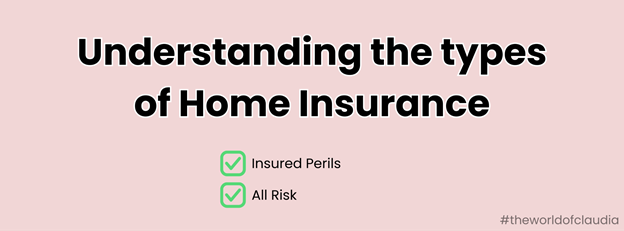
Home insurance generally falls into two categories: “Insured Perils” and “All Risk”. As their names suggest, insured perils refer to specific events listed in the policy, such as fire, lightning, explosions, burst pipes, theft involving forced entry, and certain natural disasters. Any damage that does not arise from the events explicitly stated in the policy will not be covered.
All risk plans, on the other hand, offer wider protection. They generally cover most scenarios unless specifically excluded in the policy terms. Due to the wider scope of coverage, all risk plans typically come with higher premiums.

Beyond the type of coverage, it is also important to understand how claims are calculated. Home insurance policies typically fall under either an “Average Clause” or “First Loss” basis. For example, under the Average Clause, if the contents of your home amount to more than the insurance coverage, your claims may be proportionately reduced. In other words, being underinsured can result in lower claim settlements.
With first loss plans, this penalty does not apply. The insurer will pay up to the insured amount stated in the policy, regardless of the total value of home contents.

In summary, fire insurance ensures that the bare minimum is covered, while home insurance helps reduce financial strain when unforeseen incidents occur. As with all protection planning, the key lies in understanding what coverage you currently have, what it includes, and whether it still suits your needs.
As you start 2026 on a positive note, it may be helpful to ask yourself:
- Do I know what my existing fire insurance covers?
- Do I have adequate protection for my home contents?
- Would taking up home insurance give me peace of mind?
Protection planning is about making thoughtful decisions early, so that you are better equipped for whatever lies ahead. If you are unsure where to begin or would like a second opinion, we are always happy to help. Sometimes, a simple review can make all the difference. Wishing you a happy, healthy, and prosperous year ahead.
Contributor:

Claudia Tan
Financial Services Director
Phillip Securities Pte Ltd (A member of PhillipCapital)
https://bit.ly/TTPclaudia
Disclaimer
These commentaries are intended for general circulation and do not have regard to the specific investment objectives, financial situation and particular needs of any person. Accordingly, no warranty whatsoever is given and no liability whatsoever is accepted for any loss arising whether directly or indirectly as a result of any person acting based on this information. You should seek advice from a financial adviser regarding the suitability of any investment product(s) mentioned herein, taking into account your specific investment objectives, financial situation or particular needs, before making a commitment to invest in such products.
Opinions expressed in these commentaries are subject to change without notice. Investments are subject to investment risks including the possible loss of the principal amount invested. The value of units in any fund and the income from them may fall as well as rise. Past performance figures as well as any projection or forecast used in these commentaries are not necessarily indicative of future or likely performance.
Phillip Securities Pte Ltd (PSPL), its directors, connected persons or employees may from time to time have an interest in the financial instruments mentioned in these commentaries.
The information contained in these commentaries has been obtained from public sources which PSPL has no reason to believe are unreliable and any analysis, forecasts, projections, expectations and opinions (collectively the “Research”) contained in these commentaries are based on such information and are expressions of belief only. PSPL has not verified this information and no representation or warranty, express or implied, is made that such information or Research is accurate, complete or verified or should be relied upon as such. Any such information or Research contained in these commentaries are subject to change, and PSPL shall not have any responsibility to maintain the information or Research made available or to supply any corrections, updates or releases in connection therewith. In no event will PSPL be liable for any special, indirect, incidental or consequential damages which may be incurred from the use of the information or Research made available, even if it has been advised of the possibility of such damages. The companies and their employees mentioned in these commentaries cannot be held liable for any errors, inaccuracies and/or omissions howsoever caused. Any opinion or advice herein is made on a general basis and is subject to change without notice. The information provided in these commentaries may contain optimistic statements regarding future events or future financial performance of countries, markets or companies. You must make your own financial assessment of the relevance, accuracy and adequacy of the information provided in these commentaries.
Views and any strategies described in these commentaries may not be suitable for all investors. Opinions expressed herein may differ from the opinions expressed by other units of PSPL or its connected persons and associates. Any reference to or discussion of investment products or commodities in these commentaries is purely for illustrative purposes only and must not be construed as a recommendation, an offer or solicitation for the subscription, purchase or sale of the investment products or commodities mentioned.
This advertisement has not been reviewed by the Monetary Authority of Singapore.
About the author
Claudia Tan
Financial Services Director
Claudia is an award-winning Financial Services Director with over 20 years of practical experience in the Financial Advisory industry. She is currently managing a team and servicing a group of clients by providing solutions, like Stock and Unit Trusts investment. As a veteran in the financial industry, Claudia has also published multiple wealth advisory articles.
Equipped with qualifications from the Society of Trust and Estate Practitioners, Claudia is constantly helping her clients to look beyond legacy planning. Her knowledge and experience have helped many understand the importance of wealth management and the need for financial planning at every stage of life, providing a sense of financial security that lasts even beyond their current generation.
 Before the Year Ends: Key Financial Steps for a Confident 2026
  The ILP Debate: Why Singaporeans Struggle With Financial Product Decisions
  Mooncakes: The Hidden Environmental Cost of Gifting
  Why Idle Cash Attracts Scammers & How to Beat Them