

“We have only just begun this buildout.”
Those were the words of NVIDIA CEO Jensen Huang when describing the artificial intelligence (AI) revolution. Huang recently referred to AI as the “largest infrastructure buildout in human history”, arguing that trillions of dollars of investment will be required before the full potential of AI can be realised.
While investors often focus on AI applications such as ChatGPT, autonomous agents, and generative content, the more immediate investment opportunity may lie beneath the surface—in the infrastructure powering these technologies.
Just as the internet required data centres, fibre networks and cloud computing platforms, AI requires unprecedented amounts of computing power, memory, storage and networking capacity. Every AI model trained and every AI query processed relies on a vast ecosystem of hardware providers operating behind the scenes.
AI’s Unsung Hero: Memory
One company increasingly attracting investor attention is Micron Technology.
While NVIDIA’s GPUs often dominate headlines, advanced memory has become one of the most critical components within AI systems. High Bandwidth Memory (HBM) allows AI accelerators to process enormous volumes of data at the speeds required by modern AI workloads.
Micron’s recent results highlight the strength of this trend. The company reported record revenue, earnings and cash flow, driven by robust AI-related demand and tight industry supply conditions. Management noted that AI demand continues to support strong growth across its memory business.
Analysts have also pointed to HBM as a major growth driver, with demand from hyperscale data centres creating a structural shift in the memory market. Consensus expectations for Micron’s HBM revenue have been revised sharply higher as AI infrastructure spending accelerates globally.
Beyond NVIDIA: The Broader AI Ecosystem
The AI investment theme extends well beyond a handful of technology giants.
Investors are increasingly exploring opportunities across the entire AI value chain, including semiconductor manufacturers, memory suppliers, networking providers, cloud infrastructure companies and data-centre operators.
Recent industry commentary suggests that AI-related spending remains resilient despite periodic market volatility. Memory demand, in particular, continues to benefit from the rapid expansion of AI training and inference workloads. Some analysts have even described the current environment as the early stages of a semiconductor “supercycle” driven by AI infrastructure investment.
Accessing AI Opportunities Through US Markets
Many of the world’s leading AI companies are listed in the United States, making US equities a key destination for investors seeking exposure to this transformative trend.
With US Zero Commission Trading with POEMS Cash Plus Account, investors can access a wide range of AI-related opportunities across the US market while reducing transaction costs. Whether investing in established industry leaders or emerging beneficiaries of the AI infrastructure buildout, lower trading costs can help investors participate more efficiently in long-term growth themes.
The AI revolution is changing the world as we know it. As Jensen Huang said that “It is a foregone conclusion that AI will be infrastructure for the world, just like the Internet was infrastructure for the world.”
FAQ
1. Is AI taking a breather, or something bigger?
On Wednesday 10th June 2026 morning (SG time), US indexes after close:
- Nasdaq slipped -1%
- S&P slipped -0.3%
- DOW gained +0.2%
- A clear sector rotation is occurring, with AI and AI-linked sectors pulling back after record breaking rallies; as concerns around overextended AI valuations, geopolitical escalations and rising rate odds weighed on expectations.
- The Dow which represents the “old” economy and blue chips stocks, including financials, real estate, consumer goods, healthcare, ended up higher compared with the tech-dominant Nasdaq and cap weighted S&P 500 (as seen below).
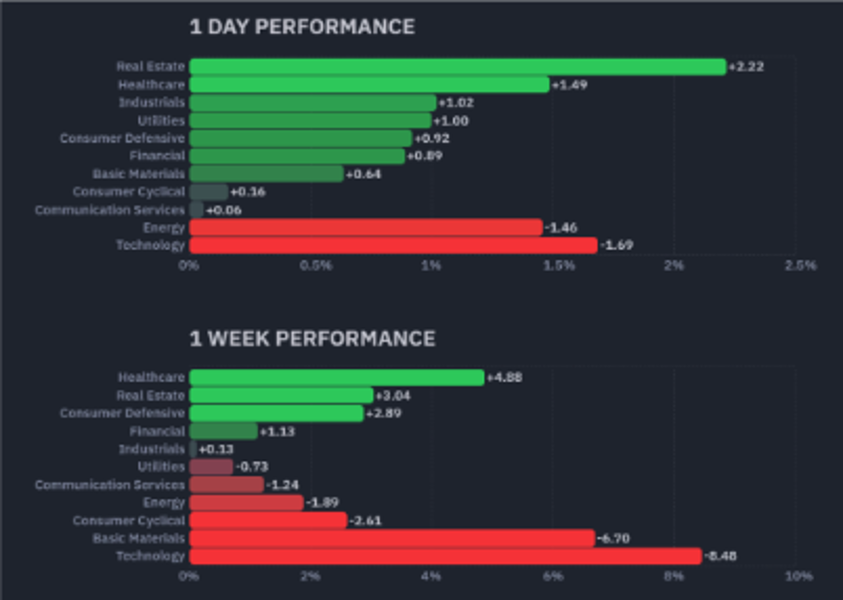 Figure 1: Daily and weekly performances of the 11 Sectors in the US as of 10th June 2026 (Wednesday)
https://finviz.com/groups
2. Tech in danger zone?
As at 9th June 2026, the daily chart of the Tech sector ETF (XLK) relative to the SPDR S&P 500 ETF Trust SPY has suffered a sharp fall to its 20-day EMA support area (red dotted line). A clear underperformance against S&P 500.
Key support area remains the orange line of 0.2422, which was its previous resistance.If sell off pressures were to persist, the XLK/SPY ratio could fall to the green support area of 0.2338. A breakdown below that support would invalidate the bullish momentum that pushed the XLK to parabolic highs.
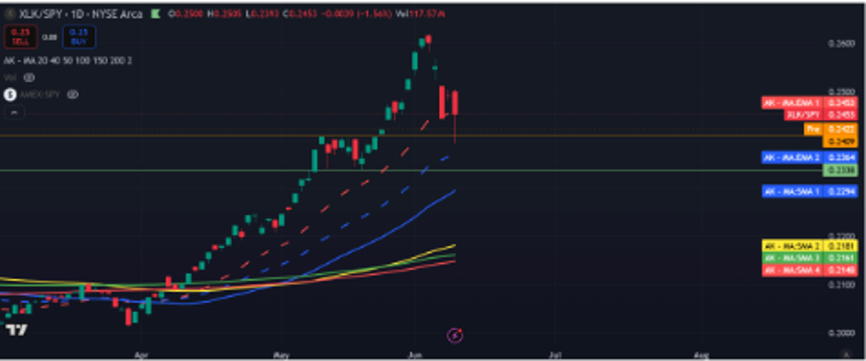
From a momentum point of view, XLK has still outperformed the S&P 500 index YTD, with prices above key moving averages. But recent price action seems to suggest that its lead may be narrowing as the rest of the laggards play catch up. Watch out for the key support levels, with 0.2338 serving as an important level, represented by the green line.
Alternatives sector plays
Healthcare (XLV)
- The big laggard of 2025, is it finally playing catch-up in 2026?
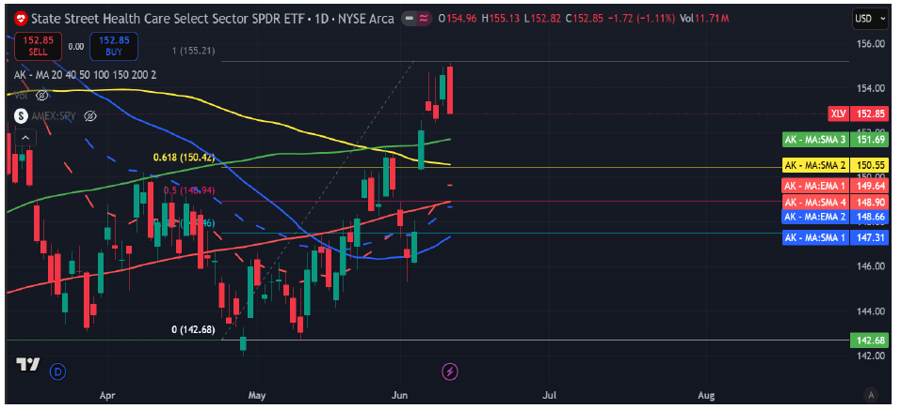
- From a technical point of view, XLV has restored bullish momentum in the short term, as the 20-day Exponential Moving Average crosses above 40-day Exponential Moving Average, supported by decisive breakouts above several key resistance levels.
- Its current rally represents a significant turnaround from the weakness seen earlier in 2026, with the April low serving as a key support area
- The bullish rally will set to continue if prices can break above the key resistance area of US$155, represented by the white line.
Real Estate (XLRE)
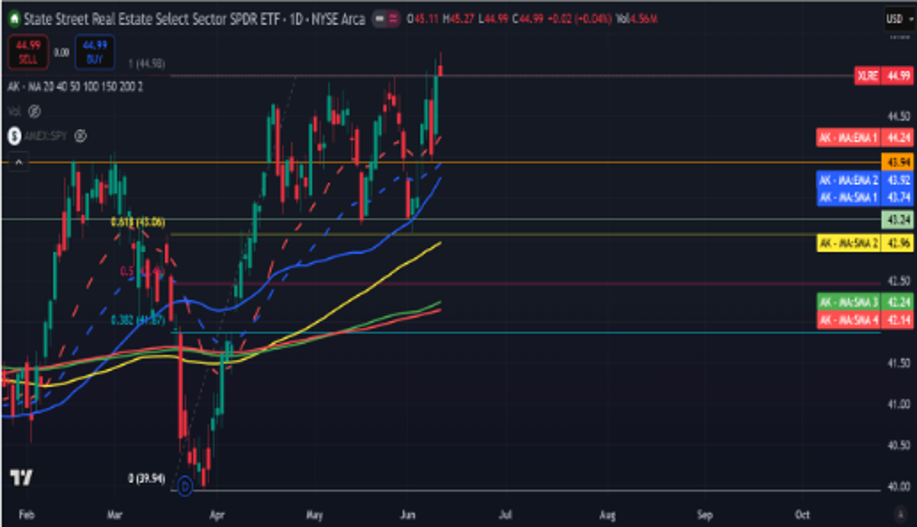
- Price action is bullish in the short term, with 20-day Exponential Moving Average, represented by thered dotted line crosses above 40-dayExponential Moving Average, represented by the blue dotted.
- Coupled with a decisive break above the former resistance at US$43 (orange line). That resistance area has transformed into a key support area through a classic resistance to support reversal.
- The key resistance area to watch would be US$45, represented by the white line, the swing high within the Fibonacci retracement. Price action seems poised for another leg up if there is a break above, after some range bound trading from April to May.
Disclaimer
These commentaries are intended for general circulation and do not have regard to the specific investment objectives, financial situation and particular needs of any person. Accordingly, no warranty whatsoever is given and no liability whatsoever is accepted for any loss arising whether directly or indirectly as a result of any person acting based on this information. You should seek advice from a financial adviser regarding the suitability of any investment product(s) mentioned herein, taking into account your specific investment objectives, financial situation or particular needs, before making a commitment to invest in such products.
Opinions expressed in these commentaries are subject to change without notice. Investments are subject to investment risks including the possible loss of the principal amount invested. The value of units in any fund and the income from them may fall as well as rise. Past performance figures as well as any projection or forecast used in these commentaries are not necessarily indicative of future or likely performance.
Phillip Securities Pte Ltd (PSPL), its directors, connected persons or employees may from time to time have an interest in the financial instruments mentioned in these commentaries.
The information contained in these commentaries has been obtained from public sources which PSPL has no reason to believe are unreliable and any analysis, forecasts, projections, expectations and opinions (collectively the “Research”) contained in these commentaries are based on such information and are expressions of belief only. PSPL has not verified this information and no representation or warranty, express or implied, is made that such information or Research is accurate, complete or verified or should be relied upon as such. Any such information or Research contained in these commentaries are subject to change, and PSPL shall not have any responsibility to maintain the information or Research made available or to supply any corrections, updates or releases in connection therewith. In no event will PSPL be liable for any special, indirect, incidental or consequential damages which may be incurred from the use of the information or Research made available, even if it has been advised of the possibility of such damages. The companies and their employees mentioned in these commentaries cannot be held liable for any errors, inaccuracies and/or omissions howsoever caused. Any opinion or advice herein is made on a general basis and is subject to change without notice. The information provided in these commentaries may contain optimistic statements regarding future events or future financial performance of countries, markets or companies. You must make your own financial assessment of the relevance, accuracy and adequacy of the information provided in these commentaries.
Views and any strategies described in these commentaries may not be suitable for all investors. Opinions expressed herein may differ from the opinions expressed by other units of PSPL or its connected persons and associates. Any reference to or discussion of investment products or commodities in these commentaries is purely for illustrative purposes only and must not be construed as a recommendation, an offer or solicitation for the subscription, purchase or sale of the investment products or commodities mentioned.
This advertisement has not been reviewed by the Monetary Authority of Singapore.