US-Domiciled ETFs Vs Ireland-Domiciled (UCITS) ETFs: Which Is Better For Singapore Investors? July 24, 2026

Why Your Dividend Looks Smaller Than Expected

Imagine checking your brokerage account after a dividend payment and noticing that the amount is lower than you expected. It’s a common moment of confusion for new ETF investors, and the usual suspects — fund fees or weak performance — are rarely the real cause.
In reality, one of the biggest and most overlooked factors is withholding tax, and specifically, where the ETF you hold is domiciled.
For Singapore investors building exposure to the S&P 500, the Nasdaq 100, or global equities, understanding ETF domicile can meaningfully improve long-term, after-tax returns, without taking on any additional investment risk. This article looks at what domicile actually means, why Ireland-domiciled funds have become the default choice for so many non-US investors, how the dividend withholding tax math plays out in practice, and where a US-domiciled ETF might still make more sense.
What Is ETF Domicile?

ETF domicile refers to the country in which a fund is legally registered and regulated. It is a separate question from which market or index the ETF actually tracks — a fund can be domiciled in one country while investing entirely in the stocks of another.
Here’s a simple illustration using a few common S&P 500 ETFs:
| ETF | Domicile |
| VOO | United States |
| IVV | United States |
| CSPX | Ireland |
| VUAA | Ireland |
Although CSPX and VOO both track the same S&P 500 Index, they are legally structured in different jurisdictions and operate under different regulatory regimes. That difference quietly shapes how dividends are taxed before they reach you, whether dividends are paid out or reinvested automatically and which regulator oversees the fund.
Why Ireland-Domiciled ETFs Are Popular With Singapore Investors

Same Markets, Different Wrapper
Ireland-domiciled ETFs can give exposure to the same underlying markets as their US counterparts, including the S&P 500, the Nasdaq 100, the MSCI World Index, emerging markets, and global bonds. Choosing an Ireland-domiciled fund over a US-domiciled one isn’t about giving up market access — you still own, indirectly, the same underlying companies. The difference lies mainly in the legal and tax structure wrapped around that exposure.
UCITS: A Recognised Investor-Protection Framework
Most Ireland-domiciled ETFs are structured as UCITS funds, short for Undertakings for Collective Investment in Transferable Securities — a European Union framework that governs how retail investment funds are run. It covers areas such as diversification limits, which prevent a fund from taking outsized exposure to a single issuer; transparency standards that include daily portfolio disclosure for most ETFs; independent custody of fund assets; and oversight by an EU regulator. For Ireland-domiciled funds, this regulator is the Central Bank of Ireland.
Because of this, UCITS funds are widely regarded as among the most heavily regulated retail investment products available anywhere in the world. This is part of why they’re distributed so widely outside Europe, including across Asia, the Middle East and Latin America.
The Real Cost: Dividend Withholding Tax

This is usually the single biggest factor in the US-versus-Ireland decision — bigger, in dollar terms, than the small gap in expense ratios that most investors fixate on.
How US-Domiciled ETFs Are Taxed
When a US-domiciled ETF pays a dividend to a non-US investor, the Internal Revenue Service (IRS) withholds tax at source. The default rate is 30%, and this applies in full unless the investor’s home country has a tax treaty with the US that lowers it. Singapore does not have such a treaty for individual investors, so Singapore-based holders of US-domiciled ETFs generally face the full 30% rate on US-source dividends.
| Dividend Received | Withholding Tax (30%) | Investor Receives |
| US$100 | US$30 | US$70 |
How Ireland-Domiciled ETFs Are Taxed
US companies held inside an Ireland-domiciled ETF still pay dividends as usual, and the US still withholds tax before that money reaches the fund. But under the US-Ireland double taxation treaty, the rate applied at fund level drops from 30% to 15%. Ireland itself does not generally add additional withholding tax, whether the fund pays that income out or reinvests it.
| Dividend Received | Withholding Tax (15%) | Fund Retains |
| US$100 | US$15 | US$85 |
Why This Matters More Than the Expense Ratio
Many investors compare ETFs purely by expense ratio, often a gap of just 0.03% to 0.07%, or a few basis points. The withholding tax gap, however, is 15 percentage points on every dollar of US-sourced dividend income. This is usually a far bigger drag in absolute terms once a fund has a meaningful yield.
Suppose you hold US$50,000 in an S&P 500-tracking ETF yielding around 1.3% a year in dividends, or about US$650 in annual dividend income. On a US-domiciled ETF, withholding tax takes roughly US$195 of that. On an Ireland-domiciled fund, it takes about US$97.50. That’s roughly US$97.50 a year staying inside your investment instead of going to the US Treasury — money that, left alone, keeps compounding.
Case Study: IVV vs CSPX

IVV and CSPX make a useful pair to compare directly, since both are run by the same issuer (BlackRock/iShares) and both track the same index — the S&P 500. However, they differ in the key areas affected by the ETF domicile.
| IVV | CSPX | |
| Domicile | United States | Ireland |
| Tracks | S&P 500 | S&P 500 |
| Expense Ratio (TER) | 0.03% | 0.07% |
| US Dividend Withholding Tax | 30% | 15% |
| Dividend Handling | Distributing | Accumulating |
Despite tracking an identical index, CSPX’s lower withholding-tax drag and automatic reinvestment of dividends mean a larger share of the underlying return stays inside the fund, year after year.
Illustrating the Compounding Effect
To isolate just the withholding-tax effect, assume US$50,000 is invested, with a constant 1.3% dividend yield reinvested each year, and identical price returns for both funds, since they track the same index. The only difference is the amount of after-tax dividend reinvested.
| Holding Period | US-Domiciled (IVV) | Ireland-Domiciled (CSPX) | Difference |
| 10 years | ≈ US$54,740 | ≈ US$55,810 | ≈ US$1,070 |
| 20 years | ≈ US$59,930 | ≈ US$62,290 | ≈ US$2,360 |
| 30 years | ≈ US$65,610 | ≈ US$69,530 | ≈ US$3,910 |
Illustrative only. Assumes a constant 1.3% dividend yield, reinvested annually, with the withholding-tax effect isolated from price returns (which are excluded since both funds track the same index). Actual yields, tax treatment, and returns will vary, and this is not a forecast of future performance.
Accumulating vs Distributing ETFs

It’s easy to mix up an ETF’s domicile with a dividend policy, even though they’re two separate decisions. Domicile determines the tax treatment; accumulating versus distributing determines whether dividends are paid out in cash or reinvested automatically inside the fund. Most US-domiciled ETFs distribute by default, since US fund rules generally require regulated investment companies to pass through most of their income. Ireland-domiciled UCITS funds, by contrast, commonly offer both accumulating and distributing share classes side by side.
Accumulating (Acc) funds reinvest dividends automatically inside the fund, which suits hands-off investors focused on long-term compounding. CSPX, VUAA, SWRD, CNDX and EIMI all fall into this category.
Distributing (Dist) funds pay dividends out in cash, which suits income-focused investors who want regular payouts. VUSA, IUSA and VWRD are examples.
One nuance worth flagging: choosing an accumulating share class does not avoid withholding tax. The 15% or 30% withholding tax is still deducted before the dividend is reinvested or paid out — “Acc” only changes what happens to the money afterwards, not whether tax was withheld in the first place.
Popular Ireland-Domiciled ETFs for Singapore Investors

A few of the more widely held Ireland-domiciled UCITS ETFs, grouped by the exposure they offer:
| Exposure | Ticker | Fund | Dividend Treatment |
| S&P 500 | CSPX | iShares Core S&P 500 UCITS ETF | Accumulating |
| S&P 500 | VUAA | Vanguard S&P 500 UCITS ETF (USD) Acc | Accumulating |
| S&P 500 | VUSA | Vanguard S&P 500 UCITS ETF | Distributing |
| Nasdaq 100 | CNDX | iShares Nasdaq 100 UCITS ETF | Accumulating |
| Global Equity (MSCI World) | SWRD | SPDR MSCI World UCITS ETF | Accumulating |
| Emerging Markets (MSCI EM IMI) | EIMI | iShares Core MSCI EM IMI UCITS ETF | Accumulating |
All the funds above are domiciled in Ireland and generally benefit from the 15% US dividend withholding rate described earlier. Fund details and fees can change, so it’s worth checking the current factsheet and Key Information Document before investing in any of them.
Trade-Offs Worth Weighing

Ireland-domiciled ETFs aren’t automatically the right call in every situation. CSPX and VUAA charge around 0.07%, compared with 0.03% for IVV or VOO — a roughly four-basis-point gap that, for most investors with real US dividend exposure, is outweighed by the 15-percentage-point withholding tax saving, though it’s worth checking against one’s own portfolio size and yield.
The largest Ireland-domiciled funds, like CSPX, are highly liquid. However, smaller or newer UCITS ETFs can trade with wider bid-ask spreads than the largest US ETFs, where market depth is hard to beat.
Currency is another factor: Ireland-domiciled ETFs are listed on European or UK exchanges and can be traded in USD, GBP or EUR depending on the listing, so it’s worth checking your broker’s FX conversion fees, which can offset some of the tax savings if you trade often.
The US market also still has the deepest range of niche, sector, factor, and leveraged or inverse ETFs; UCITS equivalents exist for many core strategies but are more limited at the margins.
Common Questions From Singapore Investors

Do Singapore investors pay tax on US ETF dividends? Yes, generally — the US withholds 30% from dividends paid to Singapore-based investors holding US-domiciled ETFs, since Singapore does not have a tax treaty with the US that lowers this rate for individuals.
Is CSPX automatically better than VOO for a Singapore investor? Not automatically. CSPX typically results in lower total tax drag; however, it comes at the cost of a slightly higher expense ratio. For most Singapore-based retail investors who aren’t US persons, the Ireland-domiciled option tends to be more tax-efficient, but liquidity, listing currency, and your broker’s fee structure are also worth comparing.
Does “accumulating” mean the dividend escapes tax? No. Withholding tax is still deducted before reinvestment — accumulating funds simply removes the need to manually reinvest your payouts.
Does Singapore tax capital gains on ETF investments? No. Singapore does not levy capital gains tax on individual investors, which is largely why this comparison focuses on dividend tax efficiency rather than capital gains.
The Bottom Line

There’s no single answer that applies to every investor. The right call depends on how much of your portfolio is invested in US dividend-paying assets, how large your US-situs holdings might grow over time, your citizenship status, and how much weight you place on cost versus tax efficiency.
As a general rule of thumb, most Singapore-based investors who aren’t US persons and are building meaningful long-term exposure to US or global equities tend to come out ahead, after tax, with an Ireland-domiciled UCITS ETF rather than its US-domiciled equivalent — without giving up access to the same underlying markets.
Trade Global Markets, Including London, With POEMS
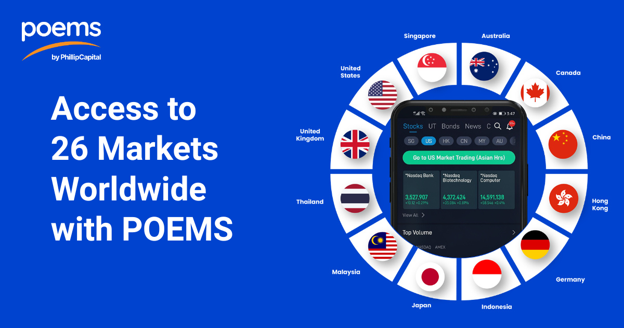
Once you’ve decided which domicile suits you, the next step is execution. Several Ireland-domiciled ETFs, including CSPX, VUAA, SWRD and CNDX, are listed on the London Stock Exchange (LSE) alongside their European listings.
POEMS, Phillip Securities’ trading platform, gives Singapore investors access to dozens of global exchanges — including the LSE, Singapore Stock Exchange (SGX), New York Stock Exchange (NYSE), NASDAQ and the Hong Kong Stock Exchange (HKEX) — through a single account, so you can manage your core Singapore portfolio and your global ETF exposure in one place.
Trading hours and commission rates vary by market and change from time to time, so check the latest rates and hours on the POEMS website, or speak with a Trading Representative, before placing your first trade on the London market.
References
- [1] IRS — NRA Withholding (statutory 30% rate on US-source income to foreign persons) — https://financialhorse.com/is-dca-the-best-way-to-buy-stocks/
- [2]IRAS — Gains from Sale of Property, Shares and Financial Instruments —https://www.iras.gov.sg/taxes/individual-income-tax/basics-of-individual-income-tax/what-is-taxable-what-is-not/gains-from-sale-of-property-shares-and-financial-instruments
- [3]iShares (BlackRock) — Core S&P 500 UCITS ETF (CSPX) fund page —https://www.ishares.com/uk/individual/en/products/253743/ishares-sp-500-b-ucits-etf-acc-fund
- [4]iShares (BlackRock) — Core S&P 500 ETF (IVV) fund page —https://www.ishares.com/us/products/239726/ishares-core-sp-500-etf
- [5]justETF — Vanguard S&P 500 UCITS ETF (USD) Accumulating (VUAA) fund profile — https://www.justetf.com/en/etf-profile.html?isin=IE00BFMXXD54
- [6]Bogleheads Wiki — Nonresident Alien Investors and Ireland Domiciled ETFs —https://www.bogleheads.org/wiki/Nonresident_alien_investors_and_Ireland_domiciled_ETFs
- [7]POEMS — London Stock Exchange (LSE) Market Access —https://www.poems.com.sg/markets/united-kingdom-lse/
Disclaimer
These commentaries are intended for general circulation and do not have regard to the specific investment objectives, financial situation and particular needs of any person. Accordingly, no warranty whatsoever is given and no liability whatsoever is accepted for any loss arising whether directly or indirectly as a result of any person acting based on this information. You should seek advice from a financial adviser regarding the suitability of any investment product(s) mentioned herein, taking into account your specific investment objectives, financial situation or particular needs, before making a commitment to invest in such products.
Opinions expressed in these commentaries are subject to change without notice. Investments are subject to investment risks including the possible loss of the principal amount invested. The value of units in any fund and the income from them may fall as well as rise. Past performance figures as well as any projection or forecast used in these commentaries are not necessarily indicative of future or likely performance.
Phillip Securities Pte Ltd (PSPL), its directors, connected persons or employees may from time to time have an interest in the financial instruments mentioned in these commentaries.
The information contained in these commentaries has been obtained from public sources which PSPL has no reason to believe are unreliable and any analysis, forecasts, projections, expectations and opinions (collectively the “Research”) contained in these commentaries are based on such information and are expressions of belief only. PSPL has not verified this information and no representation or warranty, express or implied, is made that such information or Research is accurate, complete or verified or should be relied upon as such. Any such information or Research contained in these commentaries are subject to change, and PSPL shall not have any responsibility to maintain the information or Research made available or to supply any corrections, updates or releases in connection therewith. In no event will PSPL be liable for any special, indirect, incidental or consequential damages which may be incurred from the use of the information or Research made available, even if it has been advised of the possibility of such damages. The companies and their employees mentioned in these commentaries cannot be held liable for any errors, inaccuracies and/or omissions howsoever caused. Any opinion or advice herein is made on a general basis and is subject to change without notice. The information provided in these commentaries may contain optimistic statements regarding future events or future financial performance of countries, markets or companies. You must make your own financial assessment of the relevance, accuracy and adequacy of the information provided in these commentaries.
Views and any strategies described in these commentaries may not be suitable for all investors. Opinions expressed herein may differ from the opinions expressed by other units of PSPL or its connected persons and associates. Any reference to or discussion of investment products or commodities in these commentaries is purely for illustrative purposes only and must not be construed as a recommendation, an offer or solicitation for the subscription, purchase or sale of the investment products or commodities mentioned.
This advertisement has not been reviewed by the Monetary Authority of Singapore.
About the author
Low Wee Ming
Wee Ming is a Global Markets Dealer specializing in U.S., European, and Asian markets. He has passed CFA Level II and earned the CFA Institute Sustainable Investing Certificate. He is passionate about ETF investing, strategic asset allocation, and global macroeconomic trends.
 ETF Monthly Review: Mixed September Performance with Muted October Outlook Expected
  Investing in the AI Revolution: A Guide to Semiconductor & Ecosystem ETFs
  Phillip SING Income ETF Reaches All-Time High Dividend with Banking Sector Focus
  Understanding Emerging Markets ETFs