
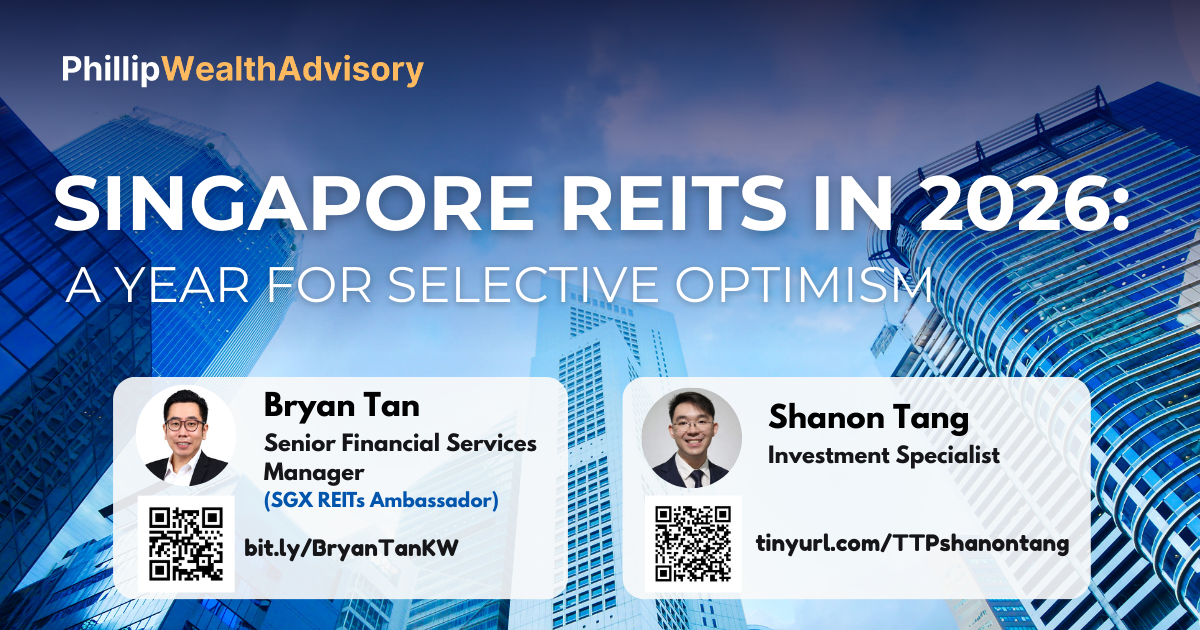
As Singapore’s interest rate environment stabilises, many investors are revisiting S-REITs as a source of income. Here’s what to consider in 2026.
Singapore Real Estate Investment Trusts (S-REITs) enter 2026 at an important crossroads. After several years of volatility driven by rising interest rates, inflation, and global economic uncertainty, the sector is now moving into a more “normalised” phase.
While conditions appear more supportive than in recent years, challenges have not disappeared. For income-focused investors, 2026 offers reasons for cautious optimism — but it also calls for greater selectivity and discipline.
1. Easing Interest Rate Pressure
One of the biggest headwinds for S-REITs in recent years has been the sharp rise in borrowing costs. Because REITs rely on debt to acquire and manage properties, higher interest rates directly reduce profitability.
By 2026, interest rates have largely stabilised and, in some cases, moderated from their peaks. This shift provides several benefits for the sector. REITs refinancing maturing loans may be able to secure more manageable borrowing costs, helping to reduce interest expenses. Lower financing costs can in turn support stronger distributable income, contributing to a more stable Distribution Per Unit (DPU) for investors.
At the same time, the stabilisation of rates may improve the yield spread between S-REITs and other income-generating instruments such as bonds and fixed deposits, making REITs relatively more attractive for income-focused investors.
REITs with well-staggered debt maturity profiles and a higher proportion of fixed-rate borrowings are likely to benefit the most, as they are less exposed to sudden refinancing pressures.
2. Resilient Underlying Property Fundamentals
Despite broader macroeconomic uncertainty, many S-REIT sub-sectors have demonstrated resilience.
Industrial and logistics REITs, for instance, continue to benefit from long-term themes such as the growth of e-commerce, supply chain diversification and the increasing need for data infrastructure. These trends have helped sustain demand for modern logistics facilities and high-quality industrial spaces.
Retail REITs, particularly those focused on suburban Singapore malls, have also shown stability. Supported by domestic consumption and neighbourhood spending patterns, these malls have maintained relatively steady footfall and tenant sales even amid broader economic fluctuations.
Meanwhile, healthcare and data centre REITs are often viewed as more defensive segments within the S-REIT universe. Healthcare properties benefit from long-term demographic trends such as ageing populations, while data centres are supported by the rapid growth of digitalisation and cloud computing.
Across many major S-REITs, occupancy rates remain relatively high. Stable occupancy supports rental income visibility, which is critical for maintaining consistent distributions to investors.
3. Attractive Income for Long-Term Investors
In 2026, S-REIT dividend yields remain relatively appealing, especially for investors prioritising steady income.
Dividend yields across many REITs continue to exceed prevailing inflation rates, allowing investors to maintain real income returns. At the same time, rental income from property portfolios tends to provide more predictable cash flows compared with cyclical equities, making REITs a popular component of income-focused investment strategies.
Singapore’s well-established regulatory framework for REITs also provides a degree of transparency and investor protection, which has contributed to the sector’s credibility among both local and international investors.
For long-term investors, reinvesting distributions can meaningfully enhance total returns through compounding, particularly when units are accumulated during periods of market weakness.
4. Strong Governance and Transparency
Singapore remains one of the most established and trusted REIT markets globally. Its regulatory framework provides a strong foundation for investor protection and contributes to the sector’s long-standing credibility among both local and international investors.
The market is supported by clear and consistent disclosure standards, allowing investors to evaluate REIT performance with greater transparency. In addition, regulatory limits on leverage help ensure that balance sheets remain relatively conservative compared with many global property markets.
Another key strength lies in the experience of REIT managers, many of whom are backed by reputable property sponsors with established track records in property development and asset management. This alignment between sponsors, managers and investors often supports disciplined capital management and long-term asset value creation.
Together, these governance standards help reduce the likelihood of excessive risk-taking while providing investors with greater visibility over financial performance, portfolio quality and balance sheet strength.
The Risks and Challenges for Singapore REITs in 2026
While the outlook is improving, investors should remain mindful of the potential risks that could affect the sector.
1. Interest Rates Remain a Key Variable
Although interest rates have stabilised, they remain higher than the ultra-low levels seen before 2022. As a result, borrowing costs across the sector are still elevated compared with historical norms.
For REITs that rely on debt financing to acquire and manage properties, this environment continues to present challenges. Highly leveraged REITs may face refinancing pressures as loans mature, particularly if they need to refinance at rates that remain significantly higher than those secured in previous years.
In addition, any resurgence in inflation or renewed global instability could delay further rate cuts by major central banks. Such developments may prolong the higher interest rate environment, placing additional pressure on REITs with weaker balance sheets or thinner interest coverage ratios. In these cases, the ability to sustain or grow distributions may remain constrained.
2. Sector-Specific Structural Challenges
Investors should also recognise that not all REIT segments share the same outlook. Treating S-REITs as a single homogeneous asset class may overlook important differences in sector dynamics.
Office REITs, for example, continue to face uncertainty as hybrid work arrangements reshape long-term office demand. In some markets, slower leasing activity and rising vacancy levels may weigh on rental growth. Hospitality REITs remain closely tied to tourism cycles and global travel patterns, making them more sensitive to economic slowdowns and fluctuations in visitor arrivals. Retail REITs operating in weaker locations may also face structural challenges from the continued rise of e-commerce and evolving consumer habits, which could affect tenant demand and rental growth.
As a result, performance divergence across S-REIT sub-sectors may widen in 2026, reinforcing the importance of careful selection when constructing a REIT portfolio.
3. Limited Short-Term Capital Upside
While income prospects for S-REITs are stabilising, capital appreciation may remain more moderate in the near term.
Property valuations continue to be sensitive to interest rates and discount rates, meaning that changes in the broader monetary environment could still influence asset values. At the same time, REIT unit prices may experience volatility alongside wider equity markets, particularly during periods of heightened macroeconomic uncertainty.
In addition, growth through acquisitions may become more measured. With borrowing costs still relatively elevated, many REIT managers are likely to adopt a more disciplined approach to capital allocation, focusing on balance sheet stability rather than aggressive expansion.
As a result, S-REITs in 2026 may be more attractive as a source of stable income rather than a vehicle for rapid capital appreciation.
4. Currency and Overseas Exposure Risks
Many S-REITs also hold overseas assets in markets such as the United States, Europe and Australia. While geographic diversification can enhance growth opportunities, it also introduces additional risks. Currency fluctuations may affect earnings and distributions when overseas income is translated back into Singapore dollars. In addition, REITs with international portfolios must navigate varying regulatory environments, economic conditions and property cycles across different regions.
These factors can introduce an additional layer of complexity and potential volatility. REITs that do not actively hedge their currency exposure may experience greater fluctuations in earnings and distributions.
What Investors Should Focus on in 2026
Given both the opportunities and risks within the sector, investors may benefit from focusing more closely on underlying fundamentals rather than simply chasing headline yields.
In particular, balance sheet strength remains a critical consideration. Metrics such as gearing levels and interest coverage ratios can provide insight into a REIT’s financial resilience. Investors may also want to examine debt maturity profiles and refinancing schedules to understand potential exposure to future interest rate movements.
Beyond financial metrics, the quality of underlying assets and their strategic locations play an important role in long-term performance. REITs supported by strong sponsors and experienced management teams may also demonstrate greater ability to navigate changing market conditions. Finally, factors such as lease expiry profiles and rental reversion trends can offer important clues about future income stability.
In a normalising market environment, quality and financial discipline may matter more than simply pursuing the highest dividend yield.
Conclusion: A Year for Selective Optimism
Singapore REITs in 2026 present a balanced risk-reward profile. The sharp interest-rate shock of previous years appears to have eased, and income visibility is improving.
However, structural shifts in certain sectors, refinancing risks, and global uncertainties mean investors must remain selective.
For those seeking steady income with moderate risk — and who are prepared to focus on high-quality REITs with strong balance sheets — S-REITs can continue to play a meaningful role in a diversified portfolio in 2026.
Contributors:

Bryan Tan
Senior Financial Services Manager (SGX REITs ambassador)
Phillip Securities Pte Ltd (A member of PhillipCapital)
http://bit.ly/BryanTanKW

Shanon Tang
Investment Specialist
Phillip Securities Pte Ltd (A member of PhillipCapital)
tinyurl.com/TTPshanontang
Disclaimer
These commentaries are intended for general circulation and do not have regard to the specific investment objectives, financial situation and particular needs of any person. Accordingly, no warranty whatsoever is given and no liability whatsoever is accepted for any loss arising whether directly or indirectly as a result of any person acting based on this information. You should seek advice from a financial adviser regarding the suitability of any investment product(s) mentioned herein, taking into account your specific investment objectives, financial situation or particular needs, before making a commitment to invest in such products.
Opinions expressed in these commentaries are subject to change without notice. Investments are subject to investment risks including the possible loss of the principal amount invested. The value of units in any fund and the income from them may fall as well as rise. Past performance figures as well as any projection or forecast used in these commentaries are not necessarily indicative of future or likely performance.
Phillip Securities Pte Ltd (PSPL), its directors, connected persons or employees may from time to time have an interest in the financial instruments mentioned in these commentaries.
The information contained in these commentaries has been obtained from public sources which PSPL has no reason to believe are unreliable and any analysis, forecasts, projections, expectations and opinions (collectively the “Research”) contained in these commentaries are based on such information and are expressions of belief only. PSPL has not verified this information and no representation or warranty, express or implied, is made that such information or Research is accurate, complete or verified or should be relied upon as such. Any such information or Research contained in these commentaries are subject to change, and PSPL shall not have any responsibility to maintain the information or Research made available or to supply any corrections, updates or releases in connection therewith. In no event will PSPL be liable for any special, indirect, incidental or consequential damages which may be incurred from the use of the information or Research made available, even if it has been advised of the possibility of such damages. The companies and their employees mentioned in these commentaries cannot be held liable for any errors, inaccuracies and/or omissions howsoever caused. Any opinion or advice herein is made on a general basis and is subject to change without notice. The information provided in these commentaries may contain optimistic statements regarding future events or future financial performance of countries, markets or companies. You must make your own financial assessment of the relevance, accuracy and adequacy of the information provided in these commentaries.
Views and any strategies described in these commentaries may not be suitable for all investors. Opinions expressed herein may differ from the opinions expressed by other units of PSPL or its connected persons and associates. Any reference to or discussion of investment products or commodities in these commentaries is purely for illustrative purposes only and must not be construed as a recommendation, an offer or solicitation for the subscription, purchase or sale of the investment products or commodities mentioned.
This advertisement has not been reviewed by the Monetary Authority of Singapore.