

Strong Financial Performance Drives Analyst Confidence
Spotify Technology S.A. has demonstrated robust momentum in its second quarter 2026 results, prompting Phillip Securities Research to maintain its Buy recommendation with an unchanged target price of US$650. The streaming giant delivered both revenue and profit after tax and minority interests (PATMI) within expectations, representing 49% and 48% of full-year forecasts respectively.
Company Overview and Market Position
Spotify operates as a leading global audio streaming platform, leveraging its proprietary dataset of user listening behaviour to deliver superior personalisation and discovery features. This competitive advantage strengthens platform stickiness and supports continued pricing power in the highly competitive streaming market.
Key Performance Drivers Show Positive Momentum
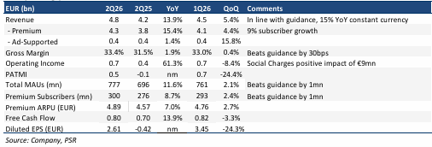
The company’s financial performance reveals several encouraging trends that strengthen its long-term investment case. Revenue growth has accelerated significantly to 14% year-on-year, marking a substantial improvement from 8% in the first quarter and 7% in the fourth quarter of 2025. This acceleration stems primarily from strong Premium revenue growth of 15% year-on-year, supported by a 7% increase in Premium average revenue per user (ARPU).
The pricing strategy implementation has proven successful, with the 8% US price increase introduced in February 2026 contributing to improved monetisation without significantly impacting subscriber growth. Premium subscriber growth remained resilient at 9% year-on-year, actually beating guidance by 1 million subscribers, demonstrating healthy demand despite recent price increases.
User engagement metrics continue to show strength, with monthly active users (MAUs) reaching 777 million, representing 12% year-on-year growth. Premium subscribers increased to 300 million, showing both annual growth of 9% and quarterly growth of 2%.
Strategic Shift and Advertising Infrastructure Transformation
Management has strategically shifted focus from maximising scale to optimising growth and monetisation. This includes implementing higher advertising loads and creating greater friction within the free tier to drive Premium conversions, though these initiatives may moderate near-term MAU additions.
The advertising segment represents a significant opportunity at an inflection point. Despite modest Ad-Supported revenue growth of 1.4% year-on-year, Spotify has completed its two-year advertising infrastructure overhaul, with 99% of impressions now served through its proprietary advertising stack. Automated channels increased to 40% of Ad-Supported revenue from 30% in the previous quarter, while active advertisers surged 60% year-on-year.
Frequently Asked Questions
Q: What is Phillip Securities Research's recommendation and target price for Spotify?
A: Phillip Securities Research maintains a Buy recommendation with an unchanged target price of US$650.
Q: How did Spotify's revenue perform in the second quarter of 2026?
A: Revenue grew 14% year-on-year, accelerating from 8% in Q1 2026 and 7% in Q4 2025, primarily driven by 15% Premium revenue growth.
Q: What were Spotify's key user growth metrics?
A: Monthly active users reached 777 million (+12% YoY), while Premium subscribers increased to 300 million (+9% YoY, +2% QoQ).
Q: How has Spotify's pricing strategy affected subscriber growth?
A: Despite an 8% US price increase in February 2026, Premium subscriber growth remained resilient at 9% year-on-year and beat guidance by 1 million subscribers.
Q: What is Spotify's strategic focus shift?
A: Management is shifting from maximising MAU growth toward improving monetisation, including higher ad loads and greater friction in the free tier to drive Premium conversions.
Q: What progress has Spotify made with its advertising infrastructure?
A: The company has completed its two-year advertising overhaul, with 99% of impressions served through its proprietary ad stack and automated channels increasing to 40% of Ad-Supported revenue.
Q: What are management's expectations for advertising growth?
A: Management expects advertising growth to inflect toward double digits in the second half of 2026, with long-term potential for Ad-Supported gross margins to expand from 20% to 40%.
Q: What is Spotify's key competitive advantage according to the analysis?
A: Spotify's large, proprietary dataset of user listening behaviour allows superior personalisation and discovery, strengthens platform stickiness, and supports continued pricing power.
This article has been auto-generated using PhillipGPT. It is based on a report by a Phillip Securities Research analyst.
Disclaimer
These commentaries are intended for general circulation and do not have regard to the specific investment objectives, financial situation and particular needs of any person. Accordingly, no warranty whatsoever is given and no liability whatsoever is accepted for any loss arising whether directly or indirectly as a result of any person acting based on this information. You should seek advice from a financial adviser regarding the suitability of any investment product(s) mentioned herein, taking into account your specific investment objectives, financial situation or particular needs, before making a commitment to invest in such products.
Opinions expressed in these commentaries are subject to change without notice. Investments are subject to investment risks including the possible loss of the principal amount invested. The value of units in any fund and the income from them may fall as well as rise. Past performance figures as well as any projection or forecast used in these commentaries are not necessarily indicative of future or likely performance.
Phillip Securities Pte Ltd (PSPL), its directors, connected persons or employees may from time to time have an interest in the financial instruments mentioned in these commentaries.
The information contained in these commentaries has been obtained from public sources which PSPL has no reason to believe are unreliable and any analysis, forecasts, projections, expectations and opinions (collectively the “Research”) contained in these commentaries are based on such information and are expressions of belief only. PSPL has not verified this information and no representation or warranty, express or implied, is made that such information or Research is accurate, complete or verified or should be relied upon as such. Any such information or Research contained in these commentaries are subject to change, and PSPL shall not have any responsibility to maintain the information or Research made available or to supply any corrections, updates or releases in connection therewith. In no event will PSPL be liable for any special, indirect, incidental or consequential damages which may be incurred from the use of the information or Research made available, even if it has been advised of the possibility of such damages. The companies and their employees mentioned in these commentaries cannot be held liable for any errors, inaccuracies and/or omissions howsoever caused. Any opinion or advice herein is made on a general basis and is subject to change without notice. The information provided in these commentaries may contain optimistic statements regarding future events or future financial performance of countries, markets or companies. You must make your own financial assessment of the relevance, accuracy and adequacy of the information provided in these commentaries.
Views and any strategies described in these commentaries may not be suitable for all investors. Opinions expressed herein may differ from the opinions expressed by other units of PSPL or its connected persons and associates. Any reference to or discussion of investment products or commodities in these commentaries is purely for illustrative purposes only and must not be construed as a recommendation, an offer or solicitation for the subscription, purchase or sale of the investment products or commodities mentioned.
This advertisement has not been reviewed by the Monetary Authority of Singapore.