Investing in the AI Revolution: A Guide to Semiconductor & Ecosystem ETFs September 4, 2026
The rapid surge in artificial intelligence (AI), generative models, cloud computing, and autonomous systems has propelled semiconductors from a niche cyclical sector into the primary engine of the global technology megatrend. From graphic processing units (GPUs) and high-bandwidth memory (HBM) to advanced lithography equipment, chipmakers form the foundational hardware layer of modern innovation.
For investors seeking to capture this structural growth wave without taking on single-stock concentration risk, Semiconductor ETFs (Exchange-Traded Funds) offer an efficient, liquid gateway.
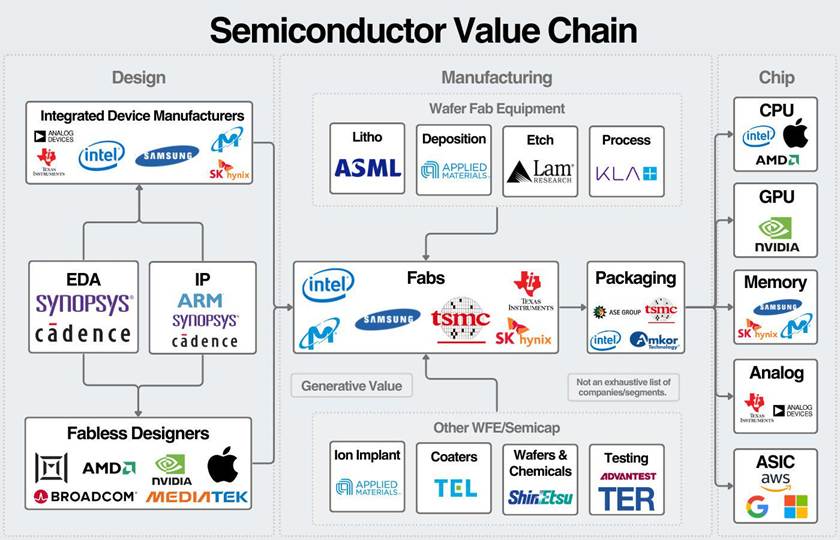 Source: Generative Value, 2024
1. Why Invest in Semiconductor & Ecosystem ETFs?
The AI & Compute Supercycle
Semiconductors are no longer tied solely to consumer electronics replacement cycles. The commercialisation of AI and high-performance computing (HPC) has initiated a multi-year capex expansion cycle among hyper-scalers and sovereign tech initiatives.
S&P Global and market research benchmarks project global semiconductor industry revenues to surpass $1.5 Trillion annually by 2030, driven predominantly by AI accelerators, automotive electrification, and edge computing (Reuters, 2026).
Full Ecosystem Coverage Beyond Single Giants
While mega-cap chip designers frequently dominate headlines, a semiconductor ETF provides diversified exposure across the entire value chain helping capture growth opportunities across the industry’s interconnected ecosystem:
Fabless Chip Designers:Companies focused purely on chip architecture and software (e.g., Nvidia, AMD, Qualcomm).
Pure-Play Foundries: Specialised manufacturers producing physical silicon wafers (e.g., TSMC, SMIC).
Semiconductor Equipment Manufacturers: Suppliers of critical photolithography and fabrication machinery (e.g., ASML, Applied Materials, Lam Research).
Outsourced Semiconductor Assembly & Test (OSAT): Advanced packaging and testing specialists critical for multi-die chip architectures.

2. Global Semiconductor ETF Landscape: US, Hong Kong & Singapore
Investors can access semiconductor exposure across different listing venues depending on their geographic preference, currency choice, and structural tilt (e.g., mega-cap concentration vs. equal-weighted mid-caps).
Overview of ETF Options
| Ticker / Exchange | Name | Primary Strategy / Focus | Market Cap & Exposure Type | Expense Ratio |
| SMH (US) | VanEck Semiconductor ETF | Global Chip Leaders (US-Listed) | Mega-Cap / Highly Concentrated (Top holdings 10–25%+)25-26 Companies | 0.35% |
| SOXX (US) | iShares Semiconductor ETF | Market-Cap Benchmark (30 Stocks) | Broad Large-Cap Focus with Capped Single-Stock Weights30 Primary Companies total 34-35 holdings | 0.35% |
| SOXQ (US) | Invesco PHLX Semiconductor ETF | Low-Cost Benchmark (PHLX Index) | Broad Large-Cap Core Exposure30-33 holdings | 0.19% |
| XSD (US) | SPDR S&P Semiconductor ETF | Equal-Weighted Index | High Mid/Small-Cap Tilt; Reduced Single-Stock Risk46 component stocks | 0.35% |
| PSI (US) | Invesco Dynamic Semiconductors ETF | Factor-Based (Quant/Smart Beta) | Dynamic Tilt toward Growth, Momentum & Value30-33 holdings | 0.56% |
| 3119 (HKEX) | Global X Asia Semiconductor ETF | Pan-Asia Chip Ecosystem | Regional Focus (Taiwan, South Korea, Japan, China)40-41 holdings | 0.68% |
| 3191 (HKEX) | Global X China Semiconductor ETF | Domestic China Supply Chain | China Onshore/Offshore Pure-Play Champions20-30 holdings | 0.68% |
| HST / HSS (SGX) | Lion-OCBC Sec Hang Seng TECH ETF | Broad Tech & Hardware (Hang Seng TECH) | Tech Ecosystem (Includes Foundry & Tech Giants)30 holdings | 0.56% |
a. Mega-Cap & Pure-Play Dominance (US Listed)
Funds like the VanEck Semiconductor ETF (SMH) adopt a market-cap weighting scheme that allows top-tier market winners (e.g., Nvidia, TSMC) to occupy substantial percentages of the portfolio. This makes SMH ideal for investors who want aggressive exposure to frontline AI category leaders.
b. Broad Market-Cap Benchmarks (US Listed)
The iShares Semiconductor ETF (SOXX) and the low-cost Invesco PHLX Semiconductor ETF (SOXQ) provide structured, broad-based exposure to large, established chip manufacturers. By enforcing single-stock weighting caps (typically 8% to 12% per name), these ETFs mitigate extreme single-company downside.
c. Mid-Cap, Small-Cap & Factor-Based Strategies (US Listed)
Equal-Weighting (XSD): The SPDR S&P Semiconductor ETF (XSD) assigns equal weight to every constituent index member. This strategy reduces reliance on mega-cap valuations while boosting exposure to high-growth mid-cap and small-cap chip designers.
Smart Beta / Factor Selection (PSI): The Invesco Dynamic Semiconductors ETF (PSI) evaluates holdings using quantitative metrics such as price momentum, earnings quality, and fundamental value.
d. Asian & Regional Supply Chain Coverage (HKEX & SGX Listed)
The Global X Asia Semiconductor ETF (3119.HK) focuses on Pan-Asian Manufacturing Hubs and tracks Asia-Pacific leaders across Taiwan, South Korea, and Japan. The ETF also provides targeted exposure to advanced foundry capacity and memory (HBM/DRAM) producers.
The Global X China Semiconductor ETF (3191.HK) targets the China Localised Ecosystem with an emphasis on domestic Chinese semiconductor firms that accelerates localisation efforts in fabrication and equipment.
The Lion-OCBC Securities Hang Seng TECH ETF (HST.SI / HSS.SI), listed on the SGX, in both SGD and USD counters, gives local investors easy, direct access to Asian tech giants and key regional foundries (such as SMIC) within a unified multi-currency instrument.
3. Key Risks in Semiconductor Investing
While structural tailwinds remain compelling, semiconductor investments exhibit elevated volatility:
Cyclical Demand Signals: Despite long-term AI growth, chipmaker revenues remain subject to short-term inventory corrections, demand swings in consumer hardware, and variable enterprise IT spending.
Geopolitical & Supply Chain Bottlenecks: Advanced semiconductor manufacturing is geographically concentrated in East Asia. Trade restrictions, export controls on advanced lithography machinery, and national security policies can trigger rapid repricing.
High Valuation Multiples: Fast-growing semiconductor design names frequently trade at elevated price-to-earnings (P/E) ratios, making them vulnerable to sharp drawdowns during interest rate spikes or temporary earnings misses.

4. Investor Checklist: Evaluating a Semiconductor ETF
Before allocating capital, evaluate the following variables on the fund’s factsheet:
- Top Holdings Concentration: Determine if the fund is top-heavy (e.g., top 3 holdings exceeding 30–40% of total assets) or evenly distributed.
- Segment Allocation (Fabless vs. Foundry vs. Equipment): Check whether the fund favours chip designers (higher margins, asset-light) or equipment and foundry operators (capital intensive, structural moats).
- Index Weighting Rules: Confirm whether the benchmark uses pure market-cap weighting, capped market-cap weighting, or equal weighting.
- Expense Ratio & Trading Spread: Compare total holding costs (expense ratios range from ~0.19% to 0.68%) and check average daily trading volumes to ensure minimal bid-ask slippage.
5. Strategic Implementation for Investors
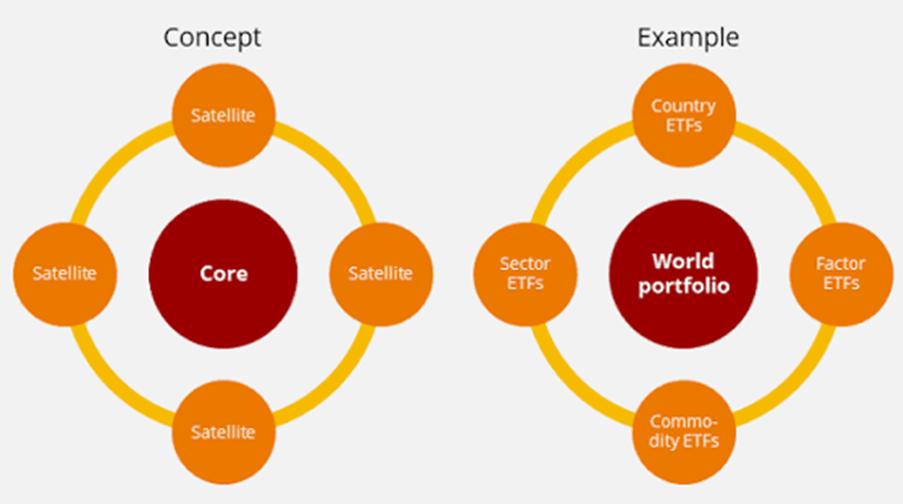
Core-Satellite Portfolio Structure
A practical approach to capturing the technology megatrend involves pairing a broad global equity allocation with a specialised semiconductor satellite (a satellite position is a smaller, targeted investment holding (usually 10% to 30% of a portfolio) :
Core Position (70–90%): Broad global or developed market index fund (e.g., S&P 500 or MSCI World).
Satellite Position (10–30%): A semiconductor ETF (SMH for mega-cap growth, XSD for mid-cap tilt, or 3119.HK / HST.SI for regional Asian diversification).
Exchange Selection & Multi-Currency Flexibility
Asian and Singapore-based investors can choose listing venues to optimise execution and convenience:
US-Listed ETFs (SMH, SOXX, XSD): Offer the highest trading volume and lowest expense ratios, traded in USD during US market hours.
HKEX/SGX-Listed ETFs (3191.HK, HST.SI): Allow trading during Asian market hours without the need for foreign exchange conversions when using local SGD or HKD counters.
In Summary
The semiconductor sector remains a key enabler of long-term technology trends, from artificial intelligence and cloud computing to automotive innovation and advanced manufacturing. This article has highlighted a range of semiconductor ETFs that investors may consider, each offering different levels of diversification, geographic exposure, concentration risk, liquidity, trading venues, and cost structures.
When evaluating whether an ETF deserves a place in your portfolio, consider factors such as its investment objective, underlying holdings, geographic and sector exposure, expense ratio, trading liquidity, costs structure, and how well it aligns with your investment goals and risk tolerance. Investors should also assess whether the ETF provides broad industry exposure or a more concentrated bet on specific semiconductor companies or themes.
References
2. https://www.generativevalue.com/p/a-primer-on-semiconductor-capital
Disclaimer
Disclaimer These commentaries are intended for general circulation and do not have regard to the specific investment objectives, financial situation and particular needs of any person. Accordingly, no warranty whatsoever is given and no liability whatsoever is accepted for any loss arising whether directly or indirectly as a result of any person acting based on this information. You should seek advice from a financial adviser regarding the suitability of any investment product(s) mentioned herein, taking into account your specific investment objectives, financial situation or particular needs, before making a commitment to invest in such products. Opinions expressed in these commentaries are subject to change without notice. Investments are subject to investment risks including the possible loss of the principal amount invested. The value of units in any fund and the income from them may fall as well as rise. Past performance figures as well as any projection or forecast used in these commentaries are not necessarily indicative of future or likely performance. Phillip Securities Pte Ltd (PSPL), its directors, connected persons or employees may from time to time have an interest in the financial instruments mentioned in these commentaries. The information contained in these commentaries has been obtained from public sources which PSPL has no reason to believe are unreliable and any analysis, forecasts, projections, expectations and opinions (collectively the “Research”) contained in these commentaries are based on such information and are expressions of belief only. PSPL has not verified this information and no representation or warranty, express or implied, is made that such information or Research is accurate, complete or verified or should be relied upon as such. Any such information or Research contained in these commentaries are subject to change, and PSPL shall not have any responsibility to maintain the information or Research made available or to supply any corrections, updates or releases in connection therewith. In no event will PSPL be liable for any special, indirect, incidental or consequential damages which may be incurred from the use of the information or Research made available, even if it has been advised of the possibility of such damages. The companies and their employees mentioned in these commentaries cannot be held liable for any errors, inaccuracies and/or omissions howsoever caused. Any opinion or advice herein is made on a general basis and is subject to change without notice. The information provided in these commentaries may contain optimistic statements regarding future events or future financial performance of countries, markets or companies. You must make your own financial assessment of the relevance, accuracy and adequacy of the information provided in these commentaries. Views and any strategies described in these commentaries may not be suitable for all investors. Opinions expressed herein may differ from the opinions expressed by other units of PSPL or its connected persons and associates. Any reference to or discussion of investment products or commodities in these commentaries is purely for illustrative purposes only and must not be construed as a recommendation, an offer or solicitation for the subscription, purchase or sale of the investment products or commodities mentioned. This advertisement has not been reviewed by the Monetary Authority of Singapore.
About the author
Mr Teo Huan Zi
Dealing Manager
Phillip Securities Pte Ltd
Mr Teo Huan Zi graduated from Nanyang Technological University (NTU) in 2014 with a Bachelor's degree in Business, majoring in Banking and Finance. He currently serves as a dealing manager with a team of more than 10 equity specialists. Additionally, he frequently conducts seminars and webinars to empower his clients with financial and investment knowledge, including fundamental analysis and technical analysis.
 ETF Monthly Review: Mixed September Performance with Muted October Outlook Expected
  Phillip SING Income ETF Reaches All-Time High Dividend with Banking Sector Focus
  Understanding Emerging Markets ETFs
  Suntec REIT Shows Strong Singapore Performance with 24.8% DPU Growth, ACCUMULATE Rating and S$1.69 Target Price