
Overcoming Volatility with Regular Savings Plan
Overcoming Volatility with Regular Savings Plans (RSP)
Other than asking what to invest in and how to invest, investors are also often concerned about having sufficient funds to invest and finding the right time to invest.“As investors, there are times when we are fixated about timing the exact peaks and bottoms of the markets.”
However, timing the market is extremely difficult, especially during such volatile times.Time in the Market is Better than Timing the Market
 Let us show you why time in the market is important with the example below:
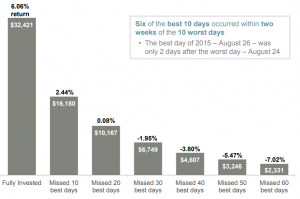
Chart 1: Performance of a $10,000 investment in S&P 500 from 3 Jan 2000 to 31 Dec 2019
Let us show you why time in the market is important with the example below:
Chart 1: Performance of a $10,000 investment in S&P 500 from 3 Jan 2000 to 31 Dec 2019
 Source: JP Morgan’s Guide to Retirement 2020
Assuming in year 2000, you had $10,000 to invest.
If you stay fully invested in the S&P 500 for 20 years:
Source: JP Morgan’s Guide to Retirement 2020
Assuming in year 2000, you had $10,000 to invest.
If you stay fully invested in the S&P 500 for 20 years:
- Your portfolio returns would be 6.06%
- Your portfolio value would have increased to more than $32,000 at the end of the 20-year period.
- Your portfolio returns would have reduced to 2.44%
- Your portfolio value would have increased to approximately $16,000 only.
Don’t Let Emotions Affect You

“Then, there are emotions, and emotions are tricky.”
Decisions by emotions are usually impulsive and not based on information gathered. Investment decisions based on emotion – such as fear – is the main reason why many people are buying at market tops and selling at market bottoms instead. Remember, having personal feelings for your investment will not improve your winning probability, but a longer investment horizon will.So, what now?
Fret not!“RSP(s) can help you to overcome these two stumbling blocks -
Time and Emotions.”
Instead of trying to perfectly time the market, you can have time in the market by adopting Dollar Cost Averaging (DCA). Diversify your risk by taking advantage of DCA, buy more unit trusts when prices are low; buy less unit trusts when prices are high. This enables you to smooth out the returns and also reduce the stress in investing as you will not be required to decide whether it’s the right time to invest. Here’s how it works: Assuming Amy and Bob have $300 each to invest. Amy chooses to invest all $300 in January and receives 30 units at $10/unit. Bob however, chooses to invest $100 monthly into an RSP. Here’s the calculations for Bob’s investment:| January | February | March | |
| Amount Invested (a) | $100 | $100 | $100 |
| Price/Unit (b) | $10 | $5 | $8 |
| Units Received (a÷b) | $100 ÷ $10 = 10 | $100 ÷ $5 = 20 | $100 ÷ $8 = 12.5 |
| Amy’s Investment | Bob’s Investment |
| Unit Price: $10/unit | Average Unit Price (Total Price ÷ No of transactions) $(10+5+8) ÷ 3 = $7.67/unit |
| Cost of Investment: $10/unit | Average Cost of Investment (Total Cost ÷ No of Units purchased) $300 ÷ 42.5 = $7.05 |
| Total Units Received: 30 | Total Units Received: 42.5 |
Phillip Capital Management – Being Nimble With Innovative Cash Management Solutions [INSIGHT RELEASE]
Phillip Capital Management (S) Ltd has published an article titled “Being Nimble With Innovative Cash Management Solutions”.
Owing to the recent market volatility, we understand that a number of investors are sitting on the side-lines, with surplus cash idling in bank savings accounts. This phenomenon calls for a review of how investors should manage their surplus cash.
In the article, one of the Top Financial Advisor-cum-Trading Representative in Phillip Securities Pte Ltd speaks about a more efficient parking facility for surplus funds that has benefited many of her clients.
To find out more, please read the full article.
United SGD Fund End March 2020 Update
Join Joyce Tan, Co-Head of Fixed Income Asia & Singapore, as she updates on the Q1 performance of the United SGD Fund, and discusses the fund positioning and outlook amid COVID-19.
[embed]https://youtu.be/osLRUe7VYS8?list=PLUc9eMJO6adONVGitaO003aOjjoYNJJf5[/embed]
Phillip Capital Management – A Better Way To Manage Surplus Cash & Case Study Of A Government Agency [INSIGHTS RELEASE]
Phillip Capital Management (S) Ltd is pleased to inform you that Phillip Money Market Fund ("PMMF") has hit a significant milestone of reaching SGD $1 billion in asset-under-management ("AUM") during the first quarter of 2020.
In the similar period, we have seen how markets went into risk-off mode and investors rushed for safety just as the COVID-19 escalated into a global pandemic. This gives us the indication that more investors are embracing PMMF for its high defensiveness.
Their latest article is about the value that PMMF brings, with a past case study involving a government agency parking its excess daily cash flow into the fund.
To find out more, please read the full article.
Phillip Capital Management – Abundance Of Liquidity To Create Opportunities In Tech Space Once Again
Phillip Capital Management (S) Ltd has recently published an article titled “Abundance Of Liquidity To Create Opportunities In Tech Space Once Again”.
The article seeks to answer some of these questions:
- Why is our Global Opportunities Fund taking on a risk-on view on global markets?
- What region to be overweight on, US or China?
- How does a global fund with a balanced mandate offer investors potential long-term upside while still maintaining a level of stability?
Phillip Capital Management – Favourable S-REITs Yield Spreads Against 10-year SGS
Phillip Capital Management (S) Ltd has recently published an article titled “Favourable S-REITs Yield Spreads Against 10-year SGS”.
The article highlights some of the insights our fund managers gathered:
- As at the start of April, the market seems to have priced in an average 20% cut in DPUs for S-REITs (base case scenario)
- In our worst case scenario (from perspective of April), assuming a 50% cut in future DPUs, S-REITs as a whole would yield about 4.16%
- Compared to the 10-year SGS, yield spreads were 5.63% and 3.14% for base case and worst case respectively
- During GFC, yield spread between S-REITs and 10-year SGS was only 3.5%
Allianz AGI Insights (April 2020): How to rethink US allocations during the coronavirus crisis?
Allianz Global Investors Insights
Please find Market Insights article from Allianz Global Investors below:
Insights April 2020 - How to rethink US allocations during the coronavirus crisis
Should I Invest In US Funds Amid COVID-19 Pandemic?
Should I Invest In US Funds Amid COVID-19 Pandemic?
Markets have been extremely volatile due to the coronavirus (COVID-19) situation and oil price war. Panic has seeped into the global stock markets and caused a market carnage. It is not just the volatility, but also the velocity of the market crash that caught us by surprise. On 11 March 2020, S&P 500 fell more than 20% from its recent peak and took the shortest amount of time in history, a record of 16 days to go into bear market. The market has since entered an extended period of panic, with S&P 500 recording the worst start to a quarter in history. United States may still be able to turn the tide despite COVID-19. Pent-up demands could drive the economy recovery in the second half of the year. The COVID-19 pandemic has yet to peak, hence we may see more selling pressure before witnessing a US comeback. Recently, investment houses have been racing to cut their economic growth outlook as economic data are expected to reflect the massive negative impact due to COVID-19. While there is still ongoing fear and anxiety, the pandemic shall eventually pass and consumption behaviour will return to some sort of normality just like it did after previous crisis such as 9/11. Is the Market Correction over? We are closely monitoring signs that possibly suggest the end of market corrections caused by COVID-19. Table 1: Market Bottoming Signals| Key Bottoming Signals | My View |
| Peak in daily new cases and deaths | Global daily new cases and deaths have not yet reached their peaks. |
| Policy Response | We may see more policy support as all industries have been affected by the COVID-19 pandemic. |
| Market does not respond to bad economic data | Economic data has yet to show the full impact of COVID-19 pandemic. |
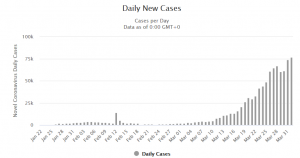
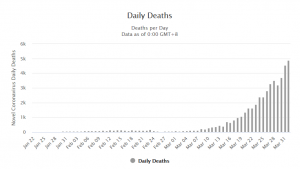
- Peak in daily new cases and deaths
 Source: Worldometer, 1 April 2020
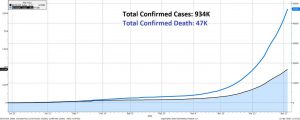
Chart 3: Total Cases and Total Deaths from COVID-19
Source: Worldometer, 1 April 2020
Chart 3: Total Cases and Total Deaths from COVID-19
 Source: Bloomberg Data, 1 April 2020
Daily new cases and deaths have not reached their peaks. Furthermore, global confirmed cases and death toll have both shown steepening curve.
Source: Bloomberg Data, 1 April 2020
Daily new cases and deaths have not reached their peaks. Furthermore, global confirmed cases and death toll have both shown steepening curve.
- Policy Support
- Market does not respond to bad economic data
 Source: Bloomberg Data, 1 April 2020
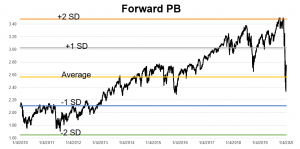
Chart 5: Forward PB for S&P 500
Source: Bloomberg Data, 1 April 2020
Chart 5: Forward PB for S&P 500
 Source: Bloomberg Data, 1 April 2020
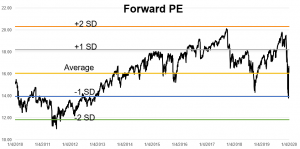
The recent market weakness resulted in fair valuations for S&P 500. The S&P 500’s price-to-earnings (PE) ratio and price-to-book (PB) are both trading near their 10-year mean.
We are cautiously optimistic in longer term as we believe pent-up demands and resumption of economic activities should induce growth for the US economy in the second half of 2020.
However, a V-shaped recovery may be too optimistic as we have not seen the full magnitude of the coronavirus-led economic disruption.
Why should you invest in US mutual funds?
Unlike investing into individual stocks that are exposed to single counter and concentration risks, a mutual fund manager could invest into a basket of stocks to benefit from a diversified portfolio.
A mutual fund is actively managed by professional fund managers. During market volatility, a fund manager could actively switch in or out security selection to ensure the fund is well positioned to weather market volatility.
US Equity Mutual Funds
Investors may consider adding large cap mutual funds into their investment portfolio as large cap companies generally have sustainable profitability and healthier balance sheet to better weather tough times. We also favour mutual funds that focus on sustainable, multi-year growth trends as high quality, growth companies are well positioned for a recovery. Investors should prepare a list of quality US equity funds to position for long term.
How to get started?
With a wide variety of US equity funds on POEMS, you can select from more than 80 US equity funds across 17 fund providers based on your investment needs. You will also get to enjoy 0% platform fees, 0% sales charge and 0% switching fees for your Unit Trust investments on POEMS.
Visit our website at https://www.poems.com.sg/fund-finder/ to explore your options!
Want to Learn More?
Get your insights at our upcoming Unit Trust Semi-Annual Webinar: Navigating the COVID-19 Panic on 30 May, 10 am. Join this informative session to get insights on what investors can do during the current trying market conditions.
Click here to register and find out more: https://zoom.us/webinar/register/WN_tXvwY8UZSkms2ZHYiXfmJQ
Source: Bloomberg Data, 1 April 2020
The recent market weakness resulted in fair valuations for S&P 500. The S&P 500’s price-to-earnings (PE) ratio and price-to-book (PB) are both trading near their 10-year mean.
We are cautiously optimistic in longer term as we believe pent-up demands and resumption of economic activities should induce growth for the US economy in the second half of 2020.
However, a V-shaped recovery may be too optimistic as we have not seen the full magnitude of the coronavirus-led economic disruption.
Why should you invest in US mutual funds?
Unlike investing into individual stocks that are exposed to single counter and concentration risks, a mutual fund manager could invest into a basket of stocks to benefit from a diversified portfolio.
A mutual fund is actively managed by professional fund managers. During market volatility, a fund manager could actively switch in or out security selection to ensure the fund is well positioned to weather market volatility.
US Equity Mutual Funds
Investors may consider adding large cap mutual funds into their investment portfolio as large cap companies generally have sustainable profitability and healthier balance sheet to better weather tough times. We also favour mutual funds that focus on sustainable, multi-year growth trends as high quality, growth companies are well positioned for a recovery. Investors should prepare a list of quality US equity funds to position for long term.
How to get started?
With a wide variety of US equity funds on POEMS, you can select from more than 80 US equity funds across 17 fund providers based on your investment needs. You will also get to enjoy 0% platform fees, 0% sales charge and 0% switching fees for your Unit Trust investments on POEMS.
Visit our website at https://www.poems.com.sg/fund-finder/ to explore your options!
Want to Learn More?
Get your insights at our upcoming Unit Trust Semi-Annual Webinar: Navigating the COVID-19 Panic on 30 May, 10 am. Join this informative session to get insights on what investors can do during the current trying market conditions.
Click here to register and find out more: https://zoom.us/webinar/register/WN_tXvwY8UZSkms2ZHYiXfmJQThe Rise of ESG Investing

The Rise of ESG Investing
Investors used to make investments in companies based on financial performance. In the recent years, increasingly they look beyond profits and prefer investing in companies that align with their principles and values.So… What Exactly is ESG?
ESG stands for Environmental, Social and Governance. The integration of ESG factors into investment policies, processes and practices helps measure the sustainability and ethicality of a company. Environmental (E) includes climate risks and pollution. Social (S) includes human capital issues and work place conditions. Governance (G) includes business ethics and tax transparency. Simply put, a socially responsible investor will decide to invest in a company based on ESG factors and steer clear of low ESG scoring companies. We believe that ESG factors will help investors assess the overall quality of a company and their financial performance in relation to the changing social and environmental issues. Table 1: ESG Issues| Environmental | Social | Governance |
|---|---|---|
| Climate change and carbon emissions | Customer satisfaction | Board composition |
| Air and water pollution | Data protection and privacy | Audit committee structure |
| Biodiversity | Gender and diversity | Bribery and corruption |
| Deforestation | Employee engagement | Executive compensation |
| Energy efficiency | Community relations | Lobbying |
| Waste management | Human rights | Political contributions |
| Water scarcity | Labour standards | Whistle-blower schemes |
Creating Value with ESG Factors
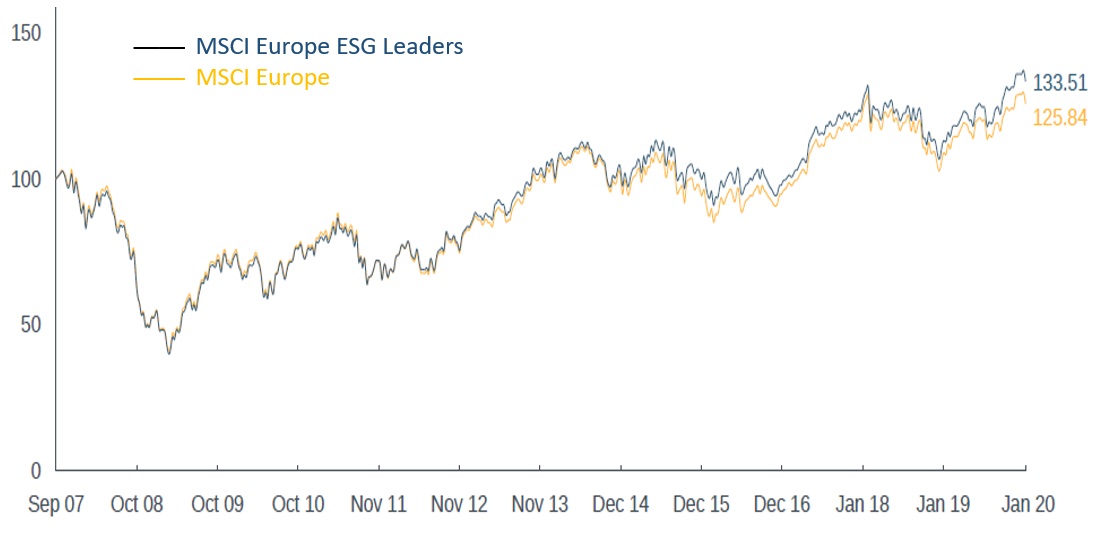
“Can I invest responsibly and make money, too?” In reality, many investors remain skeptical about ESG investing as they believe that it may result in loss of some returns. However, many studies have shown and recognised sustainable investing as a driver of long-term investment performance. The MSCI ACWI ESG Leaders Index, MSCI Europe ESG Leaders and MSCI EM ESG Leaders, which provide exposure to companies with high ESG performance relative to their sector peers, generated better returns when compared with MSCI ACWI, MSCI Europe and MSCI EM for the period of Sep 2017 to Jan 2020. Thus, it is worth noting that integration of ESG factors into the investment portfolio may potentially enhance portfolio returns. Chart 1: Cumulative Gross Returns (USD) of MSCI ACWI ESG Leaders and MSCI ACWI (Sep 2007 – Jan 2020)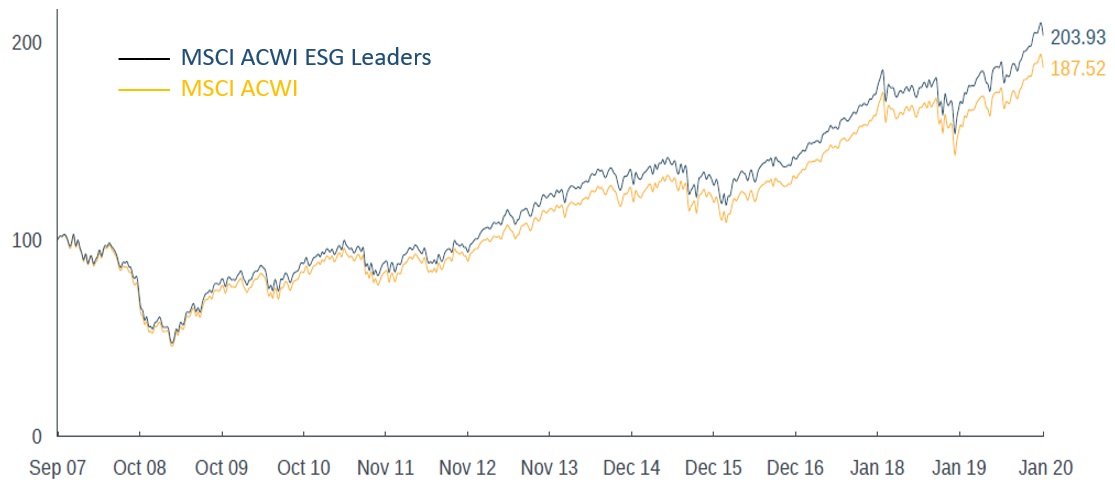 Source: MSCI ACWI ESG Leaders Factsheet, 31 Jan 2020
Chart 2: Cumulative Gross Returns (USD) of MSCI Europe ESG Leaders and MSCI Europe (Sep 2007 – Jan 2020)
Source: MSCI ACWI ESG Leaders Factsheet, 31 Jan 2020
Chart 2: Cumulative Gross Returns (USD) of MSCI Europe ESG Leaders and MSCI Europe (Sep 2007 – Jan 2020)
 Source: MSCI Europe ESG Leaders Factsheet, 31 Jan 2020
Chart 3: Cumulative Gross Returns (USD) of MSCI EM ESG Leaders and MSCI EM (Sep 2007 – Jan 2020)
Source: MSCI Europe ESG Leaders Factsheet, 31 Jan 2020
Chart 3: Cumulative Gross Returns (USD) of MSCI EM ESG Leaders and MSCI EM (Sep 2007 – Jan 2020)
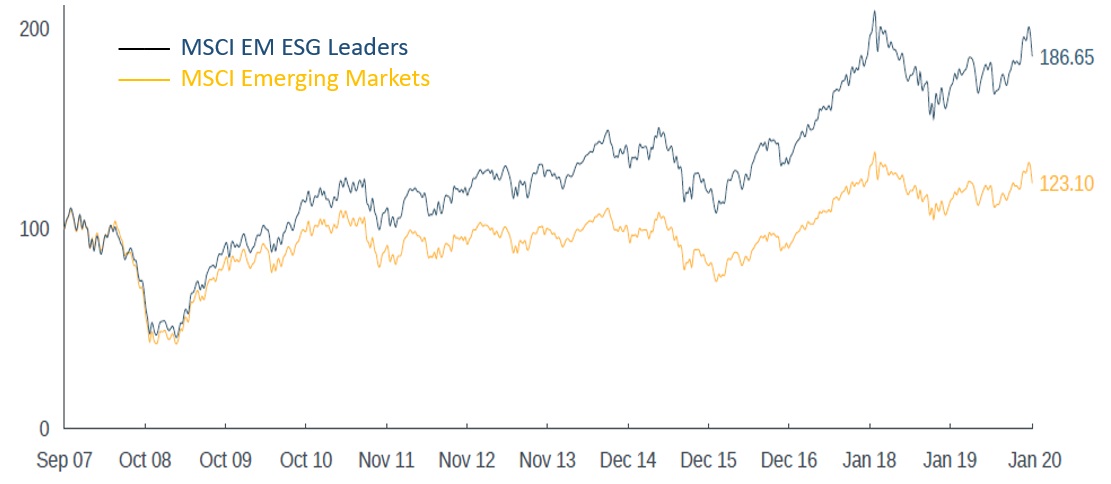 Source: MSCI EM ESG Leaders Factsheet, 31 Jan 2020
Strong Momentum Behind the ESG Investing Wave
We found that investors have been putting in more money in ESG funds last year. According to independent research company Morningstar, ESG mutual funds and exchange-traded funds saw a net inflow of $20.6 billion in 2019, which is almost four times higher than 2018. Chart 4: Sustainable Funds Estimated Annual Flows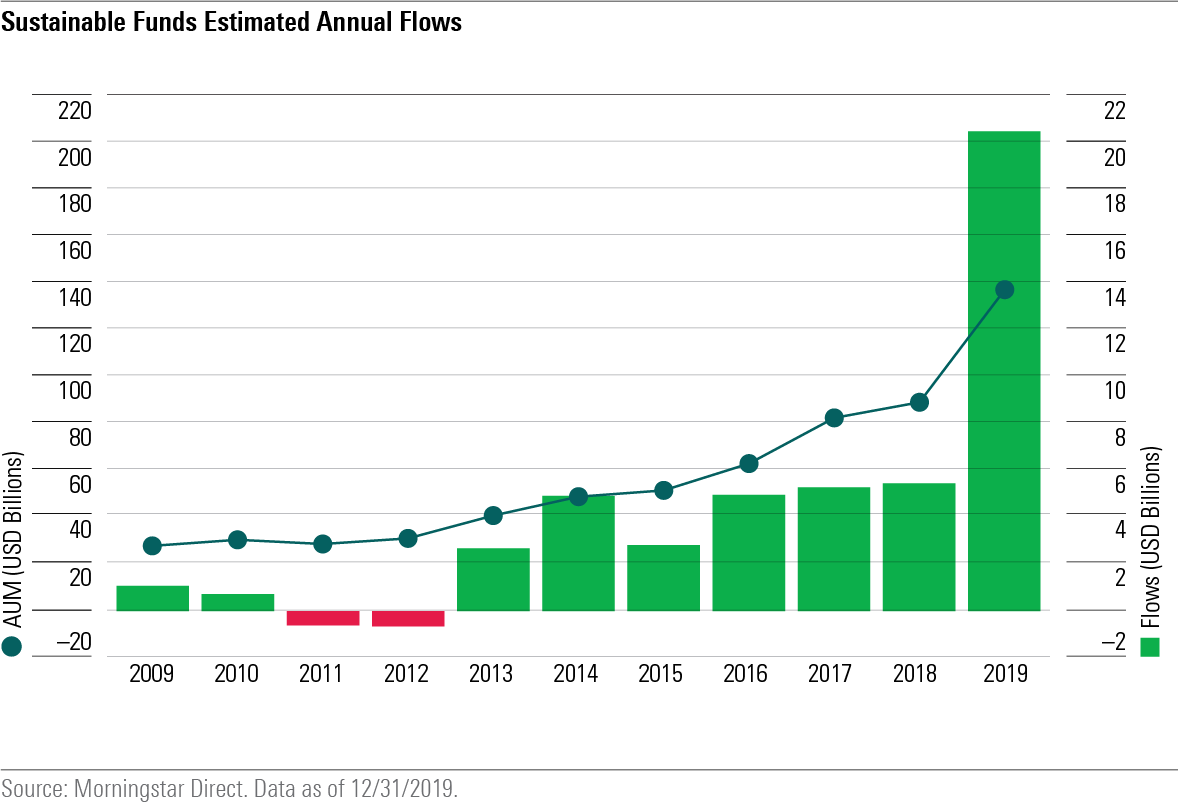 Source: Morningstar Article, “Sustainable Fund Flows in 2019 Smash Previous Records”, 10 Jan 2020
An Aspirational Set of Investment Principles
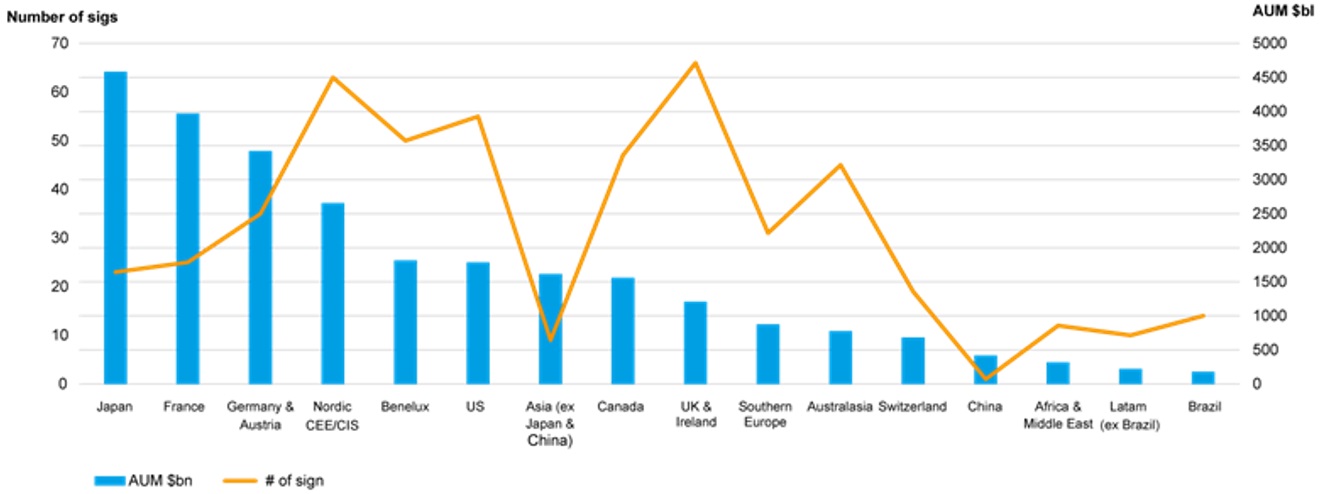
The Principles for Responsible Investing (PRI) is the world’s leading proponent of responsible investment. The UN-supported PRI is an international network of investors working together to put the Six Principles into practice. By joining PRI, investors are committed to incorporate ESG factors into their investments and ownership decisions. Today, PRI has a total of 2,372 signatories, with a total Asset Under Management (AUM) of USD 86 trillion. The largest asset owners at the PRI by AUM are based in Japan, France, Germany and Austria. Chart 5: PRI’s Number of Signatories and AUM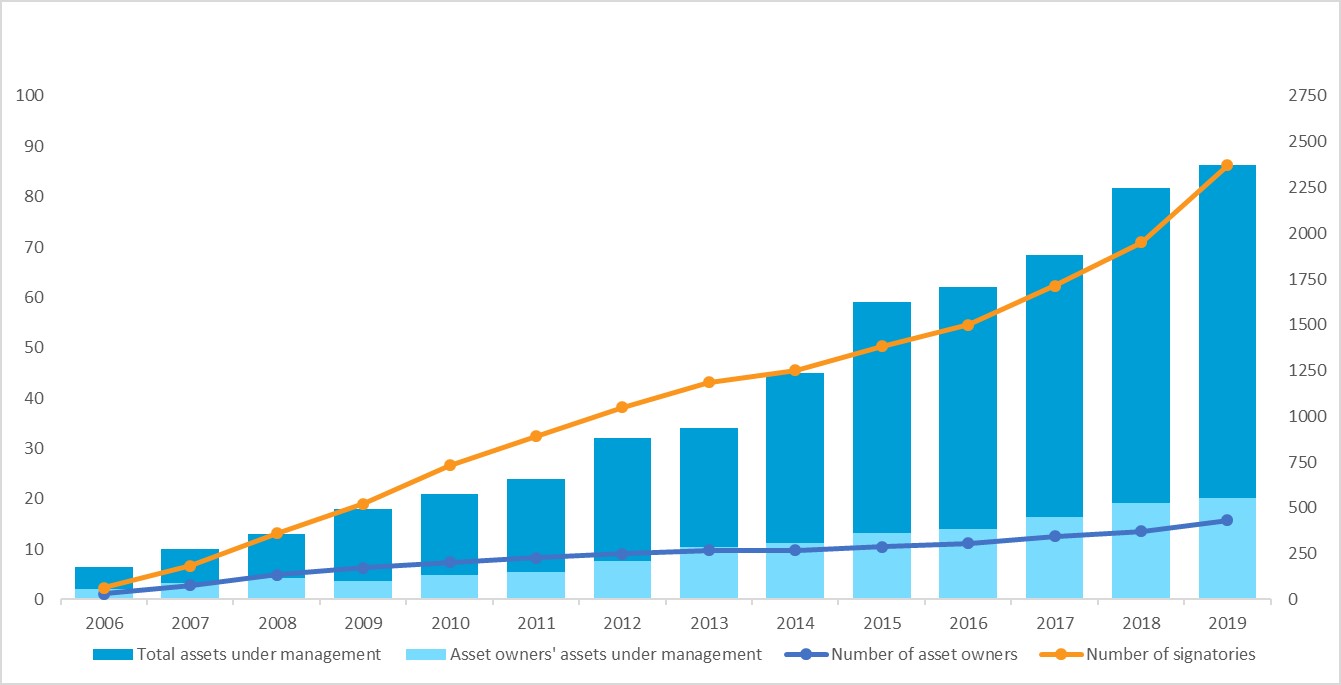 Source: PRI Website, Data as of April 2019
Chart 6: AUM by Geography
Source: PRI Website, Data as of April 2019
Chart 6: AUM by Geography
 Source: PRI Twitter, 28 Jan 2020