Event
The U.S. Federal Open Market Committee (FOMC) concluded its 16-17 June 2026 meeting by keeping the policy rate unchanged at 3.50%–3.75%. The decision was approved by a 12–0 vote, with the Committee reaffirming its dual mandate of price stability and maximum employment.
Key points to note:
- Fed communication and policy framework may change
Warsh announced five task forces covering Fed communications, balance sheet policy, data usage, productivity and jobs, and the inflation framework. These reviews could change the role of the dot plot, SEP, press conferences and forward guidance by year-end. - Fed shifts away from forward guidance
Warsh said forward guidance was not suitable for the current environment. Throughout the press conference, he avoided providing a clear signal for the next policy move, leaving the Fed to assess policy on a meeting-by-meeting basis as incoming data evolves. - Inflation remains the main concern
The Fed revised its inflation forecast higher. The 2026 PCE inflation projection was raised to 3.6% from 2.7%, while core PCE inflation was raised to 3.3% from 2.7%. This shows the Committee sees inflation as stickier than previously expected. Warsh also made clear that the 2% inflation target remains unchanged and is not up for debate. - Dot plot points to hike, but not a firm decision
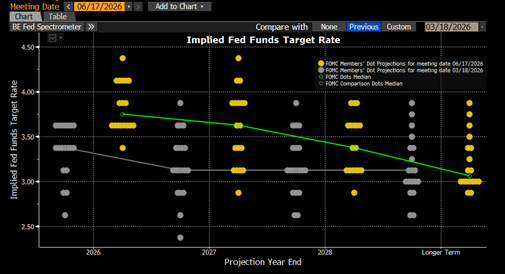
The SEP showed the median Fed funds rate at 3.8% by end-2026 and 3.6% by end-2027. For 2026, the dot plot showed 9 participants expecting a hike, 8 expecting no change, and 1 expecting a cut. However, Warsh downplayed the dot plot as firm guidance. He said the dots were submitted with “pencils with big erasers,” meaning policymakers do not feel locked into their projections. He also did not submit his own interest-rate path projection.
Outlook:
Market pricing still points to one rate hike by year-end, although the near-term base case remains a hold. The June SEP supports this view, with inflation revised higher and the end-2026. Fed funds median rising to 3.8% from 3.4%, above the current policy-rate midpoint. This suggests some policymakers believe further tightening may be needed if inflation remains sticky. At the same time, the broader macro backdrop remains resilient. 2026 GDP was revised only slightly lower to 2.2% from 2.4%, while unemployment was revised lower to 4.3% from 4.4%. This gives the Fed room to stay focused on inflation while keeping a year-end hike on the table.
Warsh did not give clear guidance on the exact conditions that would trigger a hike. Our base case is for the Fed to stay on hold in the near term. However, a 25bp hike by year-end remains possible if core CPI/core PCE stay sticky, or if higher energy prices feed through into broader services and goods inflation.
 Source: Bloomberg