Crude Oil and Market Volatility: What Investors Need to Know April 22, 2026
Crude Oil, also known as “Black Gold”, has played a significant role in advancing human civilisation. It has powered economies during times of peace albeit highly contested during periods of conflict. Crude oil, as a commodity, has contributed to the rise of nations but the decline of others. The price of crude oil has a profound influence on global economic growth and spending power of oil-rich countries.
The Grades of Crude Oil
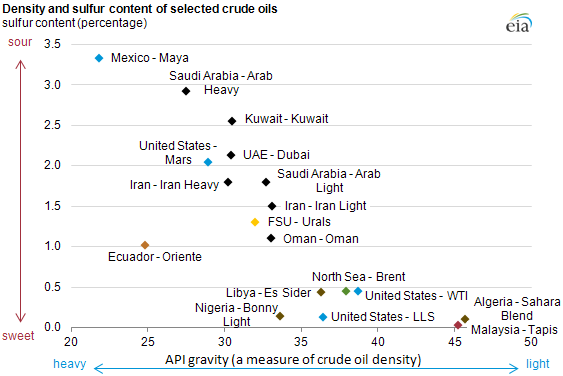
The first factor is density, measured by API gravity (expressed as light versus heavy). A higher API gravity indicates lower density and therefore lighter crude oil2. Light crude oil can be likened to vegetable oil, while heavy crude resembles the consistency of peanut butter.
Lighter crude flows more easily and can be transported through pipelines with greater efficiency compared to the heavier crude. As such, it is also easier to refine and can be made into high-value end products such as gasoline, diesel, and jet fuel3. In contrast, heavy crude requires more energy-intensive refining processes, making it pricier overall.
The second factor is the sulphur content of the crude oil, which categorises it as either sweet or sour. Sweet crude contains less than 1% sulphur, while sour crude typically contains between 1% and 2%. Sweet crude is generally easier and less costly to refine, similar to light crude, and therefore tends to command a premium over sour or heavier grades.
 Source: U.S. Energy Information Administration4
The diagram above illustrates the range of crude oil grades across regions and major producing countries. Globally, three primary benchmarks are used to price crude oil: North Sea Brent, West Texas Intermediate (WTI), and Dubai/Oman. Brent crude is the most widely used benchmark, pricing oil across Europe, Africa, the Mediterranean, and parts of Asia, including Australia5. It is typically associated with light, sweet crude.
WTI is primarily used to price US light, sweet crude, with Cushing, Oklahoma as its main trading hub, and also serves as a reference for imports from regions such as Canada and Latin America. The Dubai/Oman benchmark is commonly used for Middle Eastern crude and is widely referenced by Asian refineries. Unlike Brent and WTI, it is generally classified as medium and sour. With approximately 60% to over 70% of Asia’s crude imports originating from the Middle East, the Dubai/Oman benchmark remains critical to the region’s energy supply6.
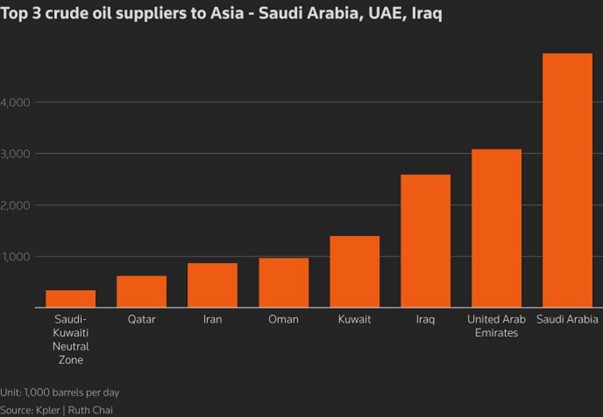 Source: Kpler │Ruth Chai
Market Forces that Affect Oil Prices
Like many commodities, both the supply and demand for crude oil plays a large role in influencing the overall price. In 2023, the global oil production stood at approximately 102.666 million barrels per day while world consumption of oil was 101.249 million barrels per day 7. This relatively narrow margin highlights the delicate balance between supply and demand in the oil market.
There is limited flexibility to significantly increase long-term supply. Global capital expenditure in the oil and gas sector has declined over time, partly due to environmental considerations and the transition towards cleaner energy sources. As a result, the market is more sensitive to disruptions.
Supply shocks often arrive in the form of geopolitical conflicts like infrastructure attacks, unexpected production cuts, and policy shifts. For example, the 1973 Arab oil embargo and the supply disruptions experienced during the, COVID-19 pandemic in 2020. Demand shocks, on the other hand, are typically influenced by macroeconomic conditions, geopolitical tensions, and global crises. For instance, conflicts such as the Russia–Ukraine war and tensions involving Iran have supported higher oil demand due to increased uncertainty and energy security concerns. Conversely, the COVID-19 pandemic led to a sharp decline in global demand as economic activity slowed significantly.
Iran Conflict & Supply Shock
On 28 February 2026, US and Israel launched coordinated strikes on Iran, targeting military infrastructure, leadership, and elements of its nuclear programme8. While the initial focus was on strategic assets, Iran’s response escalated tensions across the region, raising concerns over disruptions to global oil logistics.
Iran retaliated by targeting key energy infrastructure across the Gulf, including facilities in Saudi Arabia, Qatar, the UAE, and Oman9. These actions disrupted production and signalled heightened risks to regional oil supply.
Of particular concern is the Strait of Hormuz, a critical maritime route through which a significant portion of the world’s oil supply is transported. Iran has threatened to restrict passage through the strait, creating fears of a major supply bottleneck10. Any sustained disruption could severely impact global oil flows, particularly for Asian economies that rely heavily on Middle Eastern exports.
As a result, oil prices surged sharply. By 9 March 2026, Brent crude reached approximately US$119.50 per barrel, while WTI rose to around US$119.48 per barrel, marking significant increases from pre-conflict levels11.
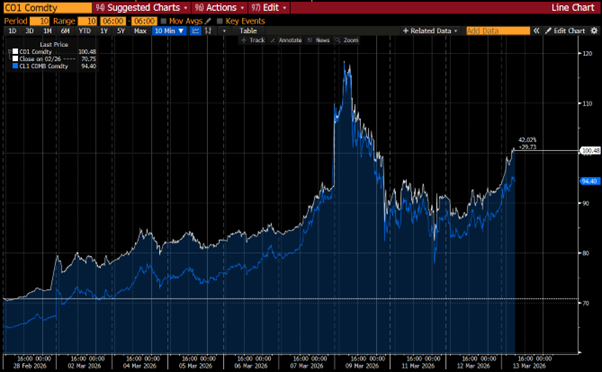 Source: Bloomberg
Interconnectedness of Oil and World Economies
Global economies remain heavily reliant on crude oil, with consumption estimated at approximately 104 million barrels per day in 2025, a 0.7% increase from 202412. Crude oil and its by-products fuels not just the oil and gas industry, but global logistics, travel, construction, and even everyday products. While countries such as the US, Germany, Japan, and members of the International Energy Agency (IEA) have released strategic reserves to ease short-term supply disruptions from the Iran conflict13, such measures are temporary and do not resolve underlying supply risks.
How Companies Manage Oil Price Volatility
Industries highly exposed to fuel costs, such as airlines and cruise operators, typically adopt hedging strategies to manage price volatility. More disciplined firms may hedge around 60% of fuel costs over periods ranging from six months to two years14. In contrast, companies that do not adopt hedging practices will be greatly affected and likely to see their fuel costs effectively doubled, resulting in thinner margins or even loss generating.
Potential inflationary pressure on Singapore
Sustained elevated oil prices could exert inflationary pressure on Singapore, which is highly dependent on imports. Higher energy costs would directly impact sectors such as utilities and transport, with knock-on effects across food, retail, and construction.
Petrol prices have already risen, with 95-octane fuel increasing from S$2.88 to S$3.35 as of 13 March 2026, reflecting a notable increase following recent geopolitical developments. Prolonged high oil prices may contribute to a higher cost of living and broader inflationary pressures15.
What can investors do in times of volatility and oil price hikes?
Having proper risk management and asset allocation is key in long term investing, especially during times of uncertainty. Most investors only care about maximising returns, with the saying “High Risk, High return, no Risk, No Return”, the correct way is to maximise risk adjusted returns over just returns. By gaining exposure to assets like gold, bonds and other defensive stocks that are traditionally negatively correlated with risk assets (equities and indices), investors are able to enjoy a greater risk adjusted return. Depending on individual circumstances, a typical allocation to defensive assets may range between 10% and 40% of a portfolio. Regular portfolio rebalancing, conducted periodically throughout the year, helps maintain discipline and alignment with long-term investment objectives.
Conclusion
Crude oil remains one of the most strategically important commodities in the global economy. Price fluctuations can quickly ripple through financial markets and impact economic stability.
For investors, understanding the dynamics of the oil market is essential in navigating periods of uncertainty. A disciplined approach to risk management and portfolio construction can help build resilience and support long-term wealth creation.
You can gain exposure to crude oil price movements by trading crude oil Contracts for Differences (CFDs) with PhillipCapital. Through crude oil CFDs, you can hedge existing exposures or speculate on both rising and falling oil prices with a relatively smaller upfront capital outlay, while benefiting from extended trading hours of up to approximately 21 hours a day to stay aligned with global market developments.
However, CFDs are leveraged products which can magnify both profits and losses, and you may lose more than your initial margin. CFD trading may not be suitable for all investors. You should carefully consider your financial situation, investment objectives, and risk tolerance before trading. For more information, please visit our CFD website
References:
- [1]https://kimray.com/training/types-crude-oil-heavy-vs-light-sweet-vs-sour-and-tan-count
- [2]https://oilandgascourses.org/classification-of-crude-oil-based-on-api-gravity/
- [3]https://mansfield.energy/2025/08/20/whats-that-heavy-vs-light-crude-oil/#:~:text=When%20considering%20the%20refining%20process,and%20higher%20profitability%20for%20refiners
- [4]https://www.eia.gov/todayinenergy/detail.php?id=18571
- [5]https://www.reuters.com/business/energy/why-is-asia-so-reliant-middle-eastern-oil-2026-03-04/#:~:text=A%20pie%20chart%20depicting%20the,Middle%20East%2C%20Kpler%20data%20showed
- [6]https://www.eia.gov/international/data/world/petroleum-and-other-liquids/annual-refined-petroleum-products-consumption?pd=5&p=0000001&u=0&f=A&v=mapbubble&a=-&i=none&vo=value&t=C&g=00000000000000000000000000000000000000000000000001&l=249-ruvvvvvfvtvnvv1urvvvvfvvvvvvfvvvou20evvvvvvvvvnvvvvs&s=94694400000&e=1672531200000
- [7]https://www.bbc.com/news/articles/cx2dyz6p3weo
- [8]https://www.aljazeera.com/news/2026/3/4/which-oil-and-gas-facilities-in-the-gulf-have-been-attacked
- [9]https://www.theguardian.com/world/2026/mar/03/iran-has-largely-halted-oil-and-gas-exports-through-strait-of-hormuz
- [10]https://oilprice.com/Latest-Energy-News/World-News/Gulf-Producers-Slash-Oil-Output-by-5-Million-Bpd.html
- [11]https://www.worldometers.info/oil/
- https://www.cnbc.com/2026/03/11/iea-oil-reserves-crude-prices-iran-g7-energy.html
- [12]https://www.bbc.com/news/articles/c14m57k8vgeo
- [13]https://www.channelnewsasia.com/singapore/oil-prices-iran-war-impact-singapore-transport-grocery-prices-5981591#:~:text=%E2%80%9CThe%20longer%20oil%20prices%20stay,IMPACT%20COULD%20BE%20SHORT%2DTERM
- [14]https://www.bbc.com/news/articles/c14m57k8vgeo
- [15]https://www.channelnewsasia.com/singapore/oil-prices-iran-war-impact-singapore-transport-grocery-prices-5981591#:~:text=%E2%80%9CThe%20longer%20oil%20prices%20stay,IMPACT%20COULD%20BE%20SHORT%2DTERM
Disclaimer
These commentaries are intended for general circulation and do not have regard to the specific investment objectives, financial situation and particular needs of any person. Accordingly, no warranty whatsoever is given and no liability whatsoever is accepted for any loss arising whether directly or indirectly as a result of any person acting based on this information. You should seek advice from a financial adviser regarding the suitability of any investment product(s) mentioned herein, taking into account your specific investment objectives, financial situation or particular needs, before making a commitment to invest in such products.
Opinions expressed in these commentaries are subject to change without notice. Investments are subject to investment risks including the possible loss of the principal amount invested. The value of units in any fund and the income from them may fall as well as rise. Past performance figures as well as any projection or forecast used in these commentaries are not necessarily indicative of future or likely performance.
Phillip Securities Pte Ltd (PSPL), its directors, connected persons or employees may from time to time have an interest in the financial instruments mentioned in these commentaries.
The information contained in these commentaries has been obtained from public sources which PSPL has no reason to believe are unreliable and any analysis, forecasts, projections, expectations and opinions (collectively the “Research”) contained in these commentaries are based on such information and are expressions of belief only. PSPL has not verified this information and no representation or warranty, express or implied, is made that such information or Research is accurate, complete or verified or should be relied upon as such. Any such information or Research contained in these commentaries are subject to change, and PSPL shall not have any responsibility to maintain the information or Research made available or to supply any corrections, updates or releases in connection therewith. In no event will PSPL be liable for any special, indirect, incidental or consequential damages which may be incurred from the use of the information or Research made available, even if it has been advised of the possibility of such damages. The companies and their employees mentioned in these commentaries cannot be held liable for any errors, inaccuracies and/or omissions howsoever caused. Any opinion or advice herein is made on a general basis and is subject to change without notice. The information provided in these commentaries may contain optimistic statements regarding future events or future financial performance of countries, markets or companies. You must make your own financial assessment of the relevance, accuracy and adequacy of the information provided in these commentaries.
Views and any strategies described in these commentaries may not be suitable for all investors. Opinions expressed herein may differ from the opinions expressed by other units of PSPL or its connected persons and associates. Any reference to or discussion of investment products or commodities in these commentaries is purely for illustrative purposes only and must not be construed as a recommendation, an offer or solicitation for the subscription, purchase or sale of the investment products or commodities mentioned.
This advertisement has not been reviewed by the Monetary Authority of Singapore.
About the author
Hei Tung Sam
Manager, Dealing
Contract for Differences
Sam graduated from National University of Singapore with a Master of Science in Finance. He personally manages his own investment portfolio and does equity and economic research in his free time. Sam believes that education and information is essential to making good financial decisions.
 Building a Strategic AI ETF Portfolio
  How CFDs Complement Your Trading and Investing Strategies
  Unveiling Opportunity: Exploring the Potential of European Equities
  Mastering Stop-Loss Placement: A Guide to Profitability in Forex Trading