Dollar-Cost Averaging At Zero Cost June 19, 2026
Accessible Investing

Investing today looks nothing like it did twenty years ago. In the past, investors placed trades by calling a broker over the phone and paying high brokerage fees. It was slow, expensive and, as a result, largely dominated by institutions and wealthy investors.
Today, technological advancements and competition have transformed the brokerage industry and reshaped the investment landscape. Mobile investing apps and online trading platforms now provide retail investors with real-time market access, lower transaction costs, and more convenience. Investing is now accessible to anyone with a smartphone.
Understanding Dollar-Cost Averaging

As more people begin their investment journey, many face the challenge of deciding when to enter the market. One of the many popular strategies that helps address this uncertainty is dollar-cost averaging (DCA).
DCA is an investment strategy where you invest a fixed amount of money at regular intervals, regardless of market conditions. Rather than trying to time the market, you stay consistent by investing the same amount every month, whether prices are rising or falling.
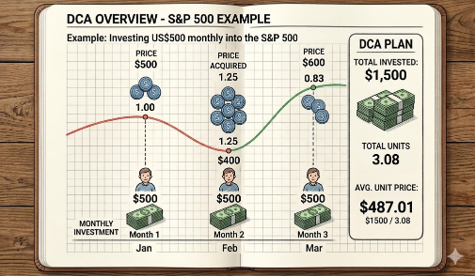
Example: Investing US$500 monthly into the S&P 500
| Month | Amount Invested | S&P 500 Price | Units Bought |
| Jan | $500 | $500 | 1.00 |
| Feb | $500 | $400 (dip) | 1.25 |
| Mar | $500 | $600 (rally) | 0.83 |
The amount invested remains constant each month, but the number of units purchased varies with market prices. When prices fall, the same investment amount buys more units; when prices rise, fewer units are bought. This helps investors accumulate more units during market downturns and fewer during market rallies, potentially lowering the average cost per unit over time.
Historically, the S&P 500 has delivered average annualised returns of around 8% to 10% over the long run. Hence, investors who remain disciplined and continue investing through market fluctuations have generally been rewarded over time. However, investors should note that past performance is not necessarily indicative of future results.
For a worked example using STI ETF, refer to POEMS’ article on DCA here.
Benefits of DCA:
- Reduces emotional decision-making
- Lowers the risk of investing a lump sum at the wrong time
- Reduces the average cost per share over time
- Encourages consistency and discipline
For investors focused on long-term wealth accumulation, consistent contributions can add up to more than most people realise.
If you are new to investing, are risk-averse, prefer a hands-off approach, or do not have time to monitor markets daily, the DCA strategy may be worth considering.
POEMS offers a Regular Savings Plan (RSP) that automates DCA across a range of stocks and ETFs — find out more here.
Costs Matter More Than You Think

Transaction costs are easy to overlook. Each fee appears small, but they accumulate over time.
Traditional brokerage accounts in Singapore typically charge a commission per transaction, subject to a minimum fee. As an example, a standard rate of 0.16% with a minimum fee of US$27.25 means a US$500 trade ends up costing approximately 5.5% in commission. Although the stated commission is 0.16%, the minimum fee dominates for small trades, resulting in a disproportionately high effective cost. For anyone practising DCA with regular contributions into US markets, this recurring cost creates a significant drag on every transaction.
Consider a comparison of investing US$500 monthly over 10 years:
| With US$27.25 Commission | Zero Commission | |
| Monthly Investment | US$500 | US$500 |
| Annual Fees Paid | US$327 (1 Monthly Trade) | US$0 |
| Capital Invested (10 Years) | US$56,730 | US$60,000 |
Assuming an 8% annual return, that US$3,270 in saved fees grows to approximately US$7,100 over 10 years. The opportunity cost of paying commissions is therefore not just US$3,270, but also the potential gains that it could have generated.
While each commission may seem small, every transaction adds to the overall cost of investing. For a high-frequency intra-day trader executing approximately 10 to 20 trades per day, each charged at US$2 to US$4 per trade, total fees would amount to US$20 to US$80 per day. Over time, these costs accumulate and reduce the amount of capital that stays invested and compounding. Lower fees allow more capital to remain invested and benefit from compounding over the long term.
Zero-Commission Investing

The investing landscape has changed significantly over the past decade. One of the biggest developments has been the rise of zero-commission trading, which has removed a major cost barrier and made investing more accessible to retail investors.
This shift has transformed how retail investors participate in the market by making features more accessible:
- Fractional shares became more viable when commissions were removed. Previously, a flat trading fee on a small fractional purchase could consume a significant portion of the investment, making it impractical for smaller investors.
- Recurring orders allow investors to automate regular purchases and practise DCA. Under the old fee structure, each transaction would incur charges, making frequent small investments costly and less effective.
- Lower barriers for younger investors. With no commissions, investors with limited capital can start investing without fees eroding their principal.
With the growth of mobile investing platforms, zero-commission trading has made investing more accessible than ever. POEMS recently launched US$0 brokerage commissions on US stocks through its Cash Plus Account, making it the first full-service brokerage firm in Singapore to offer true zero-commission US equities.
Investors can manage their portfolios and place trades directly from their phones, while real-time market access allows them to monitor price movements and react instantly to market developments. Without commissions, investors can take advantage of market opportunities without fees eating into smaller trades.
Why Zero-Cost DCA Matters for Retail Investors

Zero-cost DCA is a game-changer for retail investors because it eliminates transaction fees that disproportionately affect portfolios. Removing these costs allows contributions to be fully invested.
For retail investors:
- Low barrier of entry, making it easier to start with smaller amounts
- Supports disciplined investing habits
- Enables recurring investment strategies without fees affecting each contribution
- Reduces hesitation and emotional resistance during volatile market periods
For long-term investors:
- Better capital efficiency, as more money remains invested and able to compound over time
- Encourages consistency, rather than relying on market timing
Overall, zero-cost investing combined with DCA reduces two key barriers for retail investors: cost and complexity. It replaces them with a simple and repeatable strategy that supports long-term investing discipline.
True Zero Commission

Geography, high fees, or access to platforms no longer constrain investing. Today, anyone with a smartphone can start investing with ease.
For retail investors, zero-cost DCA offers a straightforward way to take advantage of this shift. With commissions at US$0, investors can invest consistently, build positions over time, and allow compounding to work without small fees quietly eating into returns.
DCA remains one of the simplest long-term strategies. With POEMS Cash Plus offering US$0 commission, no platform fees and no settlement fees on US stocks, it removes barriers that previously made regular investing more difficult.
However, zero-cost DCA is not a one-size-fits-all solution. Investors should consider their financial goals and risk tolerance before incorporating DCA into their investment strategy.
In today’s market, consistency and discipline often matter more than trying to time the perfect entry. Start your zero-commission DCA journey with POEMS Cash Plus today.
Appendix/Sources
- [1]https://financialhorse.com/is-dca-the-best-way-to-buy-stocks/
- [2] https://www.investopedia.com/terms/d/dollarcostaveraging.asp
- [3]https://www.poems.com.sg/market-journal/simple-but-powerful-strategies-behind-dca-and-dva/
- [4]https://www.home.saxo/content/articles/macro/worried-about-investing-at-market-highs-dollar-cost-averaging-dca-can-help-10122024
- [5] https://www.stashaway.sg/r/singapore-best-online-brokerages-trading-platforms
- [6]https://www.dbsvickers.com/vickers/pricing/individualaccount?pid=sg-vickers-en-trade-heroblock-individual-account-learnmorebtn
Disclaimer
These commentaries are intended for general circulation and do not have regard to the specific investment objectives, financial situation and particular needs of any person. Accordingly, no warranty whatsoever is given and no liability whatsoever is accepted for any loss arising whether directly or indirectly as a result of any person acting based on this information. You should seek advice from a financial adviser regarding the suitability of any investment product(s) mentioned herein, taking into account your specific investment objectives, financial situation or particular needs, before making a commitment to invest in such products.
Opinions expressed in these commentaries are subject to change without notice. Investments are subject to investment risks including the possible loss of the principal amount invested. The value of units in any fund and the income from them may fall as well as rise. Past performance figures as well as any projection or forecast used in these commentaries are not necessarily indicative of future or likely performance.
Phillip Securities Pte Ltd (PSPL), its directors, connected persons or employees may from time to time have an interest in the financial instruments mentioned in these commentaries.
The information contained in these commentaries has been obtained from public sources which PSPL has no reason to believe are unreliable and any analysis, forecasts, projections, expectations and opinions (collectively the “Research”) contained in these commentaries are based on such information and are expressions of belief only. PSPL has not verified this information and no representation or warranty, express or implied, is made that such information or Research is accurate, complete or verified or should be relied upon as such. Any such information or Research contained in these commentaries are subject to change, and PSPL shall not have any responsibility to maintain the information or Research made available or to supply any corrections, updates or releases in connection therewith. In no event will PSPL be liable for any special, indirect, incidental or consequential damages which may be incurred from the use of the information or Research made available, even if it has been advised of the possibility of such damages. The companies and their employees mentioned in these commentaries cannot be held liable for any errors, inaccuracies and/or omissions howsoever caused. Any opinion or advice herein is made on a general basis and is subject to change without notice. The information provided in these commentaries may contain optimistic statements regarding future events or future financial performance of countries, markets or companies. You must make your own financial assessment of the relevance, accuracy and adequacy of the information provided in these commentaries.
Views and any strategies described in these commentaries may not be suitable for all investors. Opinions expressed herein may differ from the opinions expressed by other units of PSPL or its connected persons and associates. Any reference to or discussion of investment products or commodities in these commentaries is purely for illustrative purposes only and must not be construed as a recommendation, an offer or solicitation for the subscription, purchase or sale of the investment products or commodities mentioned.
This advertisement has not been reviewed by the Monetary Authority of Singapore.
About the author
Global Markets Desk (Asia Market)
The Global Markets Desk Asia Market Dealing team specializes in managing Asia Markets, covering key regions like Greater China, Malaysia, Japan, Thailand, and others. In addition to executing client orders, they also provide educational content through market journals and webinars, offering insights into macroeconomics, stock picks, and technical analyses for the Asia market landscape.
 Wells Fargo Maintains Growth Momentum Despite Rate Headwinds
  Raffles Education Set for Growth Pivot as Focus Shifts to ASEAN K-12 Expansion
  Nanofilm Technologies Targets Growth Through Commercialisation of Deep Tech Solutions
  JPMorgan Chase Maintains ACCUMULATE Rating Despite Lower Target Price