KOSPI Vs KOSDAQ: Which South Korean Market Is Right For You? May 26, 2026
This is the second part of our South Korean Market Series — New to South Korea? Start with our South Korean Stock Market Guide.
Two Markets, One Decision

If you’ve decided that South Korean stocks deserve a place in your portfolio, your next question should be: which Korean stock exchange should I trade on? South Korea has two main stock markets — the KOSPI and the KOSDAQ — and understanding the difference between them can meaningfully shape your investment strategy.
Here’s the honest answer up front: most international investors will find themselves drawn to the KOSPI for core positions, while the KOSDAQ offers higher-risk, higher-reward opportunities for those comfortable with more volatility. But the full picture is more nuanced — and knowing it gives you an edge.
The Basics: Two Boards, One Exchange

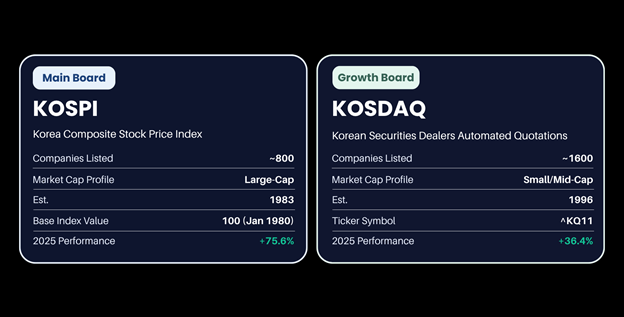
Both the KOSPI and KOSDAQ are operated by the Korea Exchange (KRX). They share the same trading infrastructure, settlement rules, and regulatory framework.
The key differences come down to the types of companies listed, the risk profiles of those companies, and the type of returns each board has historically delivered.
A Deeper Comparison
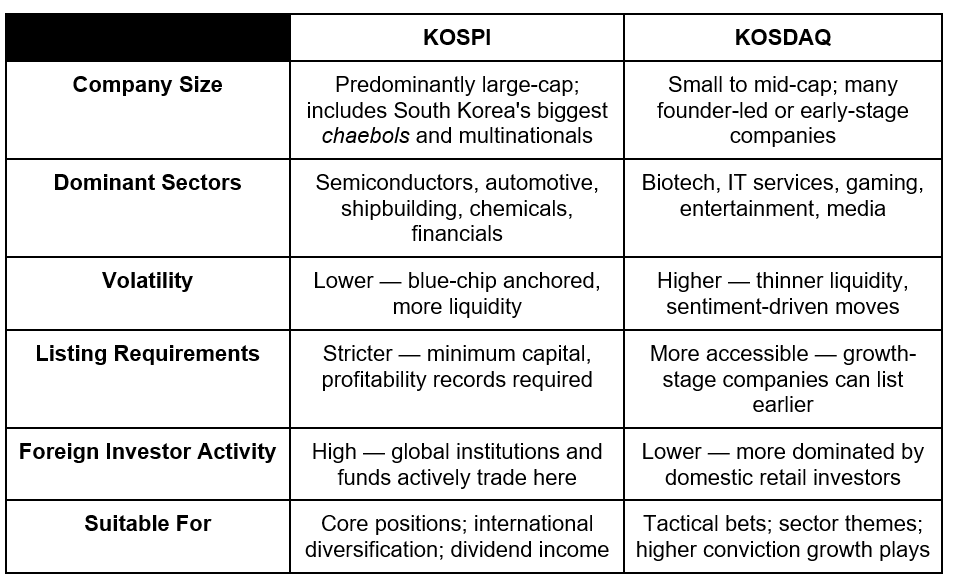
What Trades On Each Board?
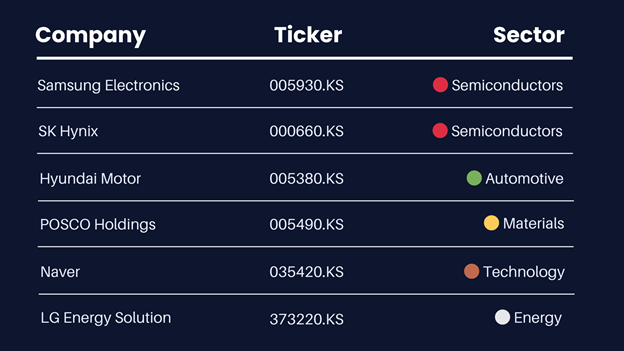
KOSPI: The Household Names
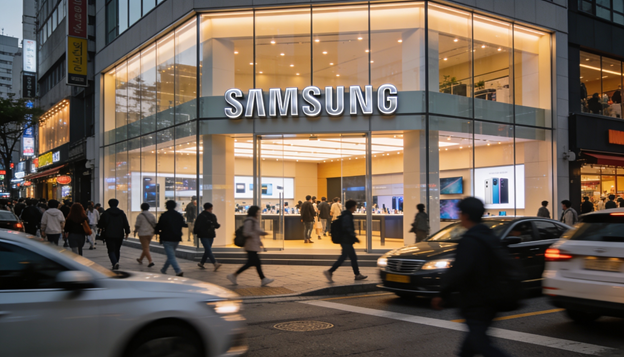
The KOSPI is where South Korea’s most globally recognisable companies trade. Samsung Electronics and SK Hynix alone make up more than a quarter of the index’s total market capitalisation. If you’ve ever used a Samsung phone, driven a Hyundai, or ordered a product packaged in LG plastics, you’ve interacted with KOSPI-listed companies.
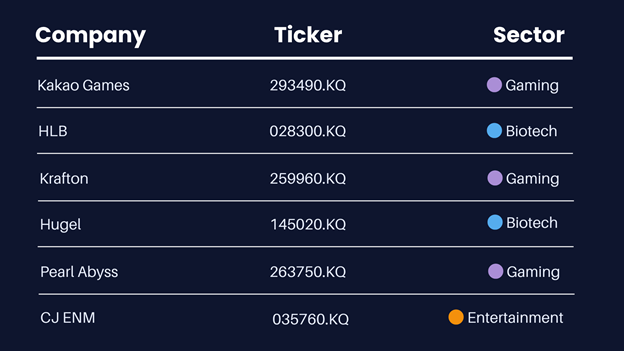
KOSDAQ: The Growth Stories

The KOSDAQ is home to a different kind of company — younger, faster-moving, and often operating in sectors where South Korea punches well above its weight globally: biotechnology, online gaming, K-pop entertainment, and software.
Which One Should You Trade?
The right choice depends on your investment style, risk appetite, and what you’re trying to achieve. Here’s a simple way to think about it:
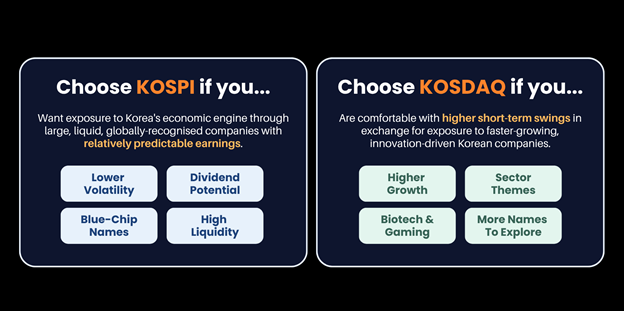
Practical Tip: Many experienced investors in South Korean equities use the KOSPI for their core holdings and allocate a smaller portion to select KOSDAQ names where they have specific sector conviction — for example, a biotech theme or a particular gaming company. Remember, you don’t have to trade only on one of them.
A Few Things To Know Before You Start Trading
Daily Price Limits Apply To Both Boards

South Korea’s KRX applies a ±30% daily price movement limit to all listed stocks. This is a circuit breaker designed to prevent extreme intraday volatility. This means that any particular stock listed on the exchange cannot rise or fall more than 30% in a single trading session — a protection that’s particularly relevant on the KOSDAQ, where individual names can move dramatically on news.
Liquidity Differs Significantly

KOSPI’s large-cap stocks trade with high daily volumes, making it easy to enter and exit positions at predictable prices. On the KOSDAQ, mid and small-cap names can have much thinner order books. Always check average daily volume before sizing a KOSDAQ position — especially if you plan to trade in meaningful size.
Caution: Some KOSDAQ-listed biotech companies experience extreme price swings around clinical trial announcements. These can be significant opportunities — but also significant risks. Position sizing matters more here than on the KOSPI.
Trading Hours Are The Same For Both

Both boards trade Monday to Friday, 9:00 AM – 3:30 PM KST (8:00 AM – 2:30 PM SGT). The convenient time zone overlap with Southeast Asia makes both boards accessible during normal working hours — no late nights required.
The Bottom Line

The KOSPI and the KOSDAQ are complementary, not competing. The KOSPI gives you the stability and scale of South Korea’s industrial and technology giants; the KOSDAQ gives you access to the next generation of South Korean innovation. Understanding the distinction — and matching each to the right part of your portfolio — is one of the first things experienced South Korea traders get right.
Ready to explore both boards? Our platform gives you direct access to KOSPI and KOSDAQ-listed stocks with competitive FX rates and straightforward account setup.
For enquiries, please contact talktoglobalmarkets@phillip.com.sg
Disclaimer
These commentaries are intended for general circulation and do not have regard to the specific investment objectives, financial situation and particular needs of any person. Accordingly, no warranty whatsoever is given and no liability whatsoever is accepted for any loss arising whether directly or indirectly as a result of any person acting based on this information. You should seek advice from a financial adviser regarding the suitability of any investment product(s) mentioned herein, taking into account your specific investment objectives, financial situation or particular needs, before making a commitment to invest in such products.
Opinions expressed in these commentaries are subject to change without notice. Investments are subject to investment risks including the possible loss of the principal amount invested. The value of units in any fund and the income from them may fall as well as rise. Past performance figures as well as any projection or forecast used in these commentaries are not necessarily indicative of future or likely performance.
Phillip Securities Pte Ltd (PSPL), its directors, connected persons or employees may from time to time have an interest in the financial instruments mentioned in these commentaries.
The information contained in these commentaries has been obtained from public sources which PSPL has no reason to believe are unreliable and any analysis, forecasts, projections, expectations and opinions (collectively the “Research”) contained in these commentaries are based on such information and are expressions of belief only. PSPL has not verified this information and no representation or warranty, express or implied, is made that such information or Research is accurate, complete or verified or should be relied upon as such. Any such information or Research contained in these commentaries are subject to change, and PSPL shall not have any responsibility to maintain the information or Research made available or to supply any corrections, updates or releases in connection therewith. In no event will PSPL be liable for any special, indirect, incidental or consequential damages which may be incurred from the use of the information or Research made available, even if it has been advised of the possibility of such damages. The companies and their employees mentioned in these commentaries cannot be held liable for any errors, inaccuracies and/or omissions howsoever caused. Any opinion or advice herein is made on a general basis and is subject to change without notice. The information provided in these commentaries may contain optimistic statements regarding future events or future financial performance of countries, markets or companies. You must make your own financial assessment of the relevance, accuracy and adequacy of the information provided in these commentaries.
Views and any strategies described in these commentaries may not be suitable for all investors. Opinions expressed herein may differ from the opinions expressed by other units of PSPL or its connected persons and associates. Any reference to or discussion of investment products or commodities in these commentaries is purely for illustrative purposes only and must not be construed as a recommendation, an offer or solicitation for the subscription, purchase or sale of the investment products or commodities mentioned.
This advertisement has not been reviewed by the Monetary Authority of Singapore.
About the author
Global Markets Desk (Asia Market)
The Global Markets Desk Asia Market Dealing team specializes in managing Asia Markets, covering key regions like Greater China, Malaysia, Japan, Thailand, and others. In addition to executing client orders, they also provide educational content through market journals and webinars, offering insights into macroeconomics, stock picks, and technical analyses for the Asia market landscape.
 Wells Fargo Maintains Growth Momentum Despite Rate Headwinds
  Raffles Education Set for Growth Pivot as Focus Shifts to ASEAN K-12 Expansion
  Nanofilm Technologies Targets Growth Through Commercialisation of Deep Tech Solutions
  JPMorgan Chase Maintains ACCUMULATE Rating Despite Lower Target Price