Leveraged & Inverse ETFs: Power, Pitfalls, and Practical Use May 5, 2026
Table of Contents
- Introduction to Leveraged ETFs
- Overview of MAS SIP Requirements
- The Power of Leveraged ETFs
- Pitfalls of Leveraged ETFs
- Popular Leveraged & Inverse ETFs
- Should You Trade Leveraged ETFs?
Leveraged & Inverse ETFs carry many risks and may not be suitable for risk-averse investors.
Introduction to Leveraged & Inverse ETFs

Leveraged and inverse ETFs use derivatives to deliver amplified or inverse returns relative to an underlying index, typically on a daily basis. These products are designed to provide a multiplier effect, allowing investors to gain enhanced exposure to market movements in both rising and falling conditions.
While they offer the potential for higher returns, they also come with elevated risks. As such, they are generally more suitable for short-term tactical strategies rather than long-term investing.
Overview of MAS SIP Requirements

As leveraged and inverse ETFs use more complex structures, they are classified as Specified Investment Products (SIPs). This means investors must demonstrate a certain level of knowledge before trading them.
Since 2012, in alignment with the Monetary Authority of Singapore’s efforts to enhance trading protections for retail investors, brokers are required to assess an investor’s relevant knowledge and experience before permitting investments in SIPs.
As a result, investors must complete the Customer Account Review (CAR) eligibility form before being allowed to invest in listed SIPs. If you’re new to these products, you can build your understanding by completing the SIP product knowledge module offered through the SGX Academy to qualify for trading.
The Power of Leveraged ETFs

Leveraged ETFs can provide amplified exposure to well-known companies such as NVIDIA, Amazon, Tesla, and Netflix, many of which are already highly volatile.
Beyond individual stocks, leveraged ETFs are also available on major indices such as the S&P 500, Dow Jones Industrial Average, and Nasdaq-100.
1. Short-Term Directional Positioning
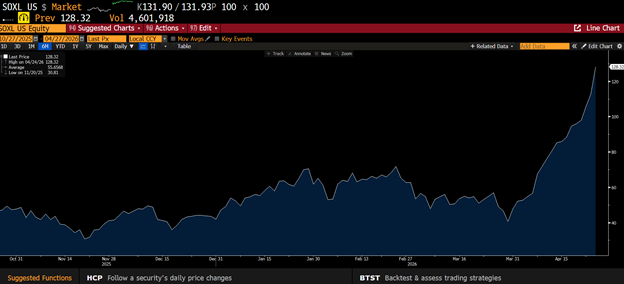 Bloomberg: Direxion Daily Semiconductor Bull 3X ETF (SOXL.US) Updated as of 28 April 2026
As illustrated in the Bloomberg screenshot, leveraged ETFs can deliver amplified returns at a sector level, such as offering 3x exposure to semiconductor performance, which allow investors to capitalise on short-term market momentum.
 Source: POEMS
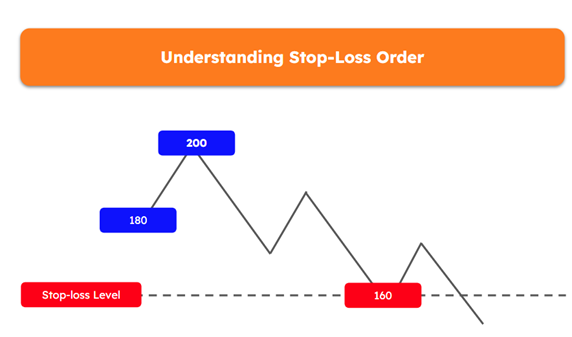
However, leverage works both ways. If the market reverses, losses are equally magnified. Investors are therefore strongly encouraged to implement risk management strategies, such as stop-loss orders, before taking on additional positions.
2. Hedging Portfolio To Protect Downside Risk
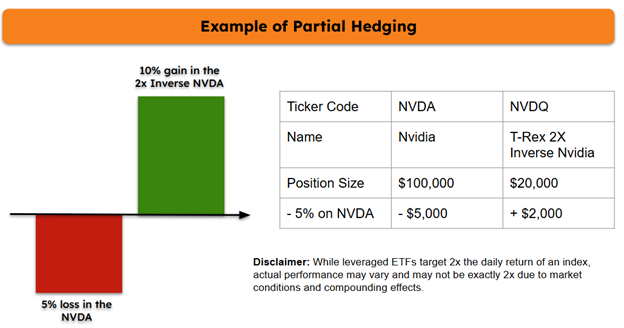
During periods of heightened uncertainty and volatility, portfolios may come under pressure. Investors who wish to protect their portfolios can always take on short positions to hedge their downside risk.
 Source: POEMS
Inverse or leveraged ETFs can be effective hedging tools, allowing investors to offset potential losses by taking inverse positions against their existing holdings, thereby reducing potential losses during market downturns.
The Pitfalls of Leveraged ETFs

The key risks of leveraged ETFs stem from their structure and daily reset feature, which makes them fundamentally different from traditional ETFs.
- Daily Reset Risk
Leveraged ETFs are designed to deliver a multiple of daily returns, not long-term performance. Holding these products over multiple days may result in returns that deviate significantly from the expected multiple of the underlying index. - Volatility Decay
In volatile or sideways markets, leveraged ETFs may lose value due to volatility decay. Price fluctuations can erode returns even if the underlying index ends up relatively unchanged. - Compounding Effect
Compounding can work against investors over time. Losses require a larger percentage gain to recover, meaning even small declines can have a disproportionate impact on overall performance.
Illustration of Compounding Effect:
| Open Price (USD) | Closing Price (USD) | % Difference |
| 53.5 | 50.83 | – 5% |
| 50.83 | 53.37 | + 5% |
Despite a 5% decline followed by a 5% gain, the price does not return to its original level. This effect, combined with volatility decay, illustrates why leveraged ETFs are generally unsuitable for long-term holding.
Popular Leveraged & Inverse ETFs
| Ticker Code | Issuer | Underlying | Leverage | Market Cap | Price (USD) |
| TQQQ | ProShares | NASDAQ | 3x | 24.59B | 62.64 |
| SOXL | Direxion | ICE Semiconductor Index | 3x | 12.23B | 123.39 |
| SPXL | Direxion | S&P 500 | 3x | 4.65B | 149.42 |
| NVDL | GraniteShares | NVDA | 2x | 3.73B | 110.44 |
| TECL | Direxion | Technology | 3x | 2.98B | 149.42 |
Source: POEMSLast Updated: 27 April 2026
Should You Trade Leveraged ETFs?

Leveraged and inverse ETFs can be powerful tools when used appropriately. To use them effectively, investors must have a clear understanding of their structure, risks, and intended use cases.
They are best suited for:
- Short-term trading strategies
- Tactical positioning
- Portfolio hedging
Ultimately, successful use of these instruments depends on discipline, risk management, and a strong understanding of how they behave under different market conditions.
Start Your Global Investment Journey Today! Open an account with POEMS and take the first step toward a diversified, globally-focused portfolio!

For more information about trading on POEMS, you can visit our website or reach out to our Night Desk representatives at 6531 1225.
Disclaimer
These commentaries are intended for general circulation and do not have regard to the specific investment objectives, financial situation and particular needs of any person. Accordingly, no warranty whatsoever is given and no liability whatsoever is accepted for any loss arising whether directly or indirectly as a result of any person acting based on this information. You should seek advice from a financial adviser regarding the suitability of any investment product(s) mentioned herein, taking into account your specific investment objectives, financial situation or particular needs, before making a commitment to invest in such products.
Opinions expressed in these commentaries are subject to change without notice. Investments are subject to investment risks including the possible loss of the principal amount invested. The value of units in any fund and the income from them may fall as well as rise. Past performance figures as well as any projection or forecast used in these commentaries are not necessarily indicative of future or likely performance.
Phillip Securities Pte Ltd (PSPL), its directors, connected persons or employees may from time to time have an interest in the financial instruments mentioned in these commentaries.
The information contained in these commentaries has been obtained from public sources which PSPL has no reason to believe are unreliable and any analysis, forecasts, projections, expectations and opinions (collectively the “Research”) contained in these commentaries are based on such information and are expressions of belief only. PSPL has not verified this information and no representation or warranty, express or implied, is made that such information or Research is accurate, complete or verified or should be relied upon as such. Any such information or Research contained in these commentaries are subject to change, and PSPL shall not have any responsibility to maintain the information or Research made available or to supply any corrections, updates or releases in connection therewith. In no event will PSPL be liable for any special, indirect, incidental or consequential damages which may be incurred from the use of the information or Research made available, even if it has been advised of the possibility of such damages. The companies and their employees mentioned in these commentaries cannot be held liable for any errors, inaccuracies and/or omissions howsoever caused. Any opinion or advice herein is made on a general basis and is subject to change without notice. The information provided in these commentaries may contain optimistic statements regarding future events or future financial performance of countries, markets or companies. You must make your own financial assessment of the relevance, accuracy and adequacy of the information provided in these commentaries.
Views and any strategies described in these commentaries may not be suitable for all investors. Opinions expressed herein may differ from the opinions expressed by other units of PSPL or its connected persons and associates. Any reference to or discussion of investment products or commodities in these commentaries is purely for illustrative purposes only and must not be construed as a recommendation, an offer or solicitation for the subscription, purchase or sale of the investment products or commodities mentioned.
This advertisement has not been reviewed by the Monetary Authority of Singapore.
About the author
Thng Xiao Xiong
Xiao Xiong is an assistant manager in the Global Markets Team specializing in UK markets. He is a graduate of the Singapore Institute of Technology with a bachelor's in Aircraft System Engineering. He has a strong interest in macroeconomics and options strategies.
 Maximizing Retirement Wealth: How to Invest CPF-OA and SRS in SGX ETFs
  ETF Monthly Review: Mixed September Performance with Muted October Outlook Expected
  Investing in the AI Revolution: A Guide to Semiconductor & Ecosystem ETFs
  Phillip SING Income ETF Reaches All-Time High Dividend with Banking Sector Focus