
Meta Platforms Inc. Upgraded to BUY Despite Higher CAPEX Concerns, US$795 Target Price May 13, 2026

Strong Q1 Performance Drives Rating Upgrade
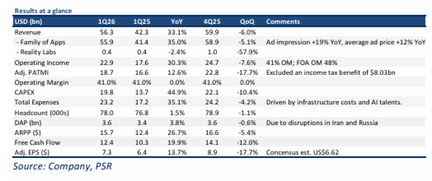
Meta Platforms Inc. has been upgraded to a BUY rating by Phillip Securities Research, despite concerns over increased capital expenditure guidance. The social media giant delivered robust first-quarter results with revenue climbing 33% year-on-year to US$56.3 billion, whilst adjusted profit after tax and minority interests rose 13% to US$18.7 billion. However, the target price has been reduced to US$795 from the previous US$825 due to higher expenses and margin compression expectations.
Meta operates as a leading social media and technology company, connecting billions of users globally through its Family of Apps ecosystem including Facebook, Instagram, WhatsApp, and Messenger. The company also invests heavily in virtual and augmented reality through its Reality Labs division.
The Positives: Resilient Advertising Performance
Meta demonstrated exceptional advertising strength in the first quarter, with ad revenue reaching US$55 billion, representing a 33% year-on-year increase compared to 16% growth in the previous corresponding quarter. This robust performance was underpinned by higher engagement and improved monetisation across the company’s platforms.
The standout driver was the integration of Muse Spark, Meta’s newly launched natively multimodal reasoning model developed by Meta Superintelligent Lab. This AI enhancement significantly improved content personalisation and recommendation capabilities across all platforms. Following deployment, Instagram Reels time spent increased 10% year-on-year, whilst Facebook video time spent rose over 8%, marking the strongest quarter-on-quarter engagement improvement in four years.
The monetisation metrics were equally impressive, with ad impressions increasing 19% year-on-year compared to 5% previously, and average price per ad rising 12% year-on-year. Given Muse Spark’s strong early traction and scalability potential across WhatsApp, Instagram, and Messenger, analysts maintain their advertising forecasts and expect 30% year-on-year revenue growth for the full year.
The Negatives: Reality Labs Losses Continue
Meta’s Reality Labs segment remains a significant drag on profitability, continuing to generate substantial losses despite some improvement. Operating losses narrowed approximately 4% year-on-year to US$4.2 billion, compared to 9.5% growth in losses previously. Segment revenue declined 2% year-on-year to US$885 million, primarily attributed to lower Quest headset sales. However, AI glasses showed promising growth with daily users expanding threefold year-on-year.
The company also revised its capital expenditure guidance upward by approximately 8%, establishing a new range of US$125-145 billion compared to the previous US$115-135 billion. Management attributed this increase to robust compute demand for scaling AI infrastructure, despite aggressive capacity ramping efforts.
Frequently Asked Questions
Q: What is Meta's new target price and rating?
A: Phillip Securities Research upgraded Meta to a BUY rating with a reduced target price of US$795, down from the previous US$825.
Q: How did Meta's Q1 revenue and profit perform?
A: Meta reported revenue of US$56.3 billion, up 33% year-on-year, and adjusted profit after tax and minority interests of US$18.7 billion, up 13% year-on-year.
Q: What is Muse Spark and how did it impact performance?
A: Muse Spark is Meta's newly launched natively multimodal reasoning model that enhanced content personalisation and recommendations, leading to 10% growth in Instagram Reels time spent and over 8% growth in Facebook video time spent.
Q: How did Meta's advertising metrics perform?
A: Ad impressions increased 19% year-on-year whilst average price per ad rose 12% year-on-year, with total ad revenue reaching US$55 billion.
Q: What happened with Meta's capital expenditure guidance?
A: Meta revised its capital expenditure guidance upward by approximately 8% to US$125-145 billion from the previous US$115-135 billion range due to robust AI infrastructure demand.
Q: How is Reality Labs performing financially?
A: Reality Labs continues to be loss-making with operating losses of US$4.2 billion, though this represents a 4% year-on-year improvement. Revenue declined 2% to US$885 million.
Q: What are the growth prospects for Meta's AI glasses?
A: AI glasses showed strong momentum with daily users growing threefold year-on-year, despite overall Reality Labs revenue declining due to lower Quest headset sales.
This article has been auto-generated using PhillipGPT. It is based on a report by a Phillip Securities Research analyst.
Disclaimer
These commentaries are intended for general circulation and do not have regard to the specific investment objectives, financial situation and particular needs of any person. Accordingly, no warranty whatsoever is given and no liability whatsoever is accepted for any loss arising whether directly or indirectly as a result of any person acting based on this information. You should seek advice from a financial adviser regarding the suitability of any investment product(s) mentioned herein, taking into account your specific investment objectives, financial situation or particular needs, before making a commitment to invest in such products.
Opinions expressed in these commentaries are subject to change without notice. Investments are subject to investment risks including the possible loss of the principal amount invested. The value of units in any fund and the income from them may fall as well as rise. Past performance figures as well as any projection or forecast used in these commentaries are not necessarily indicative of future or likely performance.
Phillip Securities Pte Ltd (PSPL), its directors, connected persons or employees may from time to time have an interest in the financial instruments mentioned in these commentaries.
The information contained in these commentaries has been obtained from public sources which PSPL has no reason to believe are unreliable and any analysis, forecasts, projections, expectations and opinions (collectively the “Research”) contained in these commentaries are based on such information and are expressions of belief only. PSPL has not verified this information and no representation or warranty, express or implied, is made that such information or Research is accurate, complete or verified or should be relied upon as such. Any such information or Research contained in these commentaries are subject to change, and PSPL shall not have any responsibility to maintain the information or Research made available or to supply any corrections, updates or releases in connection therewith. In no event will PSPL be liable for any special, indirect, incidental or consequential damages which may be incurred from the use of the information or Research made available, even if it has been advised of the possibility of such damages. The companies and their employees mentioned in these commentaries cannot be held liable for any errors, inaccuracies and/or omissions howsoever caused. Any opinion or advice herein is made on a general basis and is subject to change without notice. The information provided in these commentaries may contain optimistic statements regarding future events or future financial performance of countries, markets or companies. You must make your own financial assessment of the relevance, accuracy and adequacy of the information provided in these commentaries.
Views and any strategies described in these commentaries may not be suitable for all investors. Opinions expressed herein may differ from the opinions expressed by other units of PSPL or its connected persons and associates. Any reference to or discussion of investment products or commodities in these commentaries is purely for illustrative purposes only and must not be construed as a recommendation, an offer or solicitation for the subscription, purchase or sale of the investment products or commodities mentioned.
This advertisement has not been reviewed by the Monetary Authority of Singapore.
About the author

Serena Lim Qi
Serena is a Research Analyst covering the U.S. Technology sector at PSR. Prior to joining the firm, she worked as an Equity Dealer and held various roles across the insurance and banking industries. Serena holds a Bachelor's degree in Economics and a Postgraduate Diploma in Applied Finance from the University of Adelaide.
 Wells Fargo Maintains Growth Momentum Despite Rate Headwinds
  Raffles Education Set for Growth Pivot as Focus Shifts to ASEAN K-12 Expansion
  Nanofilm Technologies Targets Growth Through Commercialisation of Deep Tech Solutions
  JPMorgan Chase Maintains ACCUMULATE Rating Despite Lower Target Price