SIA Faces Headwinds from Associate Losses Despite Strong Operations, Neutral Rating with S$6.43 Target May 26, 2026
Company Overview
Singapore Airlines (SIA) is one of Asia’s leading premium carriers, operating an extensive international network and maintaining significant investments in aviation-related associates including Air India.
Mixed Financial Performance
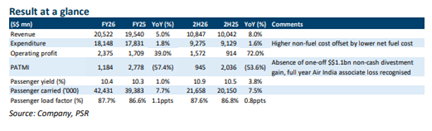
SIA delivered a tale of two halves in its latest results, with robust operational metrics overshadowed by substantial associate losses. The airline’s 2H26/FY26 profit after tax and minority interests declined sharply by 53.6%/57.4% year-on-year to S$945 million/S$1,184 million respectively, representing 97%/78% of analysts’ FY26 estimates.
Operational Excellence Shines Through
Despite the earnings headwinds, SIA’s core operations demonstrated remarkable strength. Operating profit surged an impressive 72% year-on-year in 2H26 to S$1,572 million, driven by two key factors. Firstly, the airline achieved stronger passenger yields, rising 3.8% year-on-year, whilst traffic growth expanded 4.7% year-on-year. Secondly, net fuel costs declined by S$178 million year-on-year, as effective fuel hedging strategies generated S$218 million in hedging gains during 2H26.
For the full year, operating profit climbed 39% year-on-year to S$2,375 million, achieving an 11.6% operating margin. The passenger load factor reached 87.7% as traffic growth of 4.7% outpaced capacity expansion of 3.4%. Passenger yield rose 1.0% year-on-year to 10.4 cents per revenue passenger kilometre, whilst net fuel costs fell S$361 million representing a 6.7% year-on-year decline.
Associate Losses Create Significant Drag
The primary challenge facing SIA stems from its associate investments, particularly Air India. Associate losses reached S$512 million in 2H26 and S$828 million for the full year, with Air India accounting for the majority of these losses at S$828.5 million annually.
Air India’s struggles reflect multiple operational challenges, including Pakistan’s closure of airspace to Indian carriers from April 2025, forcing costly route diversions. The US-Iran conflict in February 2026 further impacted operations, given the Middle East’s importance as a transit hub for Indian aviation. Additionally, Air India operates without fuel hedging protection, leaving it fully exposed to volatile jet fuel prices. Management has indicated these losses will remain elevated in the near term.
Research Outlook
Phillip Securities Research maintains a Neutral rating on SIA with a reduced target price of S$6.43, down from S$7.00 previously. The price-to-book multiple has been lowered from 1.3x to 1.1x to reflect heightened sector risks following the US-Iran conflict, whilst fuel cost estimates for FY27 have been increased to account for cheaper hedges rolling off. However, SIA’s strong balance sheet and special dividend policy through FY28 provide downside support for investors.
Frequently Asked Questions
Q: What was SIA's financial performance in 2H26 and FY26?
A: SIA's 2H26/FY26 profit after tax and minority interests declined 53.6%/57.4% year-on-year to S$945 million/S$1,184 million, forming 97%/78% of FY26 estimates.
Q: How did SIA's operational performance fare despite the earnings decline?
A: SIA's operations were strong, with 2H26 operating profit surging 72% year-on-year to S$1,572 million due to stronger passenger yields (up 3.8% year-on-year), traffic growth (up 4.7% year-on-year), and S$178 million decline in net fuel costs from hedging gains.
Q: What caused the significant associate losses?
A: Associate losses of S$828 million primarily came from Air India, which faced challenges from Pakistan's airspace closure to Indian carriers, the US-Iran conflict impacting Middle East transit routes, and lack of fuel hedging protection.
Q: What is Phillip Securities Research's recommendation and target price?
A: Phillip Securities Research maintains a Neutral rating with a reduced target price of S$6.43, down from S$7.00 previously, reflecting heightened sector risks and rolling off of cheaper fuel hedges.
Q: How did fuel costs impact SIA's performance?
A: Net fuel costs fell S$361 million (6.7% year-on-year decline) for the full year, with S$143 million in hedging gains and fuel bills largely locked in at pre-conflict prices benefiting the airline.
Q: What are the key operational metrics for SIA?
A: SIA achieved an 87.7% passenger load factor, 4.7% traffic growth outpacing 3.4% capacity expansion, passenger yield of 10.4 cents per revenue passenger kilometre, and 11.6% operating margin.
Q: What provides downside support for SIA shares?
A: SIA's strong balance sheet and special dividend policy through FY28 provide downside support for investors despite the current challenges.
This article has been auto-generated using PhillipGPT. It is based on a report by a Phillip Securities Research analyst.
Disclaimer
These commentaries are intended for general circulation and do not have regard to the specific investment objectives, financial situation and particular needs of any person. Accordingly, no warranty whatsoever is given and no liability whatsoever is accepted for any loss arising whether directly or indirectly as a result of any person acting based on this information. You should seek advice from a financial adviser regarding the suitability of any investment product(s) mentioned herein, taking into account your specific investment objectives, financial situation or particular needs, before making a commitment to invest in such products.
Opinions expressed in these commentaries are subject to change without notice. Investments are subject to investment risks including the possible loss of the principal amount invested. The value of units in any fund and the income from them may fall as well as rise. Past performance figures as well as any projection or forecast used in these commentaries are not necessarily indicative of future or likely performance.
Phillip Securities Pte Ltd (PSPL), its directors, connected persons or employees may from time to time have an interest in the financial instruments mentioned in these commentaries.
The information contained in these commentaries has been obtained from public sources which PSPL has no reason to believe are unreliable and any analysis, forecasts, projections, expectations and opinions (collectively the “Research”) contained in these commentaries are based on such information and are expressions of belief only. PSPL has not verified this information and no representation or warranty, express or implied, is made that such information or Research is accurate, complete or verified or should be relied upon as such. Any such information or Research contained in these commentaries are subject to change, and PSPL shall not have any responsibility to maintain the information or Research made available or to supply any corrections, updates or releases in connection therewith. In no event will PSPL be liable for any special, indirect, incidental or consequential damages which may be incurred from the use of the information or Research made available, even if it has been advised of the possibility of such damages. The companies and their employees mentioned in these commentaries cannot be held liable for any errors, inaccuracies and/or omissions howsoever caused. Any opinion or advice herein is made on a general basis and is subject to change without notice. The information provided in these commentaries may contain optimistic statements regarding future events or future financial performance of countries, markets or companies. You must make your own financial assessment of the relevance, accuracy and adequacy of the information provided in these commentaries.
Views and any strategies described in these commentaries may not be suitable for all investors. Opinions expressed herein may differ from the opinions expressed by other units of PSPL or its connected persons and associates. Any reference to or discussion of investment products or commodities in these commentaries is purely for illustrative purposes only and must not be construed as a recommendation, an offer or solicitation for the subscription, purchase or sale of the investment products or commodities mentioned.
This advertisement has not been reviewed by the Monetary Authority of Singapore.
About the author

Hashim Osman
Hashim graduated from the National University of Singapore with a degree in Business Administration.
 Wells Fargo Maintains Growth Momentum Despite Rate Headwinds
  Raffles Education Set for Growth Pivot as Focus Shifts to ASEAN K-12 Expansion
  Nanofilm Technologies Targets Growth Through Commercialisation of Deep Tech Solutions
  JPMorgan Chase Maintains ACCUMULATE Rating Despite Lower Target Price