

Company Overview
Microsoft Corporation is a leading technology company operating through three primary segments: Productivity and Business Processes, Intelligent Cloud, and More Personal Computing. The company provides cloud computing services through Azure, productivity software via Microsoft 365, and various consumer and enterprise technology solutions.
Financial Performance and Outlook
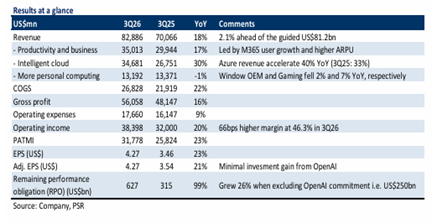
Microsoft delivered solid third-quarter results with revenue meeting expectations whilst profit after tax and minority interests exceeded forecasts. The company achieved 18% year-on-year revenue growth, primarily driven by Azure cloud revenue expansion of 40%. For the nine-month period, revenue and PATMI reached 76% and 81% of full-year forecasts respectively.
The company expects FY26 group revenue to grow 16.7%, with Azure anticipated to expand 29% supported by accelerated data centre capacity deployment. The AI business has demonstrated remarkable momentum, with AI tools exceeding a US$37 billion annual run-rate, representing 123% year-on-year growth.
Key Growth Drivers
Productivity Segment Strength
The Productivity and Business Processes segment demonstrated robust performance, climbing 17% to US$35 billion. This growth was underpinned by 19% year-on-year expansion in Microsoft 365 Commercial Cloud revenue, with average revenue per user increasing through uptake of premium offerings including Microsoft 365 Copilot and E5 enterprise subscriptions. Paid Copilot seats surpassed 20 million, representing 5% of total paid M365 commercial seats that grew 6% year-on-year.
Azure Cloud Acceleration
Intelligent Cloud revenue surged 30% year-on-year to US$34.6 billion, with Azure’s 40% growth benefiting from the early deployment of Fairwater data centre capacity in Wisconsin. Microsoft cloud revenue across all cloud-delivered services rose 29% to US$54.5 billion, driven by strong demand for Azure and first-party AI services.
Revised Investment Stance
Phillip Securities Research has downgraded Microsoft from BUY to ACCUMULATE, lowering the target price to US$485 from US$540. This revision reflects increased capital expenditure requirements of US$40 billion, bringing total CAPEX to US$190 billion due to higher component costs, AI infrastructure investments, and growing AI product usage. Despite this, revenue forecasts have been raised by 3% and 5% for FY26 and FY27 respectively, with PATMI projections increased by 9% and 17%.
Frequently Asked Questions
Q: What was Microsoft's revenue growth in the third quarter?
A: Microsoft achieved 18% year-on-year revenue growth in the third quarter, led by Azure cloud revenue growth of 40%.
Q: How is Microsoft's AI business performing?
A: The AI business exceeded a US$37 billion annual run-rate, up 123% year-on-year, with AI tools showing exceptional growth momentum.
Q: Why was Microsoft's recommendation downgraded despite strong performance?
A: The downgrade from BUY to ACCUMULATE reflects higher capital expenditure requirements of US$40 billion, increasing total CAPEX to US$190 billion due to component costs and AI infrastructure investments.
Q: What is driving growth in Microsoft's Productivity segment?
A: Growth is supported by 19% year-on-year expansion in Microsoft 365 Commercial Cloud revenue, driven by higher-tier offerings like Copilot and E5 subscriptions, with paid Copilot seats exceeding 20 million.
Q: What are the growth expectations for Azure?
A: Azure is expected to grow 29% in FY26, supported by faster ramp-up as additional data centre capacity comes online, including the early deployment of Fairwater data centre capacity.
Q: How has Microsoft 365 commercial user base performed?
A: Commercial paid seats exceeded 450 million in the second quarter with 6% year-on-year growth, led by small and medium business adoption and frontline worker uptake.
Q: What is the new target price and recommendation?
A: Phillip Securities Research has set a target price of US$485 (reduced from US$540) with an ACCUMULATE recommendation (downgraded from BUY).
Q: When will OpenAI-related revenue materialise significantly?
A: Revenue recognition from OpenAI-related backlog is expected to materialise meaningfully from 2027.
This article has been auto-generated using PhillipGPT. It is based on a report by a Phillip Securities Research analyst.
Disclaimer
These commentaries are intended for general circulation and do not have regard to the specific investment objectives, financial situation and particular needs of any person. Accordingly, no warranty whatsoever is given and no liability whatsoever is accepted for any loss arising whether directly or indirectly as a result of any person acting based on this information. You should seek advice from a financial adviser regarding the suitability of any investment product(s) mentioned herein, taking into account your specific investment objectives, financial situation or particular needs, before making a commitment to invest in such products.
Opinions expressed in these commentaries are subject to change without notice. Investments are subject to investment risks including the possible loss of the principal amount invested. The value of units in any fund and the income from them may fall as well as rise. Past performance figures as well as any projection or forecast used in these commentaries are not necessarily indicative of future or likely performance.
Phillip Securities Pte Ltd (PSPL), its directors, connected persons or employees may from time to time have an interest in the financial instruments mentioned in these commentaries.
The information contained in these commentaries has been obtained from public sources which PSPL has no reason to believe are unreliable and any analysis, forecasts, projections, expectations and opinions (collectively the “Research”) contained in these commentaries are based on such information and are expressions of belief only. PSPL has not verified this information and no representation or warranty, express or implied, is made that such information or Research is accurate, complete or verified or should be relied upon as such. Any such information or Research contained in these commentaries are subject to change, and PSPL shall not have any responsibility to maintain the information or Research made available or to supply any corrections, updates or releases in connection therewith. In no event will PSPL be liable for any special, indirect, incidental or consequential damages which may be incurred from the use of the information or Research made available, even if it has been advised of the possibility of such damages. The companies and their employees mentioned in these commentaries cannot be held liable for any errors, inaccuracies and/or omissions howsoever caused. Any opinion or advice herein is made on a general basis and is subject to change without notice. The information provided in these commentaries may contain optimistic statements regarding future events or future financial performance of countries, markets or companies. You must make your own financial assessment of the relevance, accuracy and adequacy of the information provided in these commentaries.
Views and any strategies described in these commentaries may not be suitable for all investors. Opinions expressed herein may differ from the opinions expressed by other units of PSPL or its connected persons and associates. Any reference to or discussion of investment products or commodities in these commentaries is purely for illustrative purposes only and must not be construed as a recommendation, an offer or solicitation for the subscription, purchase or sale of the investment products or commodities mentioned.
This advertisement has not been reviewed by the Monetary Authority of Singapore.