Brief Overview
In Sep 2026, the Singapore aviation sector continued its decline. China Aviation Oil (CAO) dropped significantly by 7.5%, followed by SATS and SIA at negative 2.3% and negative 0.7% respectively, while SIA Engineering edged up incrementally by 1.0%. Passenger growth remains under pressure from elevated jet fuel prices. However, cargo has been a relative bright spot, with SIA’s cargo volume rising 9.4% year-on-year in September 2026. Load factor improved most in the East Asia route region, up 5.3 percentage points to 55.8%. Phillip Securities Research maintains a Neutral stance on the air transport sector amid the lack of near-term stabilisation in the US-Iran conflict.
Investment Positives
Strong Cargo Growth Driven by AI and Semiconductor Demand
Overall cargo volumes held steady in September 2026, but performance diverged sharply by trade lane. Asia-Pacific to US volumes rose 13% to 17% year-on-year, driven by demand for semiconductors and other high-tech goods. South Korea led the growth with volumes up 54% year-on-year, and Singapore posted gains of 26% year-on-year. Singapore’s position as a regional processing and re-export hub for artificial intelligence supports its growth, even though it lacks sizeable domestic AI trade production capability.
Cargo rates remained elevated. China’s Mid-Autumn Festival and National Day Golden Week holidays prompted exporters to rush shipments out before factories closed, which would typically push air freight rates higher. Global spot rates held at US$3.45 per kilogramme, up 33% year-on-year, while Asia-Pacific to US spot rates averaged US$6.75 per kilogramme, up 40% year-on-year. Singapore to US rates were up 62% year-on-year, which supports SIA’s cargo yields on US-bound flows.
Capacity Expansion into the Fourth Quarter
Airlines continue to add international capacity into the fourth quarter of 2026 despite elevated jet fuel prices. Chinese carriers plan to raise international seats by about 9% year-on-year, with available seat kilometres to increase 13%. Long-haul routes to Europe, Russia and Canada are driving the growth. Singapore’s fourth-quarter flight capacity is set to rise about 4% year-on-year, driven by the China-Singapore route, where SIA is adding 24% more seats. We believe this could reflect SIA’s deepening partnership with Air China to enhance route coordination and revenue sharing.
SIA Engineering Benefits from Boeing 777X Certification Delays
SIA’s largest aircraft backlog is 31 Boeing 777X aircraft, intended to replace the Airbus A380s (12 units, average age 12.7 years) and Boeing 777-300ERs (22 units, average age 16.5 years), the oldest passenger aircraft in the fleet. The 777X is not expected to be delivered before April 2027 because of certification delays, with 665 unfulfilled 777X orders from at least 17 customers. The delays keep these maintenance-heavy aircraft flying longer, supporting near-term demand for SIA Engineering. Furthermore, SIA’s largest unit base, the A350XWB (65 units with an average age of 7.5 years), will power SIA Engineering’s SAESL joint venture going forward as SAESL expands engine servicing capacity from 300 to 400 engines per annum.
SATS Positioned for AI-Driven Airfreight and Middle East Expansion
Although e-commerce-driven tailwinds may be weaker, the analyst believes AI-driven airfreight will continue to support SIA’s cargo demand. SATS is also expected to expand in the Middle East market alongside Riyadh Air’s cargo infrastructure build-out.
CAO Special Dividend Potential
CAO may benefit from trading margins as regional fuel price differentials have widened. The likelihood of a special dividend or higher payout ratio — currently the lowest among Sinopec subsidiaries, backed by US$589 million in net cash — is identified as the near-term catalyst.
Investment Challenges
CAO Facing Higher Procurement Costs
CAO’s decline reflects sustained high jet fuel prices feeding through to cost of sales. With its lower-cost inventory largely used, the benefit from cheaper procurement has faded, and future jet fuel procurement will have to be at current elevated costs.
Asia-Europe Cargo Route Remains Weak
The Asia-Europe route remained under pressure. Hong Kong to Europe volumes were still down approximately 30% year-on-year as the EU’s removal of de minimis exemptions in July 2026 continued to weigh on e-commerce flows.
Elevated Jet Fuel Prices
Persistently high jet fuel prices remain a headwind for SIA and the broader sector. Singapore jet fuel price normalisation is not expected until 2029.
Outlook
The sector outlook is mixed. Cargo growth driven by AI and semiconductor demand continues to provide a tailwind, but elevated jet fuel prices and weak Asia-Europe trade lanes present headwinds. SIA’s fourth-quarter capacity expansion and deepening partnerships signal cautious optimism, while SIA Engineering benefits from aircraft delivery delays that keep older, maintenance-intensive fleets in operation.
Recommendation and Target Price
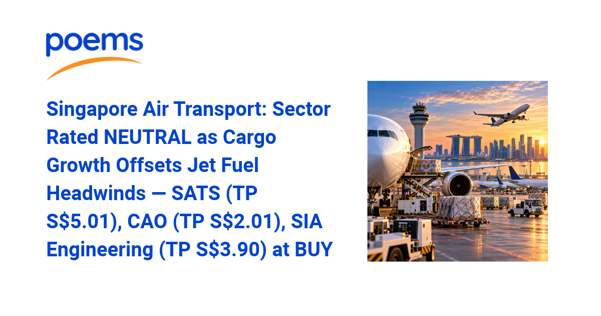
Phillip Securities Research maintains a Neutral sector stance on Singapore air transport. At the individual stock level, SIA carries a Neutral rating with a target price of S$7.09. SATS is rated BUY with a target price of S$5.01. China Aviation Oil is rated BUY with a target price of S$2.01. SIA Engineering is rated BUY with a target price of S$3.90.
This article has been auto-generated using PhillipGPT. It is based on a report by a Phillip Securities Research analyst.
Frequently Asked Questions
Q: What is the overall sector recommendation for Singapore air transport?
A: Phillip Securities Research maintains a Neutral stance on the sector amid the lack of near-term stabilisation in the US-Iran conflict and elevated jet fuel prices.
Q: How has cargo performance been in September 2026?
A: Cargo volumes have been strong on the Asia-Pacific to US route, rising 13% to 17% year-on-year driven by semiconductor and high-tech demand. South Korea led with volumes up 54% year-on-year, and Singapore posted gains of 26% year-on-year. However, the Asia-Europe route remained weak, with Hong Kong-Europe volumes down approximately 30% year-on-year.
Q: What are the current cargo spot rates?
A: Global spot rates held at US$3.45 per kilogramme, up 33% year-on-year. Asia-Pacific to US spot rates averaged US$6.75 per kilogramme, up 40% year-on-year, and Singapore to US rates were up 62% year-on-year.
Q: Why is SIA Engineering expected to benefit from Boeing 777X delays?
A: SIA's largest aircraft backlog of 31 Boeing 777X aircraft is not expected to be delivered before April 2027 due to certification delays. This keeps older, maintenance-heavy aircraft such as the A380s and 777-300ERs flying longer, supporting near-term demand for SIA Engineering's services.
Q: What is the near-term catalyst for China Aviation Oil?
A: The likelihood of a special dividend or higher payout ratio is the near-term catalyst. CAO currently has the lowest payout ratio among Sinopec subsidiaries and is backed by US$589 million in net cash.
Q: Why is the Asia-Europe cargo route underperforming?
A: The EU's removal of de minimis exemptions in July 2026 has continued to weigh on e-commerce flows, keeping Hong Kong to Europe volumes down approximately 30% year-on-year.
Q: What are the individual stock recommendations and target prices?
A: SIA is rated Neutral with a target price of S$7.09. SATS is rated BUY with a target price of S$5.01. CAO is rated BUY with a target price of S$2.01. SIA Engineering is rated BUY with a target price of S$3.90.
Q: When is jet fuel price normalisation expected?
A: According to the report, Singapore jet fuel price normalisation is expected around 2029.
Disclaimer
These commentaries are intended for general circulation and do not have regard to the specific investment objectives, financial situation and particular needs of any person. Accordingly, no warranty whatsoever is given and no liability whatsoever is accepted for any loss arising whether directly or indirectly as a result of any person acting based on this information. You should seek advice from a financial adviser regarding the suitability of any investment product(s) mentioned herein, taking into account your specific investment objectives, financial situation or particular needs, before making a commitment to invest in such products.
Opinions expressed in these commentaries are subject to change without notice. Investments are subject to investment risks including the possible loss of the principal amount invested. The value of units in any fund and the income from them may fall as well as rise. Past performance figures as well as any projection or forecast used in these commentaries are not necessarily indicative of future or likely performance.
Phillip Securities Pte Ltd (PSPL), its directors, connected persons or employees may from time to time have an interest in the financial instruments mentioned in these commentaries.
The information contained in these commentaries has been obtained from public sources which PSPL has no reason to believe are unreliable and any analysis, forecasts, projections, expectations and opinions (collectively the “Research”) contained in these commentaries are based on such information and are expressions of belief only. PSPL has not verified this information and no representation or warranty, express or implied, is made that such information or Research is accurate, complete or verified or should be relied upon as such. Any such information or Research contained in these commentaries are subject to change, and PSPL shall not have any responsibility to maintain the information or Research made available or to supply any corrections, updates or releases in connection therewith. In no event will PSPL be liable for any special, indirect, incidental or consequential damages which may be incurred from the use of the information or Research made available, even if it has been advised of the possibility of such damages. The companies and their employees mentioned in these commentaries cannot be held liable for any errors, inaccuracies and/or omissions howsoever caused. Any opinion or advice herein is made on a general basis and is subject to change without notice. The information provided in these commentaries may contain optimistic statements regarding future events or future financial performance of countries, markets or companies. You must make your own financial assessment of the relevance, accuracy and adequacy of the information provided in these commentaries.
Views and any strategies described in these commentaries may not be suitable for all investors. Opinions expressed herein may differ from the opinions expressed by other units of PSPL or its connected persons and associates. Any reference to or discussion of investment products or commodities in these commentaries is purely for illustrative purposes only and must not be construed as a recommendation, an offer or solicitation for the subscription, purchase or sale of the investment products or commodities mentioned.
This advertisement has not been reviewed by the Monetary Authority of Singapore.