Understanding Emerging Markets ETFs August 13, 2026
An Emerging Markets ETF (Exchange-Traded Fund) is a pooled investment vehicle that invests primarily in stocks from fast-growing, developing economies across Asia, Latin America, Eastern Europe, and Africa.
While some Emerging Markets ETFs track broad global indexes to cover dozens of countries at once, others target specific regions, themes, single countries, or investment factors. Additionally, investors can choose between:
- Passive ETFs: Designed to track the performance of a specific benchmark index.
- Active ETFs: Managed by portfolio managers who actively select and adjust holdings to seek outperformance. (To learn more, read our guide on What is an Active ETF?)
1. Why Invest in Emerging Markets ETFs?
Higher Long-Term Growth Potential
Developing economies like Brazil, China, and India are widely recognised for their structural economic tailwinds. These include expanding middle-class demographics, rapid urbanisation, massive infrastructure development, and accelerating technological adoption.
According to projections by S&P Global, emerging markets are expected to contribute approximately 65% of global economic growth by 2035.
Historically, these economies have expanded at a significantly faster pace than developed nations. Between 2015 and 2025, emerging markets recorded a 10-year GDP compound annual growth rate (CAGR) of ~5.8%, compared to a more modest 2.0% CAGR for developed markets (Figure 1.1). This growth differential highlights the powerful momentum underlying developing economies.
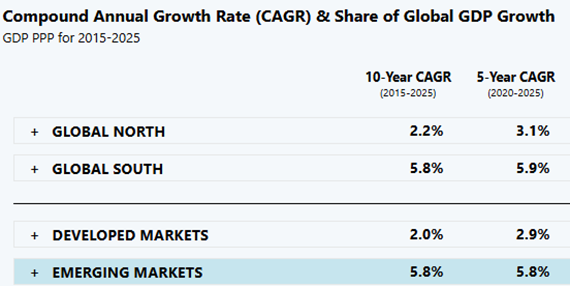 Fig 1.1 World Economics as of June 2026
High Allocation to Next-Gen Technology & Innovation
A prominent example of a broad market vehicle is the iShares MSCI Emerging Markets ETF (EEM). Beyond traditional industrial sectors, a significant portion of EEM’s portfolio is allocated to high-growth technology-related sectors (47.37%) (Figure 1.2). This weighting reflects the rapid digital transformation occurring across developing economies, where domestic champion firms dominate e-commerce, semiconductor fabrication, digital payments, and consumer platforms.
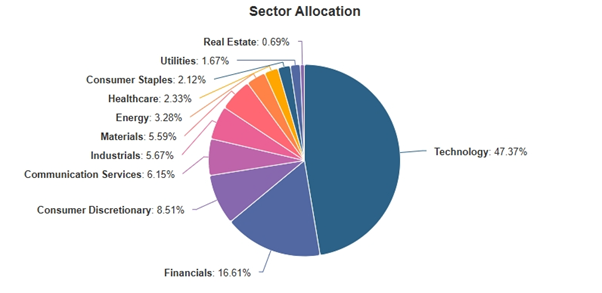 Fig 1.2 iShares MSCI Emerging Markets ETF (EEM) Sector Allocations as of 4 June 2026
Strategic Global Supply Chain Positioning
Geographically, funds like EEM feature high concentrations in key Asian growth hubs—notably China (28.82%), Taiwan (21.97%), and India (15.20%) (Figure 1.3).
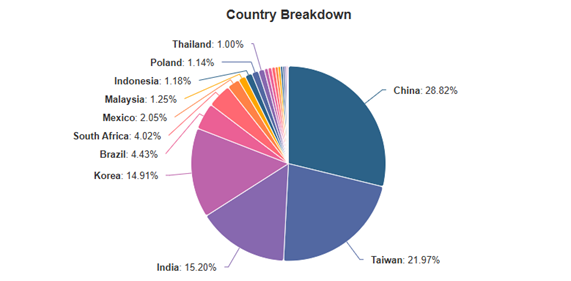 Fig 1.3 iShares MSCI Emerging Markets ETF (EEM) Country Breakdown as of 4 June 2026
While markets like Taiwan and South Korea provide vital advanced tech manufacturing (such as leading-edge semiconductors), other emerging nations, like Brazil, Indonesia, and Saudi Arabia, possess rich deposits of essential natural resources (e.g., copper, lithium, nickel, and crude oil). Together, these economies form critical backbones for both global manufacturing supply chains and the ongoing energy transition.
2. Recent Performance & Expense Breakdown
| ETF Name | Type | 1-Year Return | Expense Ratio |
| iShares MSCI Emerging Markets ETF (EEM) | Emerging Market | 34.69% | 0.72% |
| State Street SPDR S&P Emerging Asia Pacific ETF (GMF) | Emerging Market | 19.52% | 0.49% |
| iShares MSCI Emerging Markets ex China ETF(EMXC) | Emerging Market | 50.58% | 0.25% |
| iShares Core MSCI International Developed Markets ETF (IDEV) | Developed Market | 25.48% | 0.04% |
Data as of 31 July 2026. Note: Past performance is not indicative of future results.
Performance Context
Over the measured 1-year period, broad developed market benchmarks generated moderate returns (with the S&P 500 returning 19.53% and IDEV returning 25.48%). In contrast, targeted Emerging Markets ETFs significantly outperformed their developed market peers.
This outperformance demonstrates how capital inflows can surge into developing markets during periods of favourable economic policy, industrial expansion, and earnings acceleration.
Understanding Cost Differentials
Despite higher return potential, Emerging Market ETFs generally charge higher expense ratios than core US or developed market funds. Operating across multiple developing jurisdictions introduces` higher operational costs, including:
- Foreign exchange handling and currency conversions
- Differing local tax structures and custody fees
- Lower underlying market liquidity or wider local bid-ask spreads
- Complex regulatory compliance across multiple jurisdictions
Investors are essentially paying a small premium to outsource the operational complexity of building a cross-border emerging market basket manually.
3. Key Risks to Consider
While the upside trajectory can be compelling, emerging market assets carry elevated risk profiles:
Political and Regulatory Risk: Developing markets can experience abrupt policy shifts, regulatory revisions, trade barriers, or geopolitical friction that may impact corporate earnings or access to capital.
Currency (FX) Volatility: Because these funds hold assets denominated in foreign currencies (e.g., BRL, INR, TWD, KRW), returns are subject to exchange rate fluctuations. If an emerging market currency depreciates against your home currency, it can erode or neutralise underlying stock gains.
Liquidity and Market Volatility: Smaller or less developed local exchanges can suffer from liquidity dry-spells during broader global risk-off events, leading to higher price volatility.

4. Investor Checklist: Evaluating an Emerging Markets ETF
Before allocating capital to an Emerging Markets ETF, review the fund’s Factsheet for the following indicators:
Benchmark Index: Identify what the fund tracks (e.g., MSCI Emerging Markets Index vs. FTSE Emerging Index—note that FTSE classifies South Korea as a developed market, whereas MSCI classifies it as emerging).
Country & Sector Concentration: Check whether the fund is overweight in a single nation (e.g., heavy China exposure) or concentrated in a single sector (e.g., technology).
Top Holdings: Review the top 10 positions to assess single-stock concentration risk.
Tracking Error: Measure how accurately the fund replicates its underlying index performance over time.
Trading Volume & Bid-Ask Spread: Look for higher average daily trading volume and tighter bid-ask spreads to ensure cost-efficient trade execution on the exchange.
5. How Singapore Investors Can Incorporate Emerging Markets ETFs
1. Portfolio Diversification
Adding Emerging Markets ETFs to a portfolio dominated by US or domestic Singapore equities helps lower overall portfolio concentration risk. Because developing markets operate on distinct economic cycles, their returns often exhibit lower correlation with developed markets over long horizons.
2. Intraday Liquidity vs. Mutual Funds
Compared to traditional unit trusts or mutual funds, which settle only once per day at the official Net Asset Value (NAV), ETFs trade live on stock exchanges throughout market hours. This offers investors immediate pricing transparency, continuous execution flexibility, and better tactical timing for entry and exit points.
Disclaimer
These commentaries are intended for general circulation and do not have regard to the specific investment objectives, financial situation and particular needs of any person. Accordingly, no warranty whatsoever is given and no liability whatsoever is accepted for any loss arising whether directly or indirectly as a result of any person acting based on this information. You should seek advice from a financial adviser regarding the suitability of any investment product(s) mentioned herein, taking into account your specific investment objectives, financial situation or particular needs, before making a commitment to invest in such products.
Opinions expressed in these commentaries are subject to change without notice. Investments are subject to investment risks including the possible loss of the principal amount invested. The value of units in any fund and the income from them may fall as well as rise. Past performance figures as well as any projection or forecast used in these commentaries are not necessarily indicative of future or likely performance.
Phillip Securities Pte Ltd (PSPL), its directors, connected persons or employees may from time to time have an interest in the financial instruments mentioned in these commentaries.
The information contained in these commentaries has been obtained from public sources which PSPL has no reason to believe are unreliable and any analysis, forecasts, projections, expectations and opinions (collectively the “Research”) contained in these commentaries are based on such information and are expressions of belief only. PSPL has not verified this information and no representation or warranty, express or implied, is made that such information or Research is accurate, complete or verified or should be relied upon as such. Any such information or Research contained in these commentaries are subject to change, and PSPL shall not have any responsibility to maintain the information or Research made available or to supply any corrections, updates or releases in connection therewith. In no event will PSPL be liable for any special, indirect, incidental or consequential damages which may be incurred from the use of the information or Research made available, even if it has been advised of the possibility of such damages. The companies and their employees mentioned in these commentaries cannot be held liable for any errors, inaccuracies and/or omissions howsoever caused. Any opinion or advice herein is made on a general basis and is subject to change without notice. The information provided in these commentaries may contain optimistic statements regarding future events or future financial performance of countries, markets or companies. You must make your own financial assessment of the relevance, accuracy and adequacy of the information provided in these commentaries.
Views and any strategies described in these commentaries may not be suitable for all investors. Opinions expressed herein may differ from the opinions expressed by other units of PSPL or its connected persons and associates. Any reference to or discussion of investment products or commodities in these commentaries is purely for illustrative purposes only and must not be construed as a recommendation, an offer or solicitation for the subscription, purchase or sale of the investment products or commodities mentioned.
This advertisement has not been reviewed by the Monetary Authority of Singapore.
About the author
Mr Teo Huan Zi
Dealing Manager
Phillip Securities Pte Ltd
Mr Teo Huan Zi graduated from Nanyang Technological University (NTU) in 2014 with a Bachelor's degree in Business, majoring in Banking and Finance. He currently serves as a dealing manager with a team of more than 10 equity specialists. Additionally, he frequently conducts seminars and webinars to empower his clients with financial and investment knowledge, including fundamental analysis and technical analysis.
 ETF Monthly Review: Mixed September Performance with Muted October Outlook Expected
  Investing in the AI Revolution: A Guide to Semiconductor & Ecosystem ETFs
  Phillip SING Income ETF Reaches All-Time High Dividend with Banking Sector Focus
  Suntec REIT Shows Strong Singapore Performance with 24.8% DPU Growth, ACCUMULATE Rating and S$1.69 Target Price