Singapore Airlines Benefits from Fuel Hedging Amid Jet Fuel Volatility, Maintains Market Position July 14, 2026

Aviation Sector Performance and Fuel Dynamics
Singapore’s aviation sector delivered steady performance in June 2026, with SATS leading gains at 14.2%, followed by Singapore Airlines at 11.6% and SIA Engineering at 7.3%. Meanwhile, CAO declined 1.1%. The sector continues to navigate volatile jet fuel markets, with Singapore jet fuel prices currently trading at US$115 per barrel, down significantly from the March 2026 peak of US$240.5 per barrel following a US-Iran peace deal that reduced prices by approximately 50%.
Singapore Airlines’ Strategic Positioning
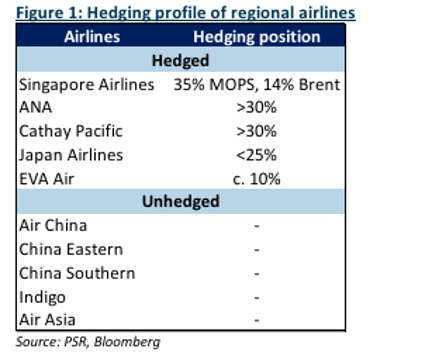
Singapore Airlines has demonstrated resilience through its comprehensive hedging strategy and operational adaptability. The carrier maintains a dual hedge structure covering both Brent crude and jet fuel, with 35% hedging on jet fuel and 14% on Brent crude for the second quarter of FY2026/27. This positioning has provided relative insulation from fuel price volatility compared to unhedged competitors.
The airline has capitalised on several market opportunities, including rerouted demand for Asia-Europe flights stopping over in Singapore due to regional conflicts. Additionally, Singapore Airlines benefits from rising cargo yields, with global freight rates increasing 41% year-on-year to US$3.40 per kilogram. The company’s budget subsidiary, Scoot, has captured demand from regional low-cost carriers that grounded aircraft during the conflict period.
Market Outlook and Competitive Landscape
Despite current price reductions, jet fuel remains approximately 33% above the 2025 averages of US$90 per barrel. Regional carriers show varying degrees of hedging protection, with Singapore Airlines, Cathay Pacific, Japan Airlines, and ANA maintaining stronger hedged positions. Conversely, China’s Big Three airlines—Air China, China Southern, and China Eastern—remain largely unhedged and face greater exposure to fuel price fluctuations.
The cargo segment presents additional opportunities, as the partial grounding of Middle East airlines has removed significant capacity from India-Europe and China/Southeast Asia-Europe routes. This capacity reduction has pushed Asia-Europe spot rates to US$5.26 per kilogram in late June, representing a 38% year-on-year increase. While Singapore Airlines’ cargo revenue exposure of 11% makes it a secondary beneficiary compared to carriers with higher cargo proportions, the company still stands to benefit from elevated rates.
Analysts maintain a neutral stance on air transportation, given uncertain resolution of geopolitical conflicts and the potential for renewed fuel price volatility if ceasefires break down.
Frequently Asked Questions
Q: How has Singapore Airlines protected itself from jet fuel price volatility?
A: Singapore Airlines employs a dual hedge structure covering both Brent crude and jet fuel, with 35% hedging on jet fuel and 14% on Brent crude for 2Q FY26/27, providing relative insulation from price fluctuations.
Q: What was the peak jet fuel price and current trading level?
A: Singapore jet fuel prices peaked at US$240.5 per barrel in March 2026 and are currently trading at US$115 per barrel, representing approximately a 50% decline following the US-Iran peace deal.
Q: How has the cargo segment benefited Singapore Airlines?
A: Rising cargo yields with global freight rates up 41% year-on-year to US$3.40 per kilogram have benefited Singapore Airlines. However, its 11% cargo revenue exposure makes it a secondary beneficiary compared to carriers with higher cargo proportions.
Q: Which regional airlines are better positioned against fuel volatility?
A: Singapore Airlines, Cathay Pacific, Japan Airlines, and ANA maintain stronger hedged positions, while China's Big Three airlines, being Air China, China Southern, and China Eastern remain largely unhedged and more exposed.
Q: What is the current analyst stance on the aviation sector?
A: Analysts maintain a neutral stance on air transportation due to uncertain resolution of the US-Iran conflict and unclear timeline for a complete resolution, keeping jet fuel price outlook uncertain.
Q: How have other Singapore aviation companies performed?
A: In June 2026, SATS led sector gains at 14.2%, SIA Engineering rose 7.3%, while CAO declined 1.1%, showing mixed performance across the aviation ecosystem.
Q: What additional revenue opportunities has Singapore Airlines captured?
A: The airline has benefited from rerouted Asia-Europe flight demand stopping over in Singapore, while Scoot has captured budget travel demand from regional low-cost carriers that grounded aircraft during conflicts.
This article has been auto-generated using PhillipGPT. It is based on a report by a Phillip Securities Research analyst.
Disclaimer
These commentaries are intended for general circulation and do not have regard to the specific investment objectives, financial situation and particular needs of any person. Accordingly, no warranty whatsoever is given and no liability whatsoever is accepted for any loss arising whether directly or indirectly as a result of any person acting based on this information. You should seek advice from a financial adviser regarding the suitability of any investment product(s) mentioned herein, taking into account your specific investment objectives, financial situation or particular needs, before making a commitment to invest in such products.
Opinions expressed in these commentaries are subject to change without notice. Investments are subject to investment risks including the possible loss of the principal amount invested. The value of units in any fund and the income from them may fall as well as rise. Past performance figures as well as any projection or forecast used in these commentaries are not necessarily indicative of future or likely performance.
Phillip Securities Pte Ltd (PSPL), its directors, connected persons or employees may from time to time have an interest in the financial instruments mentioned in these commentaries.
The information contained in these commentaries has been obtained from public sources which PSPL has no reason to believe are unreliable and any analysis, forecasts, projections, expectations and opinions (collectively the “Research”) contained in these commentaries are based on such information and are expressions of belief only. PSPL has not verified this information and no representation or warranty, express or implied, is made that such information or Research is accurate, complete or verified or should be relied upon as such. Any such information or Research contained in these commentaries are subject to change, and PSPL shall not have any responsibility to maintain the information or Research made available or to supply any corrections, updates or releases in connection therewith. In no event will PSPL be liable for any special, indirect, incidental or consequential damages which may be incurred from the use of the information or Research made available, even if it has been advised of the possibility of such damages. The companies and their employees mentioned in these commentaries cannot be held liable for any errors, inaccuracies and/or omissions howsoever caused. Any opinion or advice herein is made on a general basis and is subject to change without notice. The information provided in these commentaries may contain optimistic statements regarding future events or future financial performance of countries, markets or companies. You must make your own financial assessment of the relevance, accuracy and adequacy of the information provided in these commentaries.
Views and any strategies described in these commentaries may not be suitable for all investors. Opinions expressed herein may differ from the opinions expressed by other units of PSPL or its connected persons and associates. Any reference to or discussion of investment products or commodities in these commentaries is purely for illustrative purposes only and must not be construed as a recommendation, an offer or solicitation for the subscription, purchase or sale of the investment products or commodities mentioned.
This advertisement has not been reviewed by the Monetary Authority of Singapore.
About the author

Hashim Osman
Hashim graduated from the National University of Singapore with a degree in Business Administration.
 ETF Monthly Review: Mixed September Performance with Muted October Outlook Expected
  Investing in the AI Revolution: A Guide to Semiconductor & Ecosystem ETFs
  Phillip SING Income ETF Reaches All-Time High Dividend with Banking Sector Focus
  Understanding Emerging Markets ETFs