Singapore Market Strategy: Navigating Uncertainty Amid Regional Conflict and Capital Preservation Focus April 24, 2026

Market Performance Review
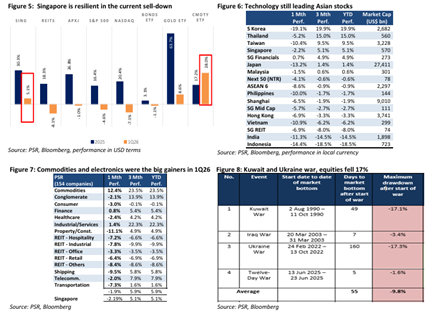
Singapore equities concluded a remarkable ten consecutive months of gains with a 2.2% decline in March, though the first quarter of 2026 still delivered a positive 5.1% return. The market reached all-time highs on 23rd February before the Iran war drove significant sector rotation, boosting performance in defence spending, biofuels, and capital markets.
Banks demonstrated resilience, maintaining gains even during March’s decline and outperforming throughout the quarter with their stable dividend yields. However, REITs faced substantial pressure as interest rate expectations shifted from anticipated cuts to potential rate hikes. Consumer segments also weakened as rising inflation compressed disposable income.
Strategic Outlook: Capital Preservation in Volatile Times
Phillip Securities Research adopts a cautious stance, emphasising capital preservation over prediction in the current uncertain environment. Equities have transformed into volatile, leveraged instruments tied to oil price movements. The closure of the Straits of Hormuz presents dual risks: driving higher energy prices and inflation whilst threatening global production through material shortages.
The current conflict’s impact could exceed previous disruptions. Unlike pandemic-era bottlenecks affecting vessel availability, the present situation threatens feedstock and raw material supplies. Singapore has already experienced force majeures at chemical facilities, affecting industries from plastics to pharmaceuticals. Historical precedent suggests oil prices could reach US$200 per barrel, based on the Kuwait war pattern when crude oil surged 275% from US$15 to US$42.
Investment Recommendations: Capitalising on Capex Cycles
Despite geopolitical uncertainties, Phillip Securities Research identifies opportunities within expanding global capital expenditure cycles. Key sectors include data centres, with hyperscalers increasing AI and data centre capex by approximately 60% in 2026. Singapore’s recent 200MW data centre application request in Jurong reflects this trend.
The semiconductor sector benefits from AI and memory chip demand driving foundry capacity expansion. Defence spending increases as countries prioritise domestic military capabilities, whilst renewable energy gains importance for energy security. Singapore’s construction sector enjoys multi-year demand growth.
Primary beneficiaries include IT service companies like Telechoice, bidding for regional data centre projects, and Frencken, positioned to benefit from semiconductor equipment demand. Oiltek targets sustainable aviation fuel opportunities. Conversely, REITs face near-term underweight recommendations due to stagflationary pressures affecting rents, interest expenses, and valuations.
Singapore’s macro fundamentals remain robust, with semiconductor exports surging 51% in February and loan growth reaching 6.3%, the fastest in over four years. Building materials demand shows strength with ready-mixed concrete up 47% year-on-year.
Frequently Asked Questions
Q: What caused Singapore equities to decline in March 2026?
A: Singapore equities fell 2.2% in March, ending ten consecutive months of gains, primarily due to the Iran war’s impact on global markets and sector rotation towards defence, biofuels, and capital markets.
Q: How are Singapore banks performing compared to other sectors?
A: Banks demonstrated resilience by maintaining gains even during March’s market decline and outperformed throughout the quarter, supported by their stable dividend yields.
Q: What is Phillip Securities Research’s investment strategy recommendation?
A: The research house advocates for capital preservation over prediction, emphasising that equities have become volatile instruments tied to oil price movements, making cautious positioning essential.
Q: Which sectors are expected to benefit from current global developments?
A: Key beneficiary sectors include data centres, semiconductors, defence, renewable energy, and construction, all driven by expanding global capital expenditure cycles accelerated by geopolitical tensions.
Q: What are the risks to oil prices from the current conflict?
A: Oil prices could potentially reach US$200 per barrel based on historical precedent from the Kuwait war, when crude oil surged 275% from US$15 to US$42 due to supply disruptions.
Q: How is Singapore’s domestic economy performing?
A: Singapore shows strong macro fundamentals with semiconductor exports up 51% in February, loan growth at 6.3% (fastest in four years), and building materials demand surging with concrete up 47% year-on-year.
Q: Which specific companies are positioned to benefit from current trends?
A: Telechoice is bidding for regional data centre projects, Frencken will benefit from semiconductor equipment demand, and Oiltek is targeting sustainable aviation fuel opportunities.
Q: Why are REITs facing pressure in the current environment?
A: REITs are experiencing headwinds due to shifting interest rate expectations from cuts to potential hikes, creating a stagflationary environment that pressures rents, increases interest expenses, and compresses valuations.
This article has been auto-generated using PhillipGPT. It is based on a report by a Phillip Securities Research analyst.
Disclaimer
These commentaries are intended for general circulation and do not have regard to the specific investment objectives, financial situation and particular needs of any person. Accordingly, no warranty whatsoever is given and no liability whatsoever is accepted for any loss arising whether directly or indirectly as a result of any person acting based on this information. You should seek advice from a financial adviser regarding the suitability of any investment product(s) mentioned herein, taking into account your specific investment objectives, financial situation or particular needs, before making a commitment to invest in such products.
Opinions expressed in these commentaries are subject to change without notice. Investments are subject to investment risks including the possible loss of the principal amount invested. The value of units in any fund and the income from them may fall as well as rise. Past performance figures as well as any projection or forecast used in these commentaries are not necessarily indicative of future or likely performance.
Phillip Securities Pte Ltd (PSPL), its directors, connected persons or employees may from time to time have an interest in the financial instruments mentioned in these commentaries.
The information contained in these commentaries has been obtained from public sources which PSPL has no reason to believe are unreliable and any analysis, forecasts, projections, expectations and opinions (collectively the “Research”) contained in these commentaries are based on such information and are expressions of belief only. PSPL has not verified this information and no representation or warranty, express or implied, is made that such information or Research is accurate, complete or verified or should be relied upon as such. Any such information or Research contained in these commentaries are subject to change, and PSPL shall not have any responsibility to maintain the information or Research made available or to supply any corrections, updates or releases in connection therewith. In no event will PSPL be liable for any special, indirect, incidental or consequential damages which may be incurred from the use of the information or Research made available, even if it has been advised of the possibility of such damages. The companies and their employees mentioned in these commentaries cannot be held liable for any errors, inaccuracies and/or omissions howsoever caused. Any opinion or advice herein is made on a general basis and is subject to change without notice. The information provided in these commentaries may contain optimistic statements regarding future events or future financial performance of countries, markets or companies. You must make your own financial assessment of the relevance, accuracy and adequacy of the information provided in these commentaries.
Views and any strategies described in these commentaries may not be suitable for all investors. Opinions expressed herein may differ from the opinions expressed by other units of PSPL or its connected persons and associates. Any reference to or discussion of investment products or commodities in these commentaries is purely for illustrative purposes only and must not be construed as a recommendation, an offer or solicitation for the subscription, purchase or sale of the investment products or commodities mentioned.
This advertisement has not been reviewed by the Monetary Authority of Singapore.
 Wells Fargo Maintains Growth Momentum Despite Rate Headwinds
  Raffles Education Set for Growth Pivot as Focus Shifts to ASEAN K-12 Expansion
  Nanofilm Technologies Targets Growth Through Commercialisation of Deep Tech Solutions
  JPMorgan Chase Maintains ACCUMULATE Rating Despite Lower Target Price