South Korean Stock Market Guide: What Investors Need To Know April 23, 2026
Beyond the Korean Wave And Pop Culture

South Korea is home to one of Asia’s most dynamic and internationally significant stock markets. From semiconductor giants to K-beauty innovators, the South Korean market offers a compelling mix of global brands, growth sectors, and an increasingly investor-friendly regulatory environment. If you have been thinking about adding South Korean equities to your portfolio, here’s everything you need to know to get started.
How Major Markets Performed in 2025
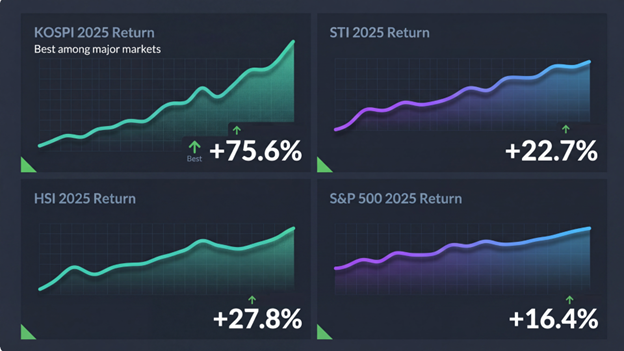
Among the major global indices tracked by Bloomberg, the KOSPI stood out as the strongest performer of the year, returning +75.6% on a total return basis. This compares favourably to the S&P 500 at +16.4%, the HSI at +27.8%, and the STI at +22.7%.
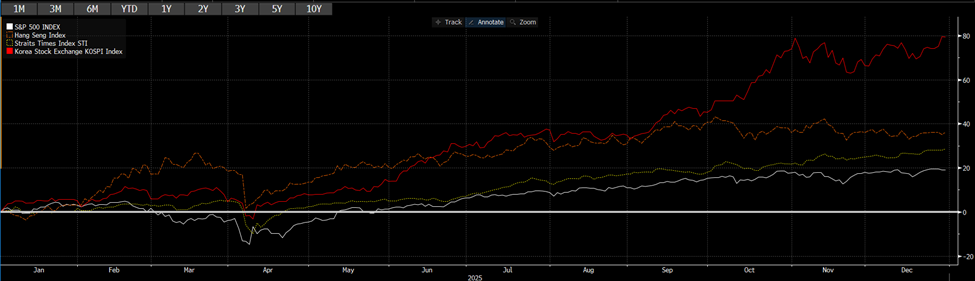 KOSPI 2025 total return (%) against other major markets Source: Bloomberg 5 April 2026
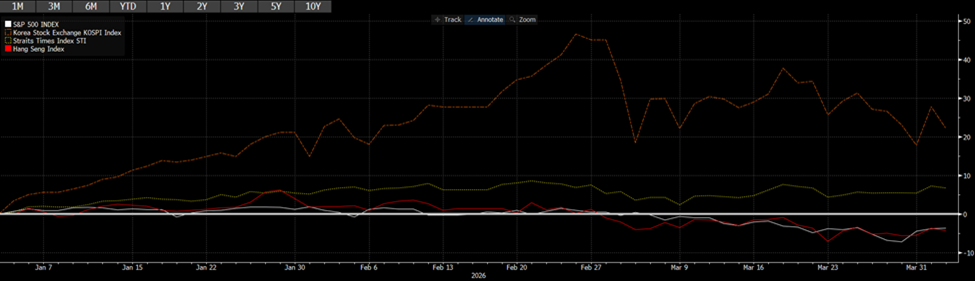 KOSPI is still the top performer YTD 2026 despite falling from approximately total return highs of 46.6% on 26 Feb 2026, to 21.5% gain at the time of writing Source: Bloomberg 5 April 2026
What Is The Korean Stock Market?
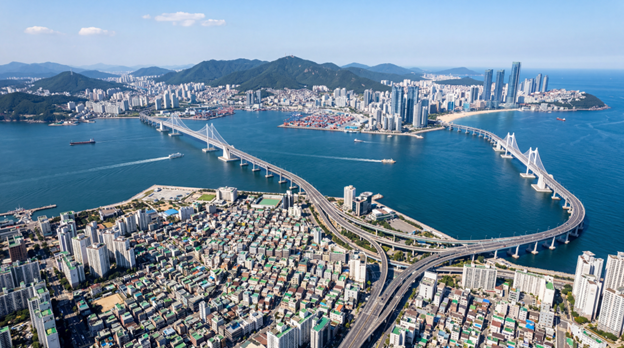
The Korean stock market is operated by the Korea Exchange (KRX), headquartered in Busan. It consists of two main boards: the KOSPI and the KOSDAQ. Together, there are over 2,400 companies listed, spanning technology, industrials, consumer goods, healthcare, and more.
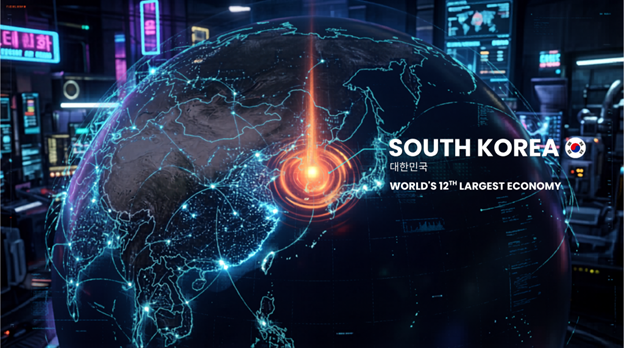
South Korea is the world’s 12th largest economy, and its listed companies include some of the most recognised brands globally, such as Samsung Electronics, SK Hynix, Hyundai Motor, LG, Kakao, and Naver, to name a few.
KOSPI Vs KOSDAQ: What’s The Difference?
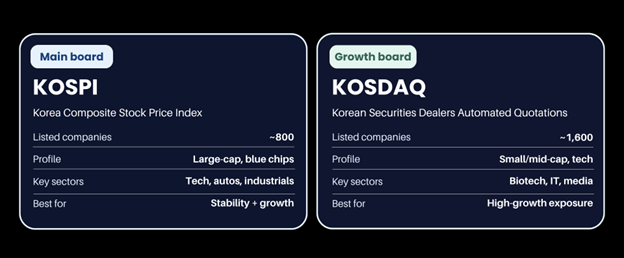
Think of it like the New York Stock Exchange vs the Nasdaq. The KOSPI is the main board for large, established companies, while the KOSDAQ skews toward smaller, high-growth, and tech-focused firms.
Why Are Investors Paying Attention To South Korea Right Now?
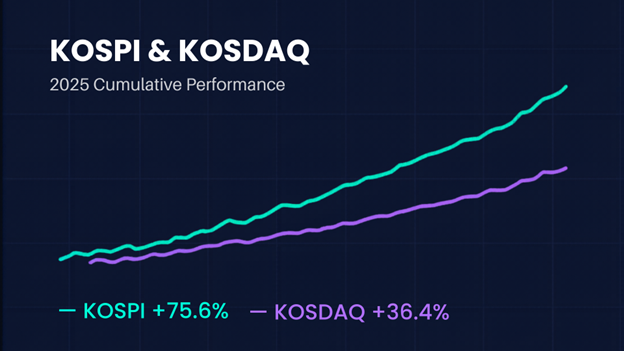
The KOSPI delivered a stunning 75.6% gain in 2025, the strongest performance among all major global indices, and the third-largest annual gain in the index’s history. The KOSDAQ also rebounded sharply, climbing 36.4% after a difficult 2024.
Several tailwinds are driving the interest:
1. The AI And Semiconductor Boom
Samsung Electronics and SK Hynix together account for more than a quarter of the KOSPI’s total market capitalisation. Both companies are central players in the global AI supply chain, supplying the memory chips that power data centres and large language models. As such, analysts expect the AI-driven semiconductor cycle to remain a key driver of KOSPI performance into 2026 and beyond.
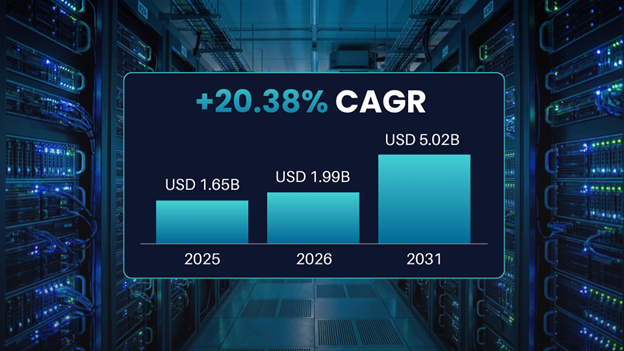
According to Mordor Intelligence, The South Korea Data Centre Market was valued at US$1.65 billion in 2025 and estimated to grow from US$1.99 billion in 2026 to reach US$ 5.02 billion by 2031, at a CAGR of 20.38% during the forecast period (2026-2031).
2. The “Korea Discount” And The Reform Effort To Close It

South Korean equities have historically traded at a discount to global peers, a phenomenon known as the “Korea Discount”, due to factors such as governance structures, chaebol (business conglomerate system, often with large international operations) complexity, and geopolitical risks linked to North Korea. The current administration has introduced market-friendly reforms and tax incentives aimed at improving corporate governance and attracting foreign capital. Closing even part of this discount could present significant upside.
Narrative Since US-Israel War On Iran

South Korean equities have experienced a downturn amid the global financial fallout from tensions in the Middle East. Nevertheless, Goldman Sachs Research remains optimistic about a rebound, projecting South Korean stocks could reach new all-time highs before year-end, citing several key factors.
Historical resilience
The KOSPI index has consistently demonstrated strong recovery performance over 3-, 6-, and 12-month windows following sharp single-day drops triggered by geopolitical tensions. Similarly, the market tends to bounce back effectively after global equity corrections of around 10%, particularly when such downturns do not coincide with a US recession.

Favourable technical signals
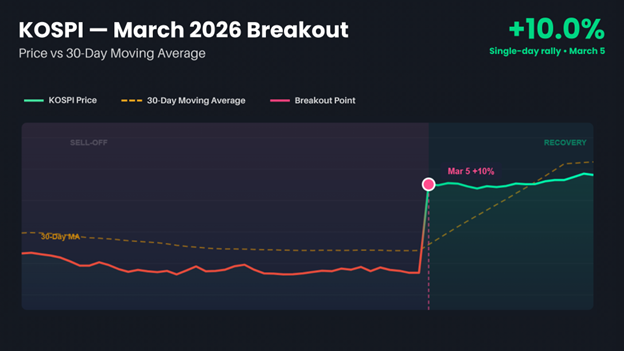
A significant single-day rally of 10% on 5 March brought the KOSPI back above its 30-day moving average. According to Timothy Moe, Chief Asia Pacific regional equity strategist and co-head of macro research in Asia at Goldman Sachs, this pattern suggests the recent sell-off was more of a long-overdue market correction than the beginning of a prolonged bear market.
Investor positioning
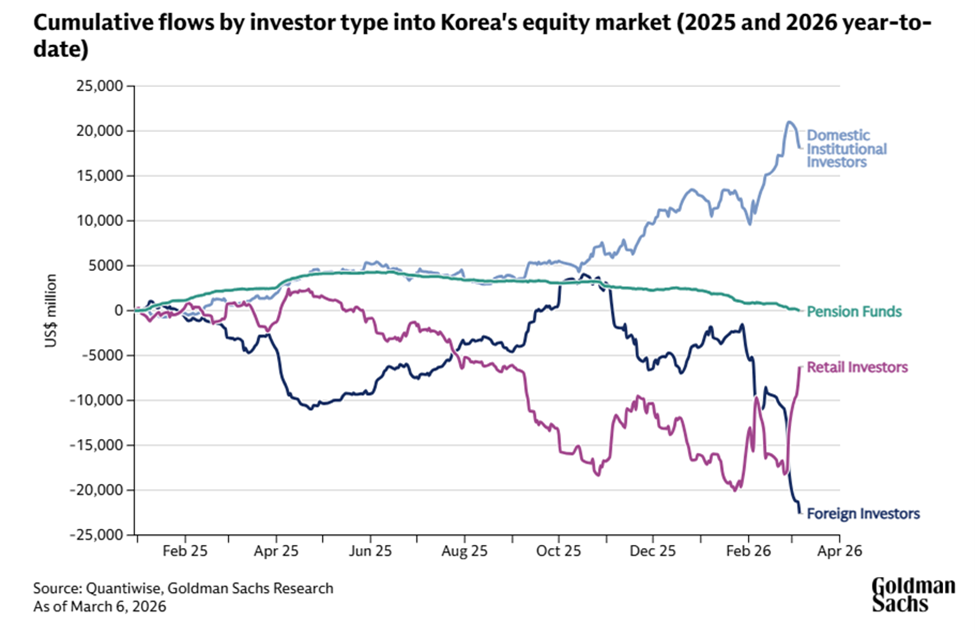
While certain indicators raise questions about overexposure to South Korean equities (hedge fund holdings that recently touched a five-year peak), Goldman Sachs Research argues that overall positioning may be less stretched than it appears. Supporting this view, foreign investors have been net sellers throughout the year, retail borrowing remains low relative to total market size, and domestic institutional ownership of South Korean stocks has yet to return to its historical norms.
Key Sectors To Watch
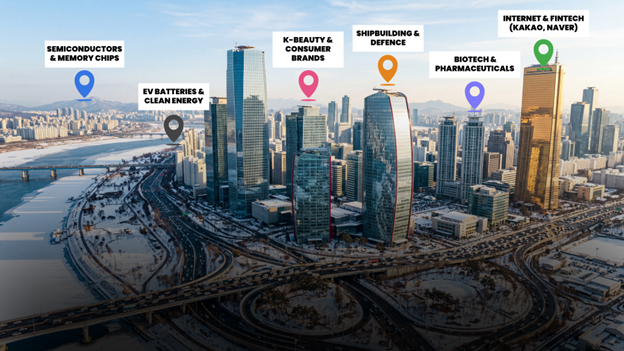
South Korea’s listed market is heavily weighted toward technology and industrials, but a number of other sectors offer interesting opportunities for foreign investors.
- Semiconductors & memory chips
- EV batteries & clean energy
- K-beauty & consumer brands
- Shipbuilding & defence
- Biotech & pharmaceuticals
- Internet & fintech (Kakao, Naver)
How To Start Trading South Korean Stocks With POEMS

Trading South Korean stocks is straightforward once you understand the basic requirements. Here’s what the process looks like:
1. Open an account with POEMS
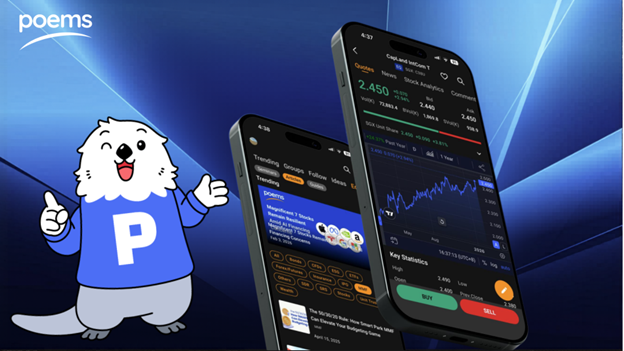
POEMS is one of the few brokers who provides access to the South Korean market. Trades can be placed directly with your trading representative.
2. Fund your account
Trades can only be settled in SGD. Ensure sufficient SGD funds.
3. Place your trades
South Korean stocks use 6-digit ticker codes. Communicate with your trading representative on the ticker code and ticker name that you wish to purchase or sell. The KRX applies a daily price movement limit of ±30%, and trading halts can be triggered during periods of extreme volatility.
What To Keep In Mind Before You Start Investing

Like any market, South Korea comes with its own risk considerations. Currency fluctuation between KRW and your domestic currency adds a layer of FX exposure. Liquidity can be thinner in smaller KOSDAQ-listed names. And while governance reforms are underway, the chaebol structure means that a handful of large conglomerates still have outsized influence on index performance.
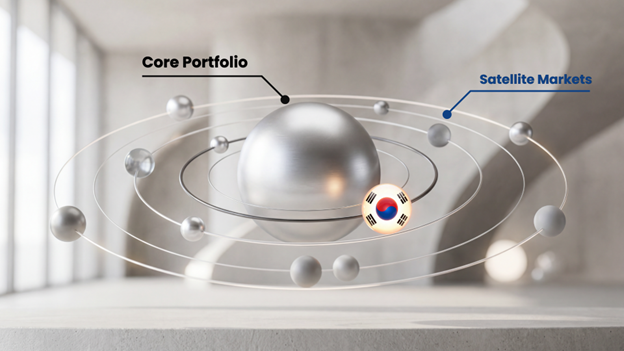
That said, for investors who already trade Asian markets and want a high-conviction, globally-significant market with a favourable time zone overlap, South Korea deserves serious consideration especially as a satellite position. (Actively managed, smaller portion of an investment portfolio that surrounds a larger, passive “core” holding).
Trade South Korea On Your Schedule

For investors based in Southeast Asia, South Korea is one of the most convenient developed markets you can access with POEMS. Korean Standard Time (KST) is just one hour ahead of Singapore time and two hours ahead of most Southeast Asian countries; the market opens and closes well within our regular working day, which means access to one of the world’s best performing indices with no lifestyle disruption.
Trading hours: South Korea Exchange operates Monday to Friday, 9:00 AM – 3:30 PM KST (8:00 AM – 2:30 PM SGT).
Start investing smarter with POEMS— power your trades with a Cash Plus Account and get the first mover advantage in your South Korea stock journey now!
For enquiries, please contact talktoglobalmarkets@phillip.com.sg
Source
- [1]https://www.mordorintelligence.com/industry-reports/south-korea-data-center-market
- [2]https://www.goldmansachs.com/insights/articles/why-koreas-stock-market-is-forecast-to-rise-to-record-highs
- [3]https://secure.fundsupermart.com/fsmone/article/rcms352420/south-korea-outlook-2026-extending-the-memory-supercycle
Disclaimer
These commentaries are intended for general circulation and do not have regard to the specific investment objectives, financial situation and particular needs of any person. Accordingly, no warranty whatsoever is given and no liability whatsoever is accepted for any loss arising whether directly or indirectly as a result of any person acting based on this information. You should seek advice from a financial adviser regarding the suitability of any investment product(s) mentioned herein, taking into account your specific investment objectives, financial situation or particular needs, before making a commitment to invest in such products.
Opinions expressed in these commentaries are subject to change without notice. Investments are subject to investment risks including the possible loss of the principal amount invested. The value of units in any fund and the income from them may fall as well as rise. Past performance figures as well as any projection or forecast used in these commentaries are not necessarily indicative of future or likely performance.
Phillip Securities Pte Ltd (PSPL), its directors, connected persons or employees may from time to time have an interest in the financial instruments mentioned in these commentaries.
The information contained in these commentaries has been obtained from public sources which PSPL has no reason to believe are unreliable and any analysis, forecasts, projections, expectations and opinions (collectively the “Research”) contained in these commentaries are based on such information and are expressions of belief only. PSPL has not verified this information and no representation or warranty, express or implied, is made that such information or Research is accurate, complete or verified or should be relied upon as such. Any such information or Research contained in these commentaries are subject to change, and PSPL shall not have any responsibility to maintain the information or Research made available or to supply any corrections, updates or releases in connection therewith. In no event will PSPL be liable for any special, indirect, incidental or consequential damages which may be incurred from the use of the information or Research made available, even if it has been advised of the possibility of such damages. The companies and their employees mentioned in these commentaries cannot be held liable for any errors, inaccuracies and/or omissions howsoever caused. Any opinion or advice herein is made on a general basis and is subject to change without notice. The information provided in these commentaries may contain optimistic statements regarding future events or future financial performance of countries, markets or companies. You must make your own financial assessment of the relevance, accuracy and adequacy of the information provided in these commentaries.
Views and any strategies described in these commentaries may not be suitable for all investors. Opinions expressed herein may differ from the opinions expressed by other units of PSPL or its connected persons and associates. Any reference to or discussion of investment products or commodities in these commentaries is purely for illustrative purposes only and must not be construed as a recommendation, an offer or solicitation for the subscription, purchase or sale of the investment products or commodities mentioned.
This advertisement has not been reviewed by the Monetary Authority of Singapore.
About the author
Global Markets Desk (Asia Market)
The Global Markets Desk Asia Market Dealing team specializes in managing Asia Markets, covering key regions like Greater China, Malaysia, Japan, Thailand, and others. In addition to executing client orders, they also provide educational content through market journals and webinars, offering insights into macroeconomics, stock picks, and technical analyses for the Asia market landscape.
 iX Biopharma Ltd – Gaining altitude with significant approvals
  Palo Alto Networks Inc – Highest Sales Growth in 9 Years
  Phillip Singapore Monthly: August 2026 – Trading at a Justified Premium
  Q & M Dental Group Awaits Inorganic Growth Amid Challenging Operating Environment