S&P 500 ETFs: Comparing IVV/VOO/SPY, CSPX/SPYL & S27 June 16, 2026
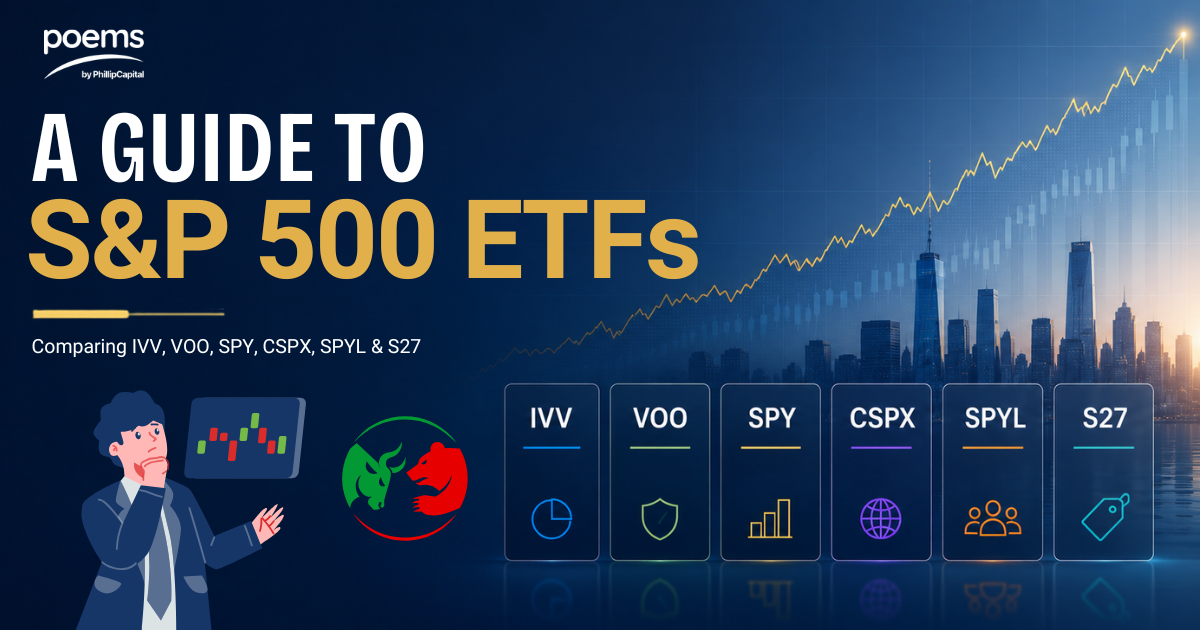
While the full list of S&P 500 ETFs is extensive, focusing on the most popular options makes your selection process much easier to navigate.
- Most popular S&P 500 ETF on US Market – IVV, VOO & SPY
- Save on withholding tax with Ireland domiciled UCITS ETFs – CSPX vs SPYL
- Invest in S&P 500 ETF using SRS – S27
Why invest in an S&P 500 ETF?
You can’t invest directly in an index, however, you can buy an ETF that holds the same companies in similar proportions, giving you diversification across 500 companies in a single purchase.
Key Benefits:
- Diversification – One share spreads your risk across hundreds of companies and multiple sectors.
- Low Cost – S&P 500 ETFs are among the cheapest investments available, with expense ratios often under 0.10%.
- Simplicity – No need to research individual stocks or rebalance your portfolio manually.
- Liquidity – These ETFs trade millions of shares daily, so you can buy or sell anytime the market is open.
Five S&P 500 ETFs at a Glance
VOO, IVV and SPY are the most popular S&P 500 ETFs. CSPX and SPYL are UCTIS ETFs that have rapidly grown in popularity among international investors due to the structural tax efficiencies offered by its Irish domicile.
While they all track the same index, they differ in areas like fees, trading liquidity, and fund structure — factors that can meaningfully affect your returns over time. Read on:
| ETF Ticker | Issuer | Expense Ratio | Assets Under Management | Listed On |
| SPY | State Street (SPDR) | 0.0945% | ~$768B USD | NYSE |
| IVV | BlackRock (iShares) | 0.03% | ~$831B USD | NYSE |
| VOO | Vanguard | 0.03% | ~$1.6T USD | NYSE |
| CSPX | BlackRock (iShares) | 0.07% | ~$144B USD | LSE |
| SPYL | State Street (SPDR) | 0.03% | ~$18B USD | LSE |
(Data as of 26/05/26)
1. SPDR S&P 500 ETF Trust (SPY)
Launched in 1993, SPY was the first ETF in the United States and remains the most heavily traded. Its massive daily volume makes it the go-to choice for traders, hedge funds, and institutions that need to move large amounts of money quickly.
The downside? Its fees are higher compared to IVV and VOO. It also uses an older structure that does not automatically reinvest dividends.
Best for: Active traders and those who prioritize liquidity above all else.
Not ideal for: Long-term investors focused on keeping costs low.
2. iShares Core S&P 500 ETF (IVV)
BlackRock’s iShares Core S&P 500 ETF matches VOO’s rock-bottom expense ratio and immediately reinvests dividends, which can slightly improve long-term returns through compounding. It’s structured as a standard ETF (unlike SPY’s older unit investment structure), giving it a bit more flexibility.
Best for: Long-term investors who want low costs and don’t need SPY’s extreme liquidity.
3. Vanguard S&P 500 ETF (VOO)
Vanguard is synonymous with low-cost investing, and VOO delivers exactly that. It’s nearly identical to IVV in structure and cost. For most people, choosing between VOO and IVV usually comes down to personal preference.
Best for: Long-term investors focused on minimizing fees.
4. iShares Core S&P 500 UCITS ETF (CSPX)
iShares Core S&P 500 UCITS ETF is a popular choice for international investors due to its Ireland domicile. Dividend withholding tax is 15%. Since it is an accumulating fund, dividends are reinvested automatically, which enhances long-term compounding.
It has a slightly higher expense ratio and may experience lower liquidity and small tracking differences compared to US-listed S&P 500 ETFs due to trading and market structure differences, but the lower dividend withholding tax and accumulating structure can possibly lead to higher returns over the long term.
Key Consideration: CSPX is listed on London Stock Exchange (LSE), subjected to LSE commission and exchange fees.
5. SPDR S&P 500 UCITS ETF (SPYL)
SPYL is a much newer offering that is Ireland domiciled and has the same accumulating structure as CSPX. The accumulating share class officially launched on 31 October 2023. It is highly liquid but does not yet match the sheer historical trading volume and fund size of CSPX.
Compared with CSPX, SPYL aggressively captures market share with its lower expense ratio. It is one of the cheapest S&P 500 UCITS ETFs available. SPYL also has a lower nominal share price, making it highly accessible and capital-efficient for frequent Dollar-Cost Averaging (DCA), without needing to rely heavily on fractional shares.
Key Consideration: SPYL is listed on London Stock Exchange (LSE), subjected to LSE commission and exchange fees.
Invest in S&P 500 with SRS
You can also invest in S&P 500 ETF on Singapore Stock Exchange as SPDR S&P 500 ETF Trust (S27), which tracks the same index as the US-listed SPY.
You can buy S27 with your SRS monies through POEMS, do remember to select settlement in SGD!
S27 is not available under CPF Investment Scheme (CPFIS), so you cannot use CPF OA/SA to buy it.
The Bottom Line
Over the long run, the S&P 500 has historically returned around 10% annually on average, despite going through events such as wars, recessions, and financial crises. Of course, future returns are never guaranteed but owning a slice of America’s largest companies has generally been a reliable way to build wealth over time.
An S&P 500 ETF won’t make you rich overnight. But for patient investors willing to ride out market ups and downs, it remains one of the simplest and most effective tools available.
Interested in investing in SPY/VOO/IVV/CSPX/SPYL or S27? Just enter the ticker code and add them to your POEMS watchlist!
| ETF Ticker | Issuer | Listed On | Payment Method |
| SPY | State Street (SPDR) | NYSE | Cash |
| IVV | BlackRock (iShares) | NYSE | Cash |
| VOO | Vanguard | NYSE | Cash |
| CSPX | BlackRock (iShares) | LSE | Cash |
| SPYL | State Street (SPDR) | LSE | Cash |
| S27 | State Street (SPDR) | SGX | Cash & SRS |
Looking to dollar-cost average and invest regularly? Explore recurring order and Share Builder Plan.
Subscribe for free US live prices for SPY/VOO/IVV
Subscribe for free SGX enhanced market depth for S27
Disclaimer
These commentaries are intended for general circulation and do not have regard to the specific investment objectives, financial situation and particular needs of any person. Accordingly, no warranty whatsoever is given and no liability whatsoever is accepted for any loss arising whether directly or indirectly as a result of any person acting based on this information. You should seek advice from a financial adviser regarding the suitability of any investment product(s) mentioned herein, taking into account your specific investment objectives, financial situation or particular needs, before making a commitment to invest in such products.
Opinions expressed in these commentaries are subject to change without notice. Investments are subject to investment risks including the possible loss of the principal amount invested. The value of units in any fund and the income from them may fall as well as rise. Past performance figures as well as any projection or forecast used in these commentaries are not necessarily indicative of future or likely performance.
Phillip Securities Pte Ltd (PSPL), its directors, connected persons or employees may from time to time have an interest in the financial instruments mentioned in these commentaries.
The information contained in these commentaries has been obtained from public sources which PSPL has no reason to believe are unreliable and any analysis, forecasts, projections, expectations and opinions (collectively the “Research”) contained in these commentaries are based on such information and are expressions of belief only. PSPL has not verified this information and no representation or warranty, express or implied, is made that such information or Research is accurate, complete or verified or should be relied upon as such. Any such information or Research contained in these commentaries are subject to change, and PSPL shall not have any responsibility to maintain the information or Research made available or to supply any corrections, updates or releases in connection therewith. In no event will PSPL be liable for any special, indirect, incidental or consequential damages which may be incurred from the use of the information or Research made available, even if it has been advised of the possibility of such damages. The companies and their employees mentioned in these commentaries cannot be held liable for any errors, inaccuracies and/or omissions howsoever caused. Any opinion or advice herein is made on a general basis and is subject to change without notice. The information provided in these commentaries may contain optimistic statements regarding future events or future financial performance of countries, markets or companies. You must make your own financial assessment of the relevance, accuracy and adequacy of the information provided in these commentaries.
Views and any strategies described in these commentaries may not be suitable for all investors. Opinions expressed herein may differ from the opinions expressed by other units of PSPL or its connected persons and associates. Any reference to or discussion of investment products or commodities in these commentaries is purely for illustrative purposes only and must not be construed as a recommendation, an offer or solicitation for the subscription, purchase or sale of the investment products or commodities mentioned.
This advertisement has not been reviewed by the Monetary Authority of Singapore.
 Maximizing Retirement Wealth: How to Invest CPF-OA and SRS in SGX ETFs
  ETF Monthly Review: Mixed September Performance with Muted October Outlook Expected
  Investing in the AI Revolution: A Guide to Semiconductor & Ecosystem ETFs
  Phillip SING Income ETF Reaches All-Time High Dividend with Banking Sector Focus