Understanding Technology ETFs: Participate in AI Megatrend with Suitable Portfolio June 17, 2026
When constructing an investment portfolio, defensive assets such as bonds and income-generating equities provide stability. However, to outperform inflation and achieve meaningful long-term wealth compounding, investors may benefit from allocating more into growth companies. In today’s global economy, one of the key growth engines is the technology sector, which powers the artificial intelligence (AI) ecosystem.
From semiconductors and cloud infrastructure to data centres and advanced software, AI is not a single industry—it is an entire value chain. For retail investors, Technology ETFs (Exchange-Traded Funds) offer the most efficient way to gain diversified exposure across this ecosystem without the concentration risk of picking individual winners.
This guide focuses on how investors can strategically deploy different types of Technology ETFs to capture the AI megatrend.
1. Understanding Tech ETFs as AI Exposure Vehicles
Technology ETFs are fundamentally growth-oriented instruments with higher investment risk profiles compared to broad-based market ETFs. Unlike traditional value sectors, technology companies reinvest earnings into innovation, allowing them to scale rapidly alongside structural trends such as AI adoption.
Key implications for investors:
- Higher Volatility, Higher Potential Returns: Tech ETFs may enjoy large upside growth, but they can also suffer from sharper drawdowns across market cycles.
- Interest Rate Sensitivity: Falling rates tend to support technology valuations, making macro timing relevant for entry points.
- Capital Gains Focus: Returns are driven primarily by price appreciation, not dividends.
For investors, this means Tech ETFs should be positioned as long-term growth allocators, not income tools.
2. Mapping Tech ETFs to the AI Value Chain
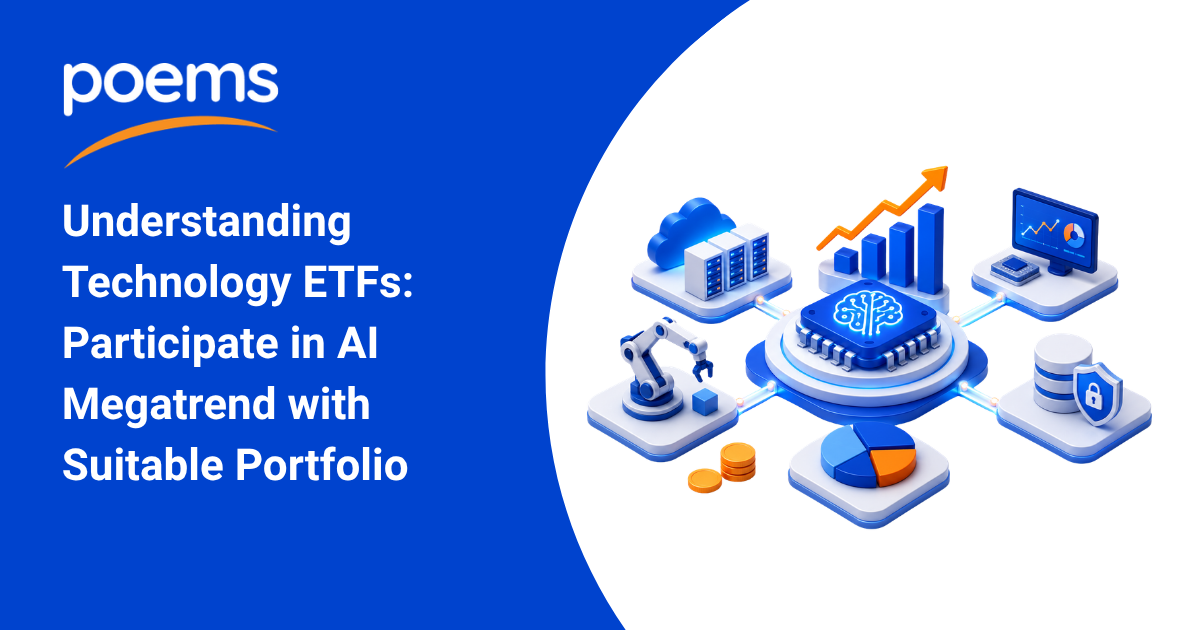
A more effective way to invest in AI is to understand where each ETF sits within the AI infrastructure stack:
AI Value Chain Exposure via ETFs:
- AI Models & Software (Top Layer)
Exposure via mega-cap heavy ETFs, such as NASDAQ-100 trackers
→ Example of companies: Microsoft, Alphabet, Meta - Compute & Data Centres (Middle Layer)
Exposure via diversified or semiconductor-focused ETFs
→ Example of companies: NVIDIA, AMD, Broadcom - Infrastructure Enablers (Foundational Layer)
Indirect exposure via broader tech or thematic ETFs
→ Examples include power, cooling, and industrial enablers
Investor Insight:
Owning a single ETF may overweight one layer. Selecting a few targeted ETFs can help investors expand their exposure across the AI ecosystem.
3. Choosing the Right “Flavour” of Tech ETF (With Real Market Proxies)
To effectively capture the AI megatrend, investors should think beyond generic “tech exposure” and instead select ETFs based on where they sit within the AI ecosystem and their risk-return profile.
Below is a practical breakdown using widely traded institutional ETFs:
| ETF Name | Ticker | Listing | Strategy | AUM (Approx) | Expense Ratio | No. of Holdings | Key Exposure |
| Invesco QQQ Trust | QQQ | NASDAQ | Mega-cap growth | ~US$494B | 0.18% | ~102 | AI platforms (Microsoft, NVIDIA, Apple) |
| Technology Select Sector SPDR | XLK | NYSE Arca | S&P 500 Tech | ~US$124B | 0.08% | ~75 | Pure US tech leaders |
| Invesco NASDAQ Next Gen 100 | QQQJ | NASDAQ | Mid-cap innovators | ~US$1B | 0.15% | ~104 | Emerging AI & software players |
| iShares MSCI World IT UCITS ETF | WITS | Euronext | Global diversified | ~US$1.04B | 0.18% | ~135 | Global tech (US and Europe e.g. ASML) |
| iShares Hang Seng TECH ETF | 3067 HK | HKEX | China tech | ~HKD15B | 0.25% | ~34 | Alibaba, Tencent, Meituan |
a) Mega-Cap Tech ETFs (Core AI Exposure): A significant portion of AI profits today is concentrated within a handful of mega-cap firms.
These ETFs are the most direct way to gain exposure to AI leaders and hyperscalers, which dominate spending on AI infrastructure and model development.
Examples: QQQ – Invesco QQQ Trust, XLK – State Street Technology Select Sector SPDR ETF
b) Small & Mid-Cap Tech ETFs (AI Growth Optionality): While riskier, these companies represent more specific firms benefiting from AI growth
These ETFs target the next generation of AI beneficiaries, including:
- SaaS platforms integrating AI
- Cybersecurity firms
- Vertical AI applications
Example: QQQJ – Invesco NASDAQ Next Gen 100 ETF
c) Multi-Cap / Global Tech ETFs (Balanced Exposure): AI sector involves global supply chain. Global exposure helps investors avoid missing out on the growth of critical enablers outside of US market
Example: WITS – iShares MSCI World Information Technology Sector Advanced UCITS ETF USD Inc
These ETFs provide diversified exposure across:
- US mega-cap leaders
- Semiconductor supply chain
- International tech, such as ASML in Europe
d) Regional Tech ETFs (China / Asia Angle): Asia and other regions also have significant investment opportunities tapping on the AI technology growth
These ETFs capture:
- China’s AI ecosystem
- Platform companies adapting AI into e-commerce, fintech, and logistics
Key risk: Regulatory intervention and policy shifts remain a key overhang.
Example: 3067 HK – iShares Hang Seng TECH ETF
4. Implementation Strategy: Building an AI ETF Portfolio
Rather than selecting a single ETF, investors should construct a layered exposure strategy aligned with the AI value chain.
Step 1: Define Your Core Exposure (Foundation Layer)
Start with a mega-cap ETF (QQQ or XLK)
Suggested allocation: 15%–25%
Step 2: Add Diversification (Ecosystem Layer)
Incorporate a global or multi-cap ETF (WITS)
Suggested allocation: 10%–20%
Step 3: Add Growth Optionality (Satellite Layer)
Allocate to mid-cap innovators (QQQJ)
Suggested allocation: 5%–10%
Step 4: Optional Regional Tilt (Tactical Layer)
For investors seeking diversification
Suggested allocation: 0%–10%
Example Portfolio Construction (Balanced Investor)
| Allocation Bucket | ETF Example | Weight |
| Core AI Leaders | QQQ | 20% |
| Global Tech Diversification | WITS | 15% |
| Growth Innovators | QQQJ | 10% |
| Asia Tech Exposure | 3067 HK | 5% |
| Total Tech Allocation | 50% |
The AI opportunity is not confined to a single company or ETF. It is a multi-layer ecosystem spanning platforms, compute, and infrastructure.
By combining different types of Technology ETFs, investors can:
- Capture exposure to current AI leaders
- Participate in future disruptors
- Gain exposure to the global technology supply chain
The AI megatrend acts as a structural growth multiplier due to the following growth factors:
- Rising global AI capital expenditure
- Increasing demand for compute and infrastructure
- Productivity gains across industries
Even a modest allocation can potentially enhance long-term portfolio returns.
6. Implementation Checklist for Investors
Before investing in any Technology ETF, investors can apply this screening framework:
- Concentration Risk
Check the ETF’s top holdings andensure alignment with your investment conviction - Sub-sector Exposure
Know whether you are buying exposure to semiconductors, software, or broad technology - Expense Ratio
For passive ETFs, consider funds with an expense ratio below 0.50% - Liquidity & AUM
Prefer funds with strong trading volume and scale and sufficient scale - Currency Considerations
Factor in USD/HKD currency risk exposure against SGD base currency
Final Takeaway
The AI revolution is not just about breakthrough technologies—it is also about the infrastructure and ecosystem that supports it. Technology ETFs provide investors with a scalable, diversified, and liquid way to participate in this transformation.
If bonds are the anchor of a portfolio, then Technology ETFs can serve as the growth engine—capturing the momentum of AI, compounding capital over time, and positioning investors on the right side of one of the most powerful structural trends of this decade.
Disclaimer
These commentaries are intended for general circulation and do not have regard to the specific investment objectives, financial situation and particular needs of any person. Accordingly, no warranty whatsoever is given and no liability whatsoever is accepted for any loss arising whether directly or indirectly as a result of any person acting based on this information. You should seek advice from a financial adviser regarding the suitability of any investment product(s) mentioned herein, taking into account your specific investment objectives, financial situation or particular needs, before making a commitment to invest in such products.
Opinions expressed in these commentaries are subject to change without notice. Investments are subject to investment risks including the possible loss of the principal amount invested. The value of units in any fund and the income from them may fall as well as rise. Past performance figures as well as any projection or forecast used in these commentaries are not necessarily indicative of future or likely performance.
Phillip Securities Pte Ltd (PSPL), its directors, connected persons or employees may from time to time have an interest in the financial instruments mentioned in these commentaries.
The information contained in these commentaries has been obtained from public sources which PSPL has no reason to believe are unreliable and any analysis, forecasts, projections, expectations and opinions (collectively the “Research”) contained in these commentaries are based on such information and are expressions of belief only. PSPL has not verified this information and no representation or warranty, express or implied, is made that such information or Research is accurate, complete or verified or should be relied upon as such. Any such information or Research contained in these commentaries are subject to change, and PSPL shall not have any responsibility to maintain the information or Research made available or to supply any corrections, updates or releases in connection therewith. In no event will PSPL be liable for any special, indirect, incidental or consequential damages which may be incurred from the use of the information or Research made available, even if it has been advised of the possibility of such damages. The companies and their employees mentioned in these commentaries cannot be held liable for any errors, inaccuracies and/or omissions howsoever caused. Any opinion or advice herein is made on a general basis and is subject to change without notice. The information provided in these commentaries may contain optimistic statements regarding future events or future financial performance of countries, markets or companies. You must make your own financial assessment of the relevance, accuracy and adequacy of the information provided in these commentaries.
Views and any strategies described in these commentaries may not be suitable for all investors. Opinions expressed herein may differ from the opinions expressed by other units of PSPL or its connected persons and associates. Any reference to or discussion of investment products or commodities in these commentaries is purely for illustrative purposes only and must not be construed as a recommendation, an offer or solicitation for the subscription, purchase or sale of the investment products or commodities mentioned.
This advertisement has not been reviewed by the Monetary Authority of Singapore.
About the author
Mr Teo Huan Zi
Dealing Manager
Phillip Securities Pte Ltd
Mr Teo Huan Zi graduated from Nanyang Technological University (NTU) in 2014 with a Bachelor’s degree in Business, majoring in Banking and Finance. He currently serves as a dealing manager with a team of more than 10 equity specialists. Additionally, he frequently conducts seminars and webinars to empower his clients with financial and investment knowledge, including fundamental analysis and technical analysis.
 Maximizing Retirement Wealth: How to Invest CPF-OA and SRS in SGX ETFs
  ETF Monthly Review: Mixed September Performance with Muted October Outlook Expected
  Investing in the AI Revolution: A Guide to Semiconductor & Ecosystem ETFs
  Phillip SING Income ETF Reaches All-Time High Dividend with Banking Sector Focus