Bond ETFs: The Defensive Anchor Every Portfolio Needs June 10, 2026
When building an investment portfolio, many retail investors naturally focus on growth: tracking local bank earnings, high-yielding S-REITs, or fast-moving global tech giants. However, a truly resilient portfolio also requires a stabilising counterweight.
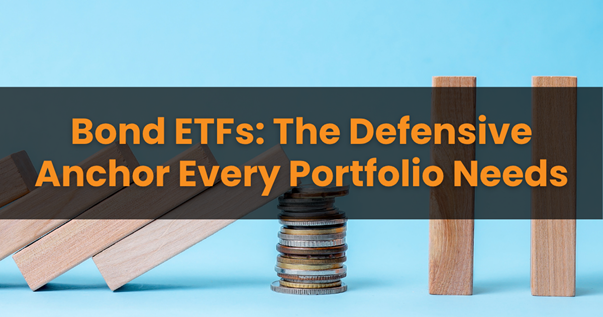
While equities drive wealth accumulation, Bond Exchange-Traded Funds (ETFs) serve as the structural “ballast” that helps keep your portfolio balanced when equity markets turn volatile. For investors new to fixed income, these instruments offer a liquid, accessible, and lower-risk mechanism to smooth out returns and generate a steady income stream.
1. Bond ETFs vs. Individual Bonds
Traditionally, retail investors faced significant structural hurdles when trying to buy individual bonds. High-quality corporate or government bonds are typically traded over-the-counter in large wholesale denominations, often requiring a minimum entry point of S$250,000 per bond. This concentration makes it incredibly difficult for an individual to build a diversified portfolio.
Bond ETFs make this asset class far more accessible by pooling hundreds or even thousands of distinct bonds into a single basket that trades on an exchange, much like a stock.
Key Structural Advantages
Low Capital Requirements
Investors can gain exposure to fixed income by purchasing units of a bond ETF through a standard brokerage account, making the asset class accessible regardless of portfolio size.
Instant Diversification
Rather than taking on the concentrated risk of lending to a single issuer, investors gain exposure to a broad portfolio of bonds across multiple borrowers, sectors, and geographies, helping to reduce issuer-specific risk.
Intraday Liquidity
Individual bonds can be difficult to sell quickly before they mature. Bond ETFs can be bought and sold freely throughout the trading day at transparent, real-time market prices.
Important Distinction
Unlike a single bond, a Bond ETF never “matures.” When an individual bond reaches its end date, the borrower returns your principal in full. A bond ETF, however, continuously rolls its capital by selling bonds as they near expiration and replacing them with newly issued ones. Consequently, the value of a bond ETF will fluctuate indefinitely based on broader market conditions.
2. Understanding the Relationship Between Interest Rates and Bond Prices
One of the most important principles in fixed income investing is that bond prices and macroeconomic interest rates move in opposite directions. Think of this relationship as a financial see-saw:
When Interest Rates Rise: Newly issued bonds start offering higher interest payouts. This makes older bonds (which are locked into lower rates) less attractive. To entice buyers, the market price of these older bonds must fall.
When Interest Rates Fall: Existing bonds holding older, higher interest rates suddenly become highly sought after, driving their market prices upward.
To measure how sensitive a bond ETF is to these interest rate swings, analysts look at a metric called Duration (measured in years).
High-Duration ETFs (holding long-term bonds maturing in 10 to 30 years) experience large price gains when interest rates fall, but suffer sharp capital losses when rates spike.
Low-Duration ETFs (holding short-term bonds maturing in 1 to 3 years) remain highly stable, experiencing minimal price changes regardless of central bank policy shifts.

3. Choosing Your “Flavour” of Bond ETF
The fixed income universe is categorised by who is borrowing the money and how creditworthy they are. For broad geographical execution, investors typically split allocations between local-currency sovereign assets and deep, global credit pools across the Singapore Exchange (SGX) and US markets.
| Asset Class Focus | Borrower Profile | Risk Level | Expected Yield | Benchmark Examples |
| Singapore Government Securities (SGS) | Backed by the Singapore Government (AAA-rated). | Exceptionally Low | Lower / Stable | ABF Singapore Bond Index Fund (SGX: A35) |
| US Treasuries & Sovereign Bonds | Backed by the full taxing power of major national governments. | Very Low | Moderate | iShares 20+ Year Treasury Bond ETF (NASDAQ: TLT) |
| Investment-Grade Corporate | Highly stable, profitable Blue-Chip corporations (Rated BBB- or higher). | Moderate | Medium | Nikko AM SGD Investment Grade Corporate Bond ETF (SGX: MBH)?? iShares iBoxx $ Investment Grade Corporate Bond ETF (NYSE Arca: LQD) |
| High Yield Bonds (“Junk Bonds”) | Growth companies or firms with weaker debt-to-equity ratios (Rated below BBB-). | High | Higher | iShares iBoxx $ High Yield Corporate Bond ETF (NYSE: HYG) |
4. Real-World Impact: The Mathematical Cushion
To understand why a dedicated fixed income allocation matters, consider how two different portfolios behave during a severe equity market downturn where global stocks plunge by 30%:
Portfolio A (100% Stocks): Capital drops by a full 30%. This steep, unbuffered drawdown frequently induces emotional panic, leading retail investors to liquidate their holdings at the absolute bottom of the market.
Portfolio B (70% Stocks / 30% Government Bond ETFs): While the equity portion drops, the high-grade government bond position holds steady or appreciates due to a “flight-to-safety” effect. As a result, the total portfolio drawdown is 21% for the overall portfolio.
That 9% difference can result in significant psychological protection. Investors who experience smaller, and manageable losses are far more likely to stay committed to their long-term financial plans.
5. Strategic Fixed Income Allocation & Implementation
Determining your fixed income allocation depends entirely on your investment horizon and how much market volatility you can stomach.
Conservative (40% to 60% Allocation): Heavily anchored in short-to-medium duration high-grade bonds. The primary objective is wealth preservation and steady income generation.
Moderate (20% to 40% Allocation): Uses a balanced mix of domestic corporate debt and global treasuries to act as a structural shock absorber while allowing the equity portion to compound.
Aggressive (10% to 20% Allocation): Treats fixed income as “dry powder.” Holding highly liquid, short-duration treasury ETFs provides a stable, uncorrelated cash reservoir that can be quickly sold to buy cheap blue-chip equities during a market crash.
Key Implementation Considerations for Singapore Investors
Currency and Tax Optimization: Executing via SGX-listed instruments (A35, MBH) eliminates foreign exchange risk since the underlying assets are denominated entirely in SGD. Conversely, allocating to US-listed fixed income (TLT, LQD) introduces USD currency exposure.
Yield Curve Positioning: If inflation remains sticky and interest rates stay elevated, keeping duration short protects your capital while reaping the front-end yield. If economic growth is slowing and a central bank rate-cutting cycle accelerates, expanding into long-duration vehicles allows you to maximize capital gains from falling yields.

6. Checklist: Evaluating a Bond ETF
Before investment into any bond ETFs, there are some essential operational metrics on the fund’s factsheet to consider:
Yield to Maturity (YTM): The most accurate measure of forward-looking income. This reflects the total annualized return you can expect if the fund holds all its underlying bonds until maturity, factoring in current market prices and coupon rates.
Effective Duration: A clear gauge of interest rate sensitivity. If an ETF has an effective duration of 7.0 years, a 1% rise in benchmark interest rates will in theory result in an approximate 7% capital loss for the fund, while a 1% fall will result in a 7% capital gain.
Credit Quality Breakdown: Ensure the credit tiers align with your risk profile. Defensive allocations should display heavy weightings in high-grade assets (AAA down to BBB). Anything ranked BB+ or below falls into high-yield, speculative territory.
Expense Ratio: Because fixed income returns are naturally tighter than equity growth rates, keeping management fees low is vital. Look for efficient, passively managed index trackers—ideally with total annual expense ratios below 0.30%.
Conclusion
Bond ETFs are designed to give your capital a reliable foundation. They will not deliver the explosive overnight gains of speculative equities, but they ensure your portfolio remains resilient when macro-economic conditions shift. For the prudent investor, maintaining a dedicated defensive anchor is the definitive strategy for navigating multi-decade market cycles with peace of mind.
Disclaimer
These commentaries are intended for general circulation and do not have regard to the specific investment objectives, financial situation and particular needs of any person. Accordingly, no warranty whatsoever is given and no liability whatsoever is accepted for any loss arising whether directly or indirectly as a result of any person acting based on this information. You should seek advice from a financial adviser regarding the suitability of any investment product(s) mentioned herein, taking into account your specific investment objectives, financial situation or particular needs, before making a commitment to invest in such products.
Opinions expressed in these commentaries are subject to change without notice. Investments are subject to investment risks including the possible loss of the principal amount invested. The value of units in any fund and the income from them may fall as well as rise. Past performance figures as well as any projection or forecast used in these commentaries are not necessarily indicative of future or likely performance.
Phillip Securities Pte Ltd (PSPL), its directors, connected persons or employees may from time to time have an interest in the financial instruments mentioned in these commentaries.
The information contained in these commentaries has been obtained from public sources which PSPL has no reason to believe are unreliable and any analysis, forecasts, projections, expectations and opinions (collectively the “Research”) contained in these commentaries are based on such information and are expressions of belief only. PSPL has not verified this information and no representation or warranty, express or implied, is made that such information or Research is accurate, complete or verified or should be relied upon as such. Any such information or Research contained in these commentaries are subject to change, and PSPL shall not have any responsibility to maintain the information or Research made available or to supply any corrections, updates or releases in connection therewith. In no event will PSPL be liable for any special, indirect, incidental or consequential damages which may be incurred from the use of the information or Research made available, even if it has been advised of the possibility of such damages. The companies and their employees mentioned in these commentaries cannot be held liable for any errors, inaccuracies and/or omissions howsoever caused. Any opinion or advice herein is made on a general basis and is subject to change without notice. The information provided in these commentaries may contain optimistic statements regarding future events or future financial performance of countries, markets or companies. You must make your own financial assessment of the relevance, accuracy and adequacy of the information provided in these commentaries.
Views and any strategies described in these commentaries may not be suitable for all investors. Opinions expressed herein may differ from the opinions expressed by other units of PSPL or its connected persons and associates. Any reference to or discussion of investment products or commodities in these commentaries is purely for illustrative purposes only and must not be construed as a recommendation, an offer or solicitation for the subscription, purchase or sale of the investment products or commodities mentioned.
This advertisement has not been reviewed by the Monetary Authority of Singapore.
About the author
Mr Teo Huan Zi
Dealing Manager
Phillip Securities Pte Ltd
Mr Teo Huan Zi graduated from Nanyang Technological University (NTU) in 2014 with a Bachelor’s degree in Business, majoring in Banking and Finance. He currently serves as a dealing manager with a team of more than 10 equity specialists. Additionally, he frequently conducts seminars and webinars to empower his clients with financial and investment knowledge, including fundamental analysis and technical analysis.
 Maximizing Retirement Wealth: How to Invest CPF-OA and SRS in SGX ETFs
  ETF Monthly Review: Mixed September Performance with Muted October Outlook Expected
  Investing in the AI Revolution: A Guide to Semiconductor & Ecosystem ETFs
  Phillip SING Income ETF Reaches All-Time High Dividend with Banking Sector Focus